For the Part 4 WA Trip

Coogee WA to Albany WA

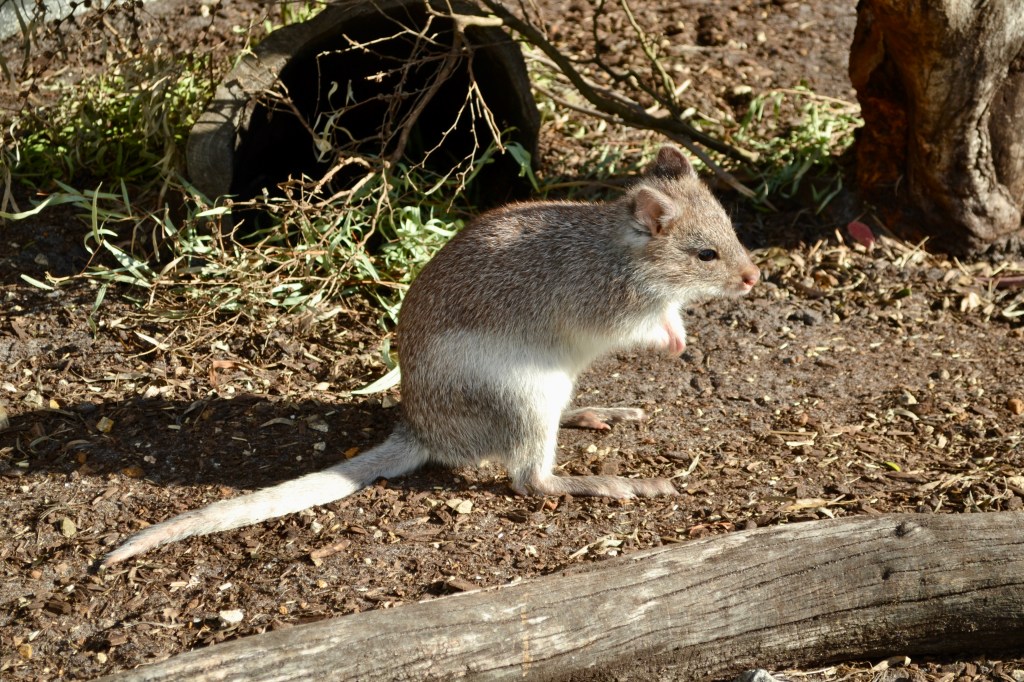
After a very tense afternoon of trying to secure accommodation, we finally booked into our caravan park late in the day.  That night we had a visit from a little Bandicoot checking our campsite for supper. He hung around for a short time and certainly was not afraid of us. All food was neatly packed away that night. The following morning, we drove into the Perth CBD. Our first impression was that of a very clean and pretty place.  Ken had been to Perth many years earlier and was totally surprised at how it had grown. He remembered it as a large historic regional town and now it was a thriving mixture of new and old. An expanding city built around a lovely harbour.

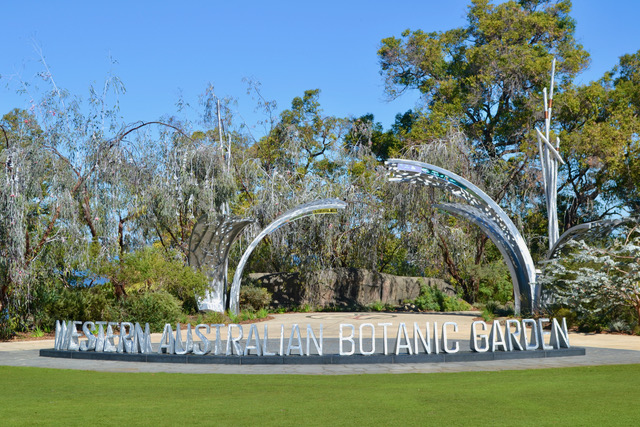
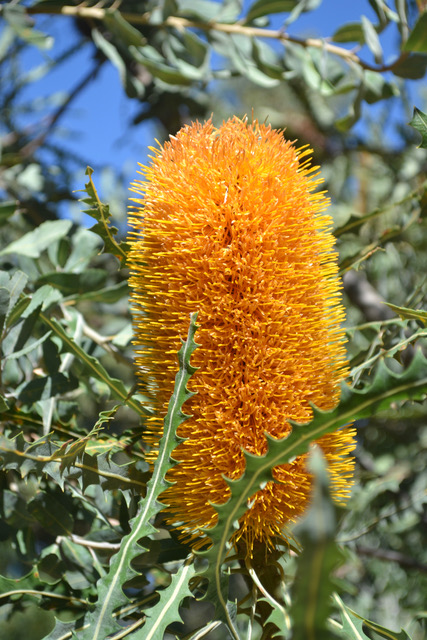
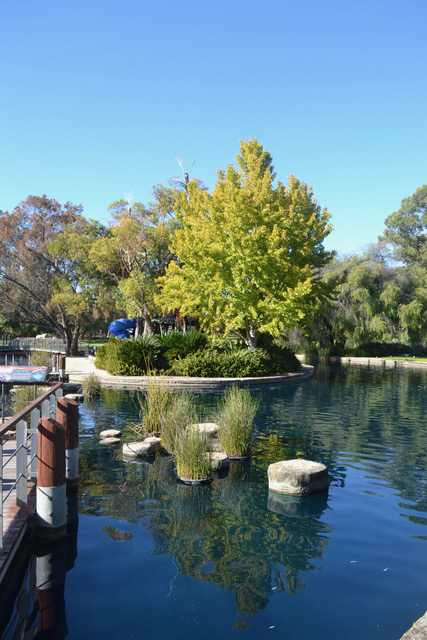
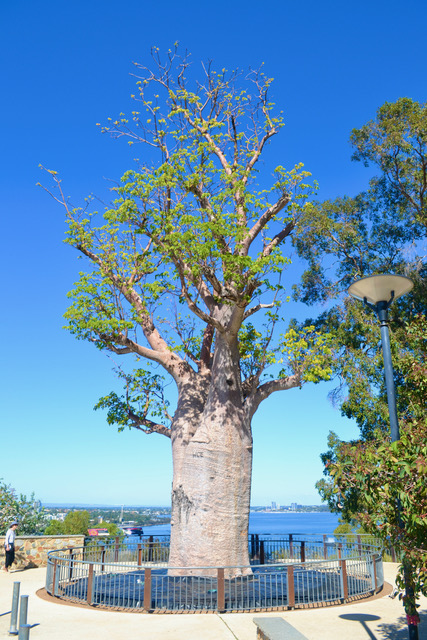
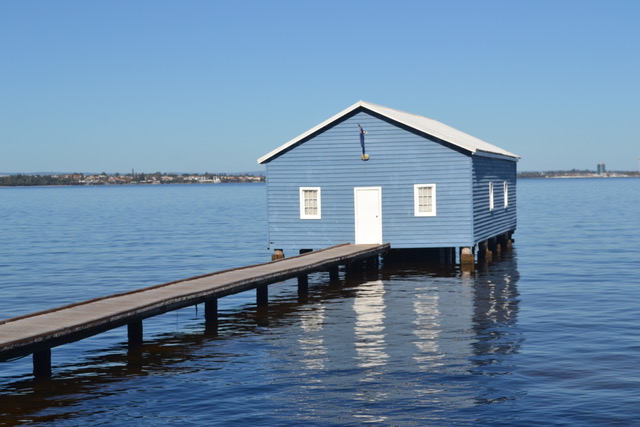
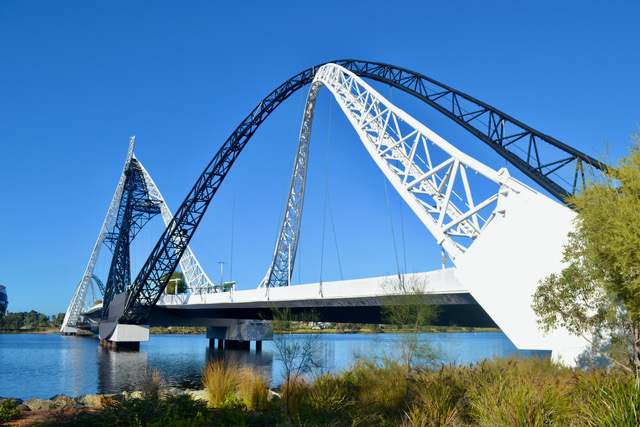
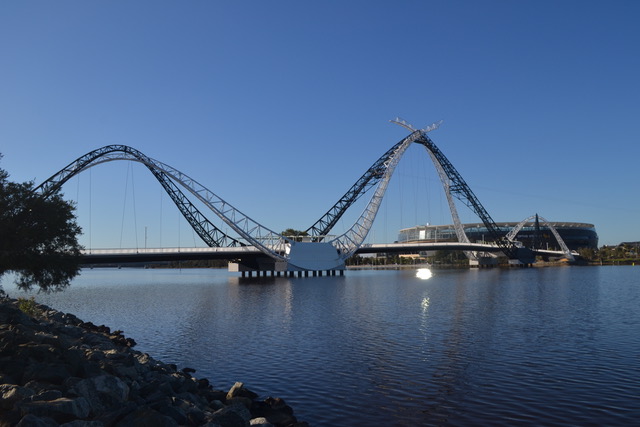
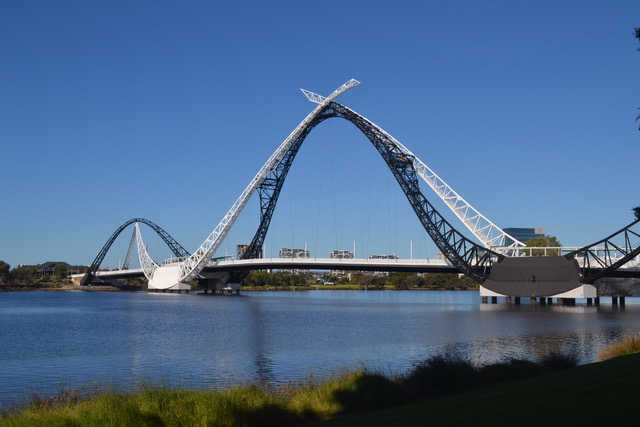
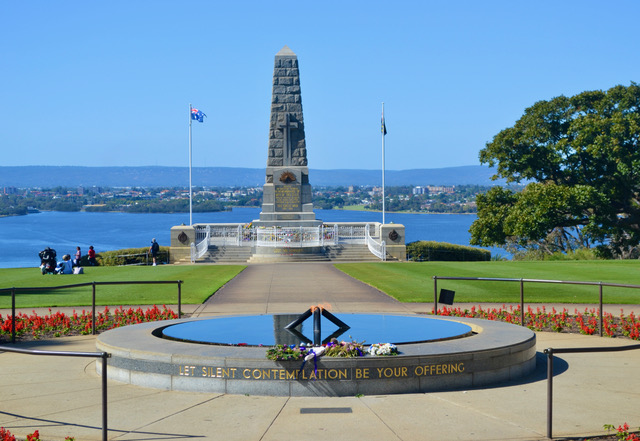
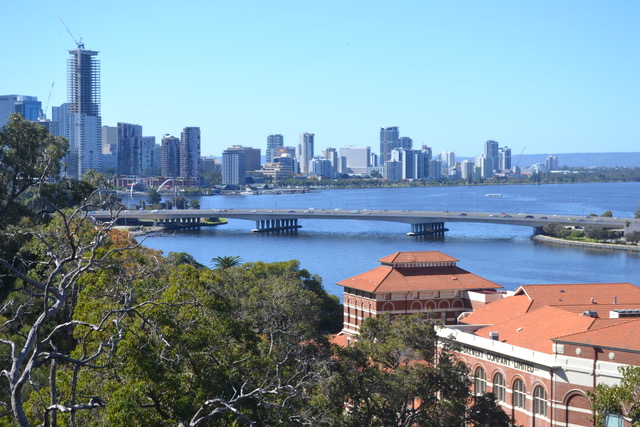
We  started at Kings Park. Which is in the heart of the city.  The main area focus ‘s around the war memorial which is surrounded by beautiful lawns looking over  gorgeous views of the city and the harbour. We walked through the Botanic gardens and then went down to photograph the  Crawley Edge  boathouse. A gorgeous historical boatshed located on the Swan River. Built in 1930’s and one of those scene’s that result in a postcard photograph. After a  light lunch in the park café and a little more wandering around the sparse grounds of Kings Park we headed for the pedestrian walkway on the edge of the river.  Matagarup Bridge is a magnificent suspension bridge crossing over the Swan River providing pedestrian access to East Perth and Burswood. Its total length is 370m and it is 9m wide. Since we visited, they have opened a bridge climb and a zip line experience. I can imagine that being very popular with both locals and tourists.  Possibly more important to some is the grand access to the Perth Optus Stadium which makes for a spectacular start for a day out or a celebratory evening.
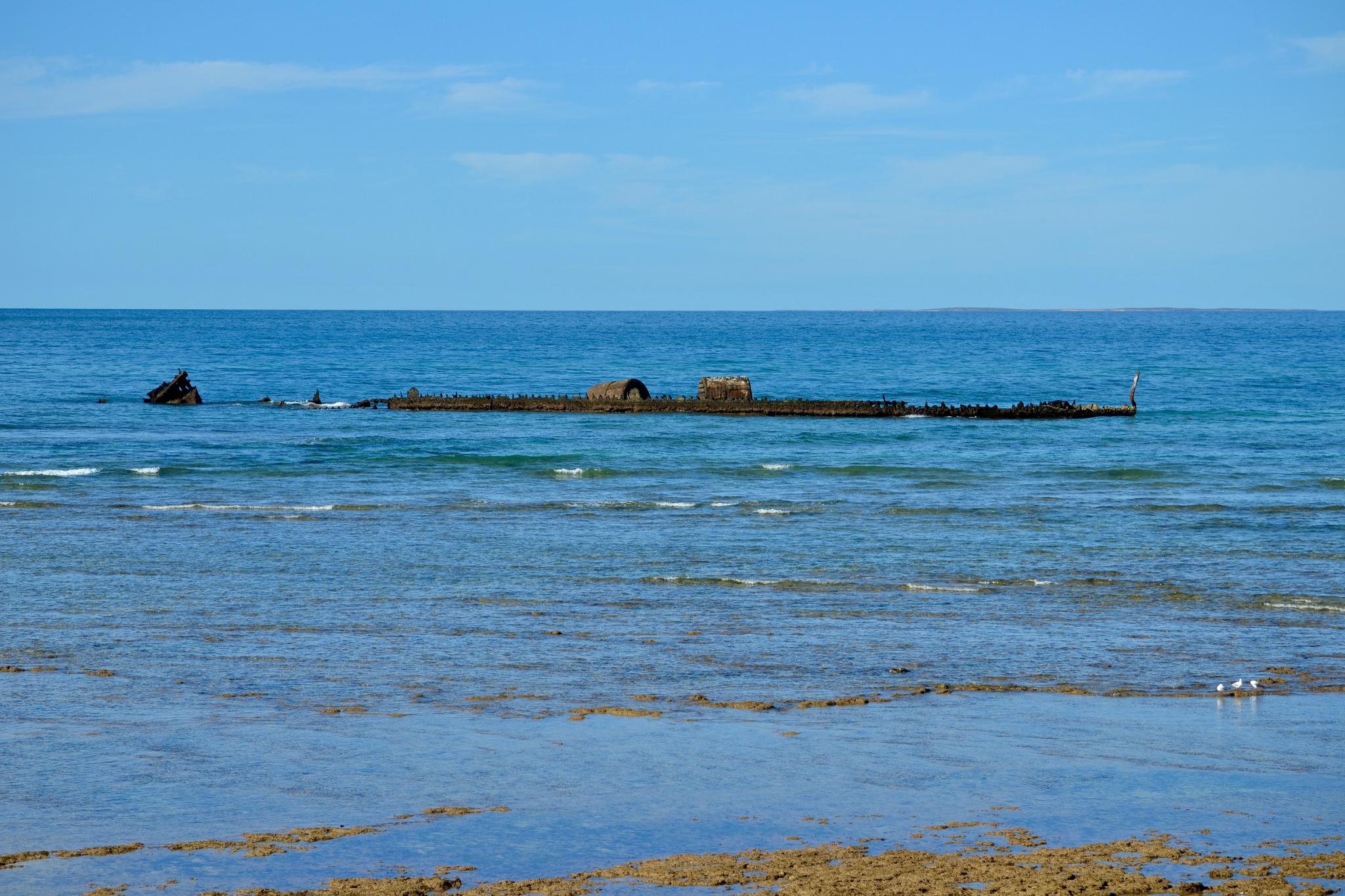
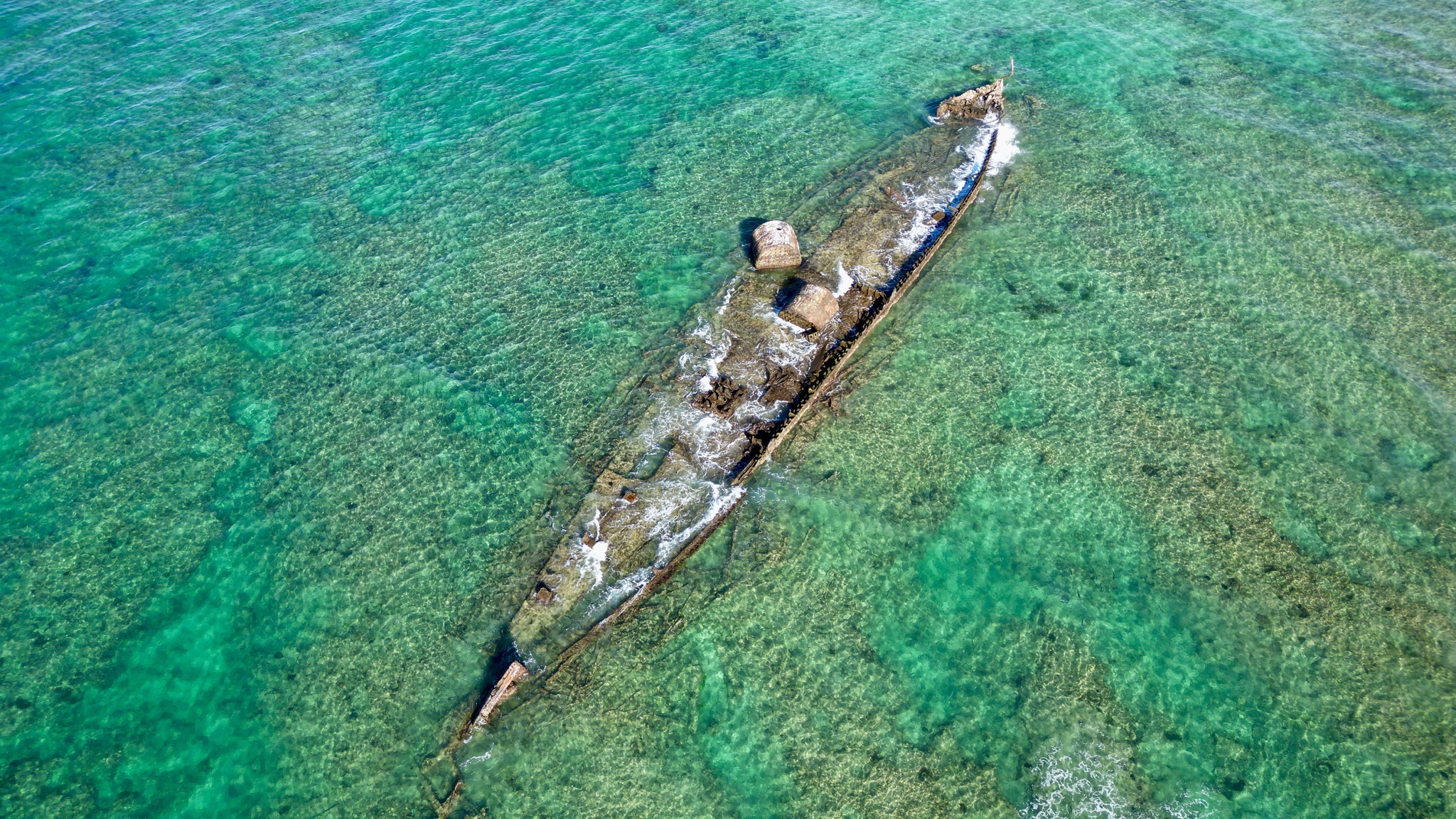
We hurried back to the caravan park as Ken wanted to get a good view of the the shipwreck of the Omeo, blown ashore in 1905 just a short drive from our caravan park at Coogee (Pronounced Coo Gee.)

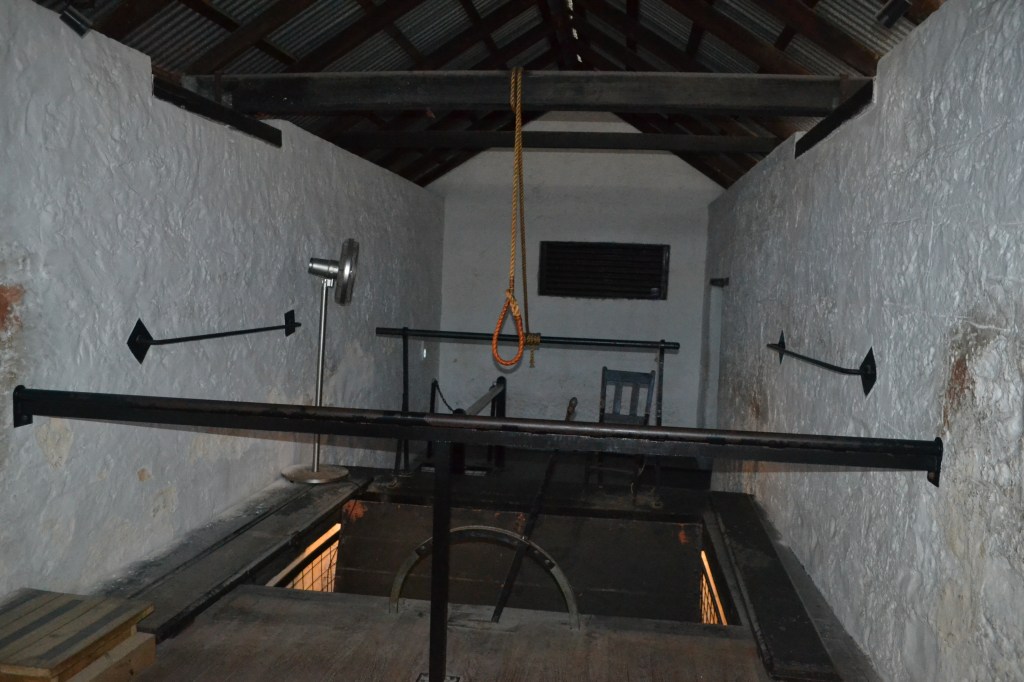
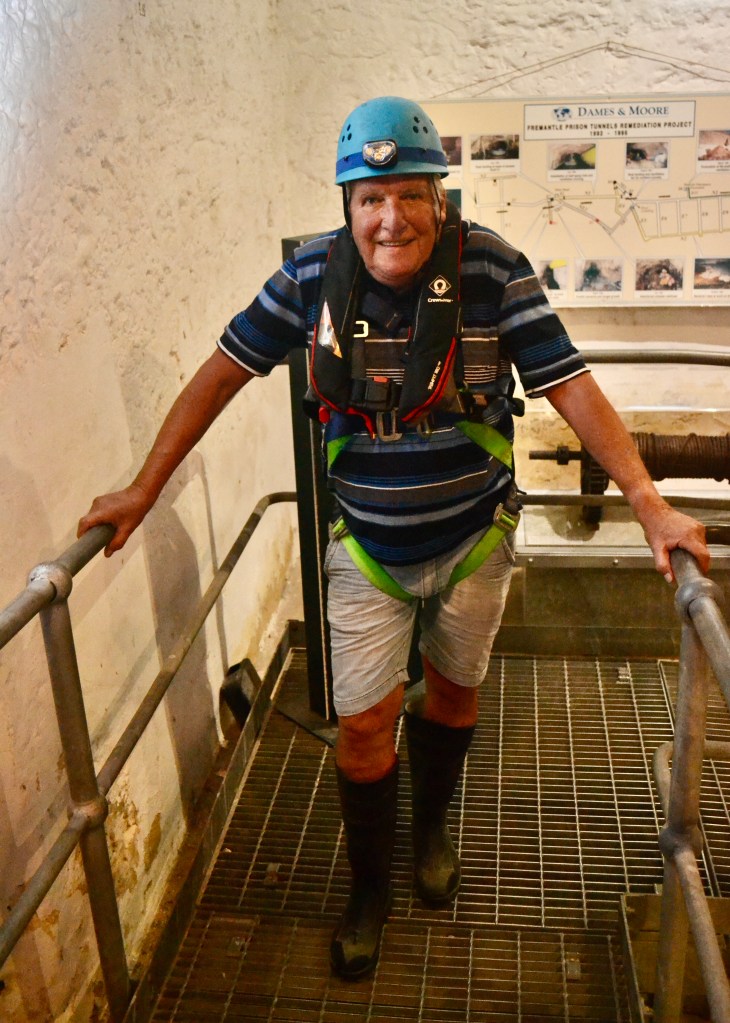
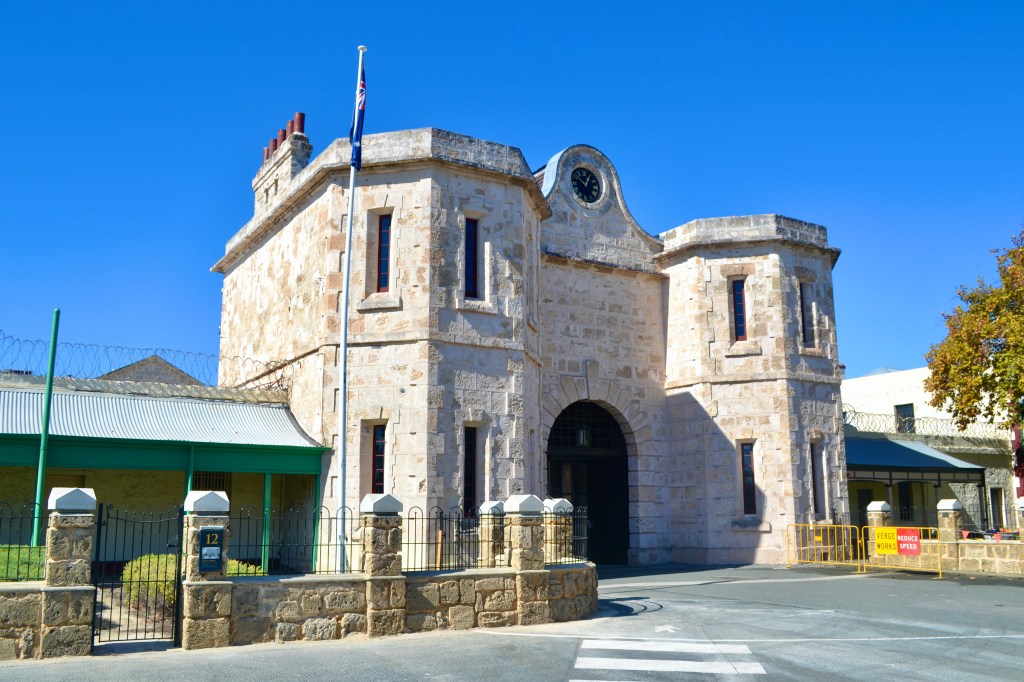
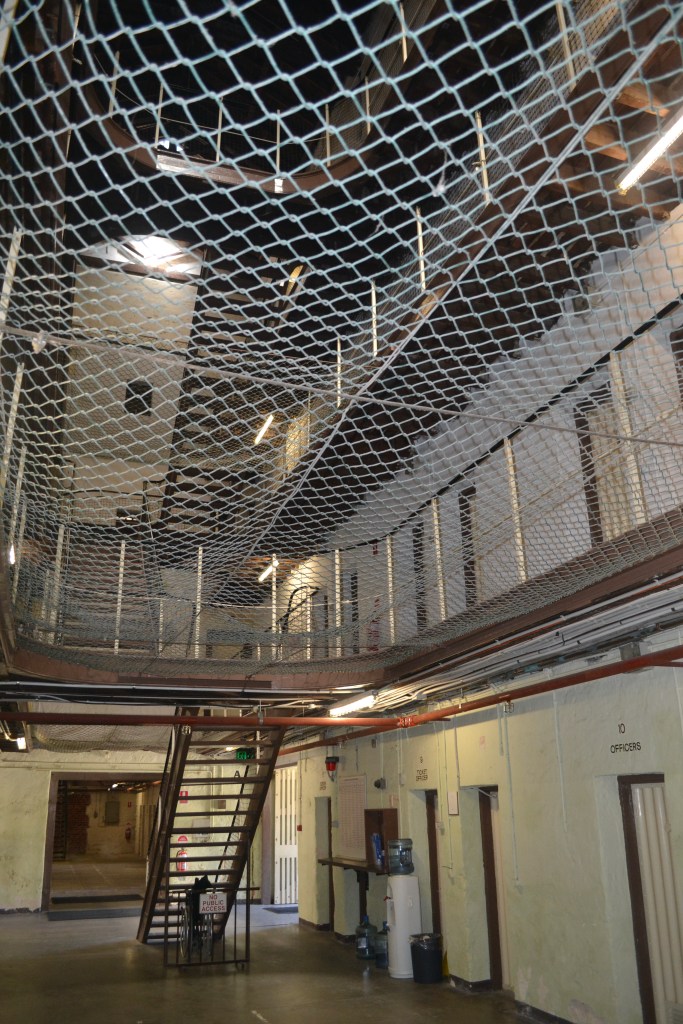
The next day I had quite a bit of work to catch up on so Ken ventured into Fremantle without me. The Gaol was his destination, and he spent many hours there doing three different tours. He came home a very sore and happy man with tales to tell and photos to show. His recommendation if you are in WA. See the photos below.

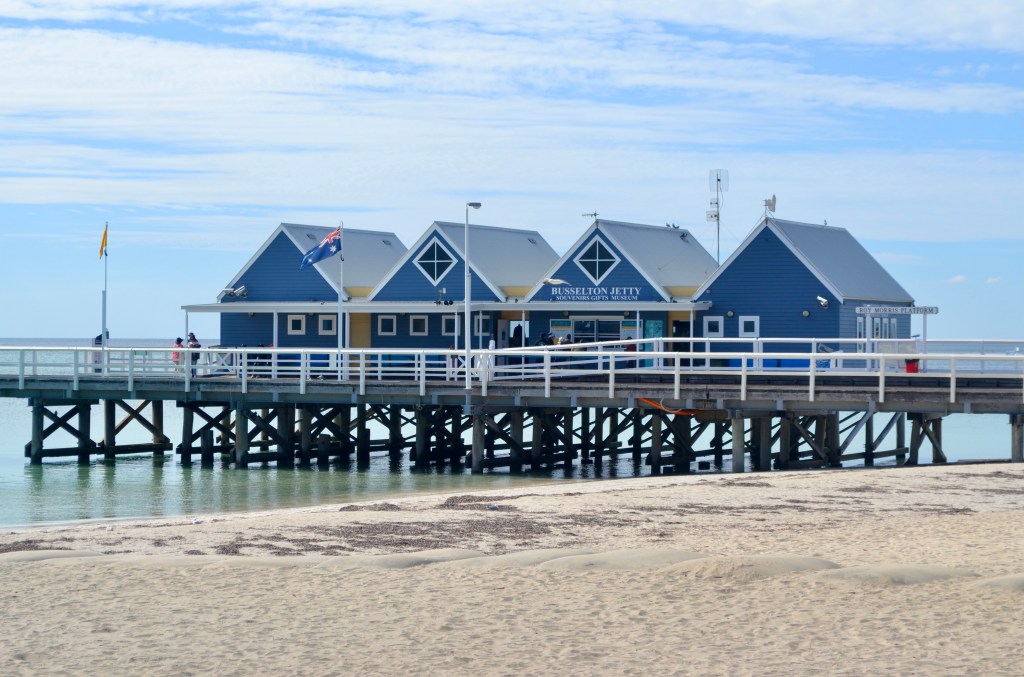
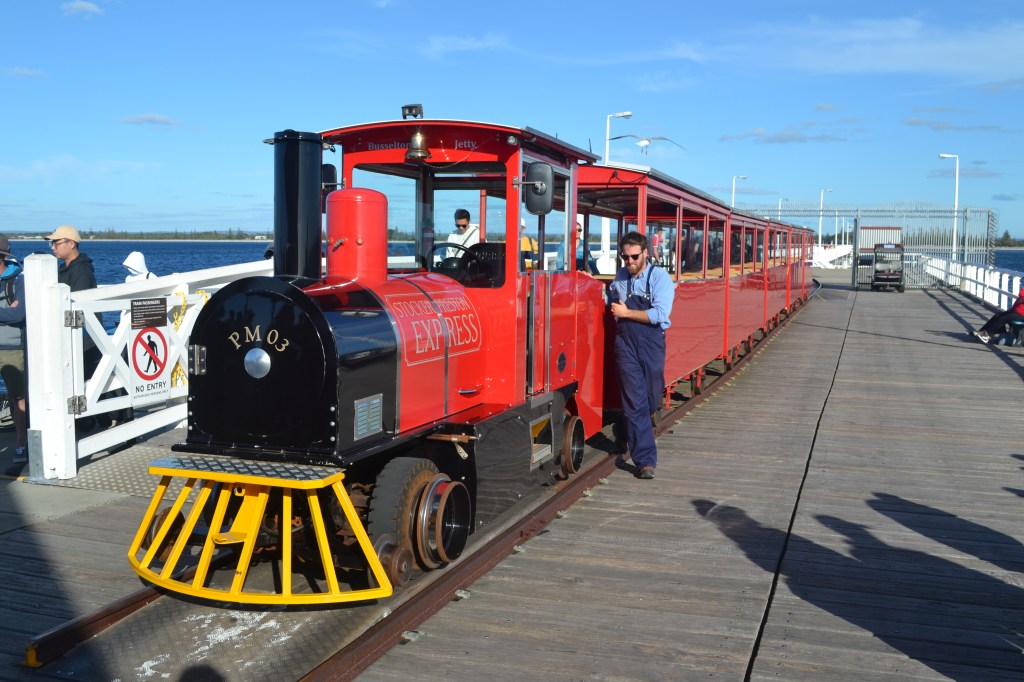
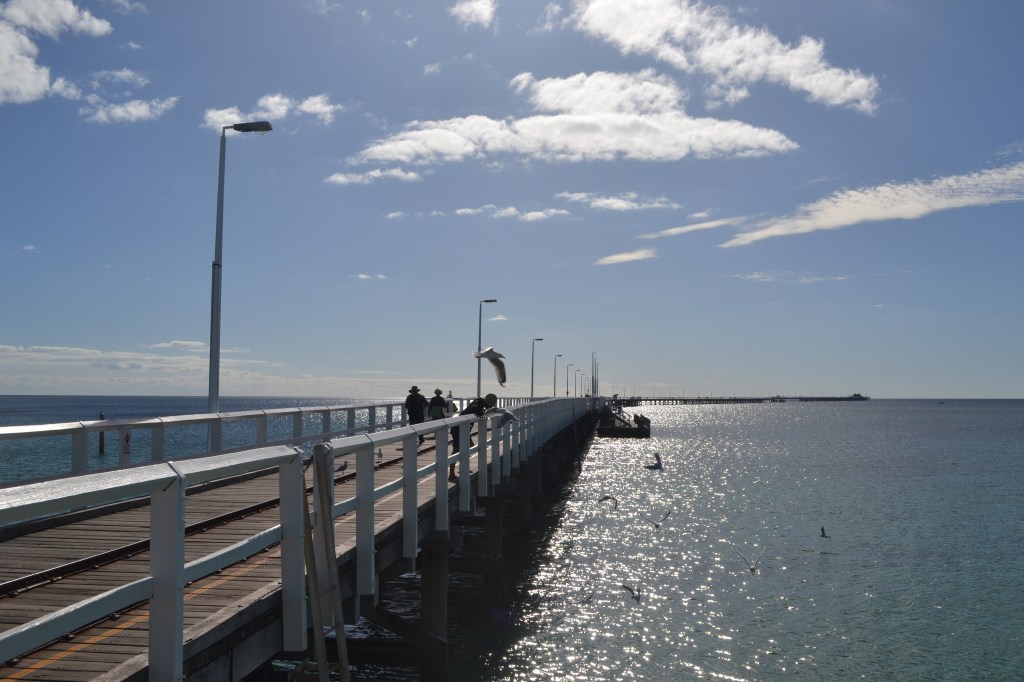
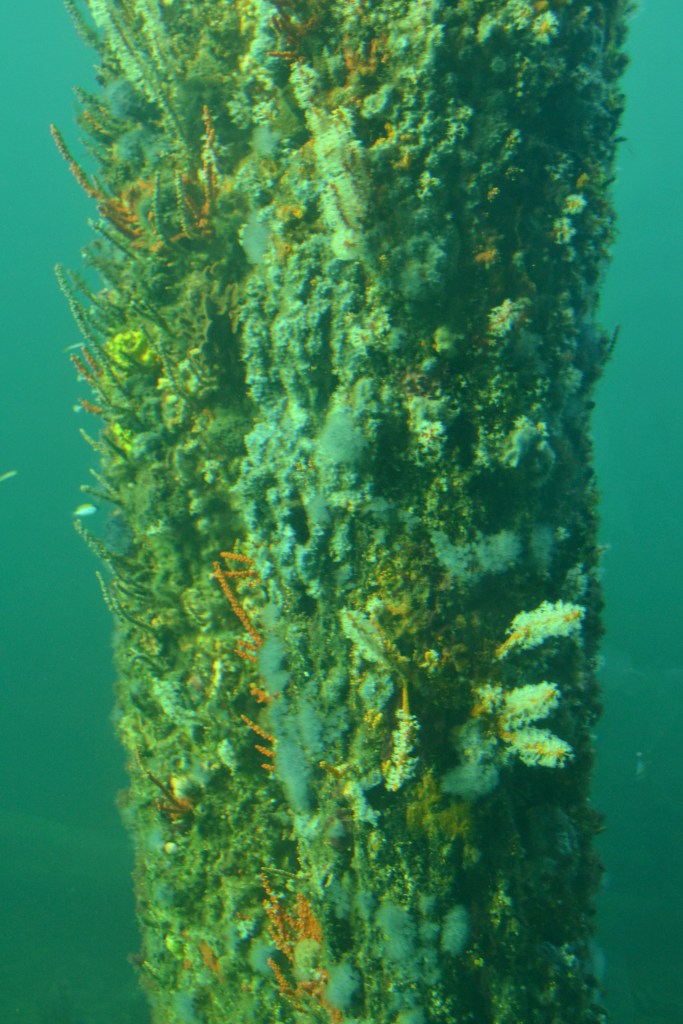
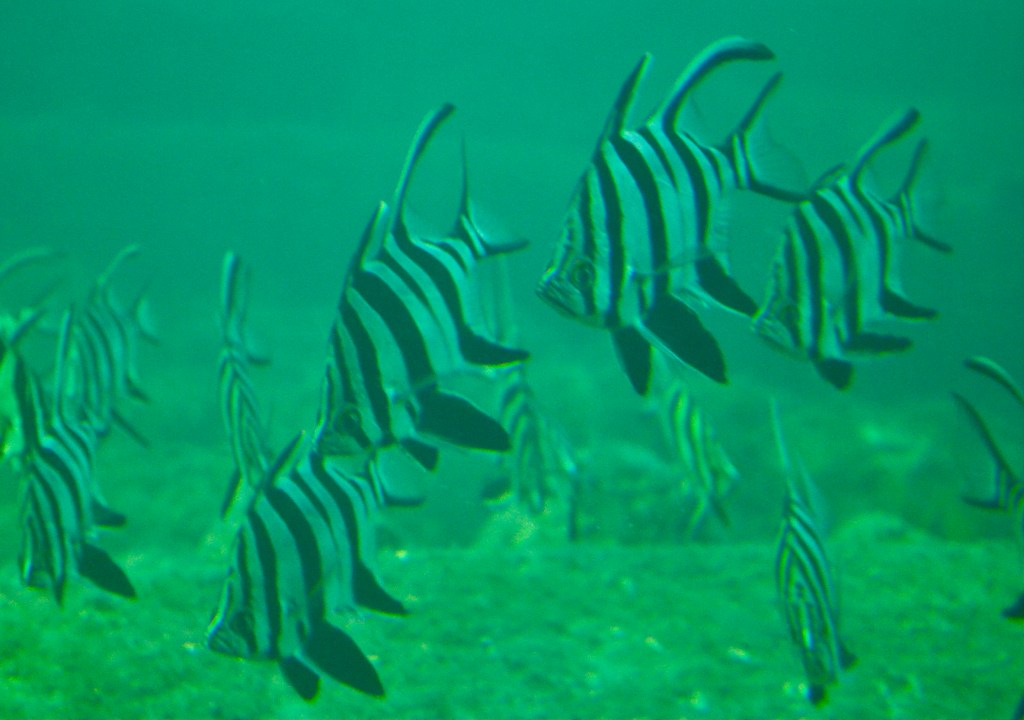
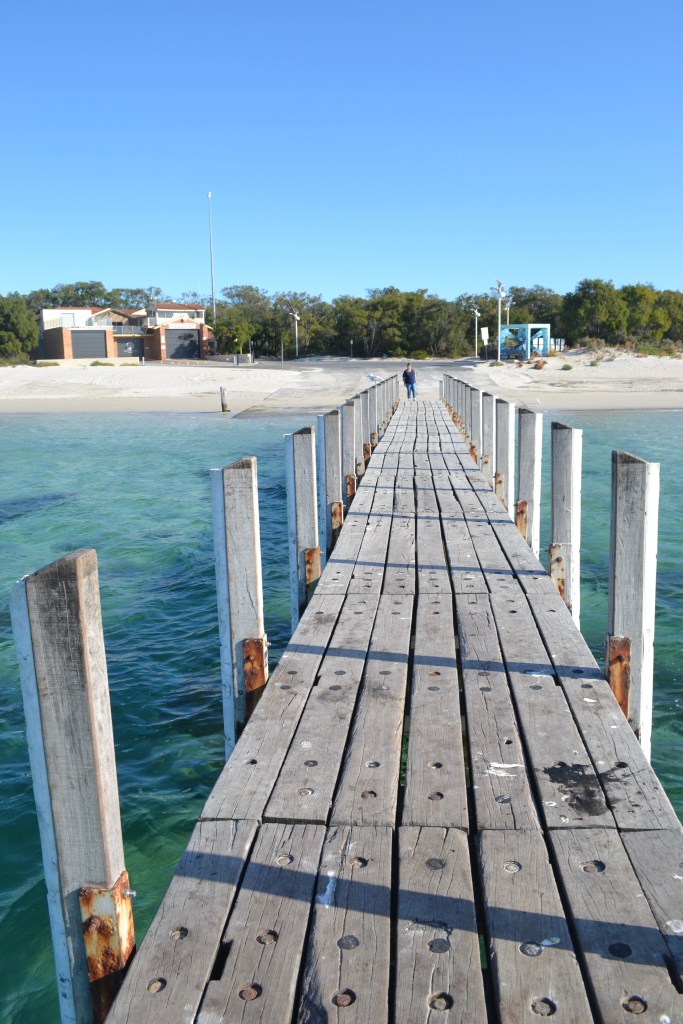
The next morning, we drove just over 2 hrs to Busselton, we booked into a caravan park and headed straight to the foreshore to see the Busselton Jetty. Famous for its length of 1.841 kilometres. The longest timber-piled jetty in the Southern Hemisphere.  You can walk the entire length or join the other tourists and ride on the cute little red train. We chose the train this time and listened to the commentary along the way. Walking would have been quicker though but maybe not as much fun. When you reach the end there is an underwater observatory. It is amazing the variety and the colour of the  coral growing on the jetty pylons deep beneath us. There are many schools of fish that can be seen through the various windows provided on each level as you descend about 8 metres below the surface.  You are not rushed, and a guide is available for questions. Finishing with a quaint gift shop to browse as you wait for your return train journey.  It takes approximately 2 hours and well worth the time. We meandered back along the water’s edge for coffee and cake. Several eating and drinking establishments are available and an extremely fun looking playing area for the kids to enjoy. We needed a Woolworths and a Bunnings that day, so off we went to search the town. Back to the caravan for some wine and cheese before dinner. 

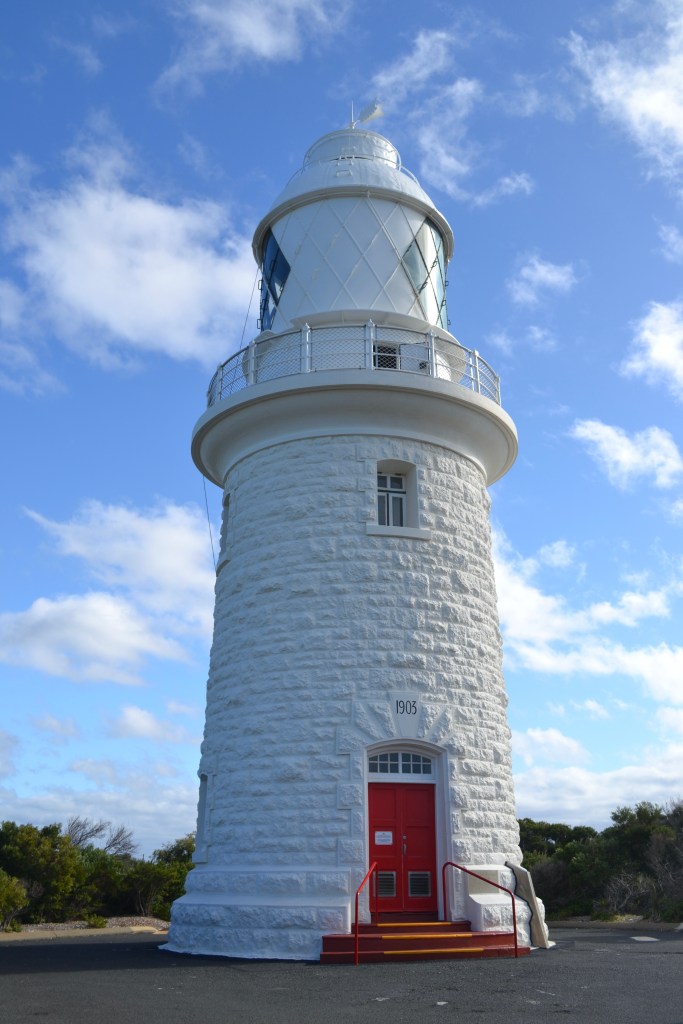
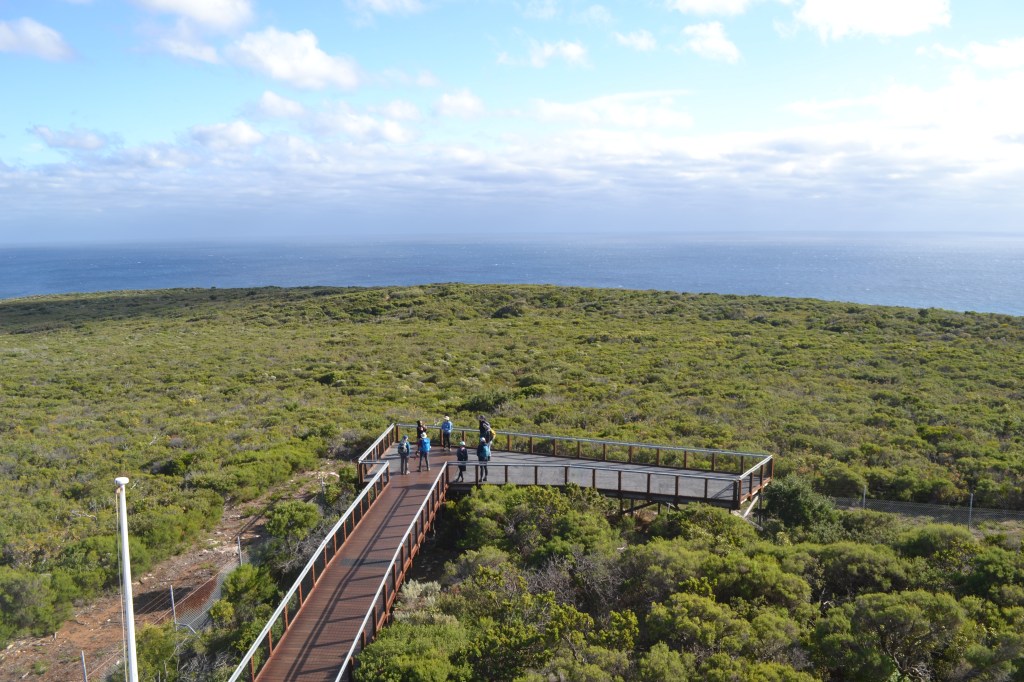
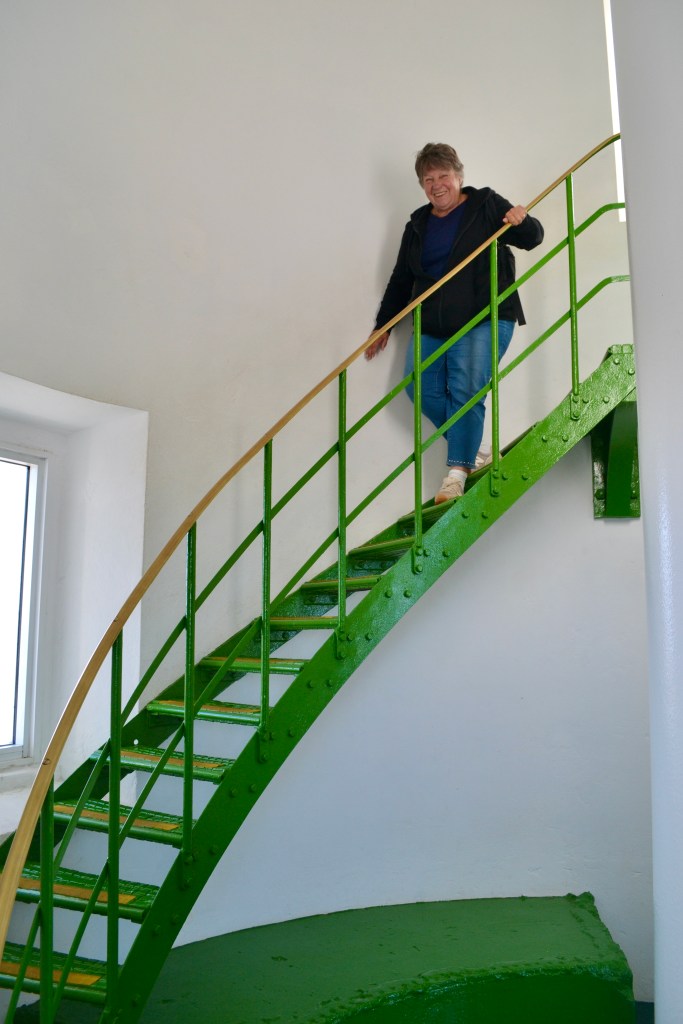
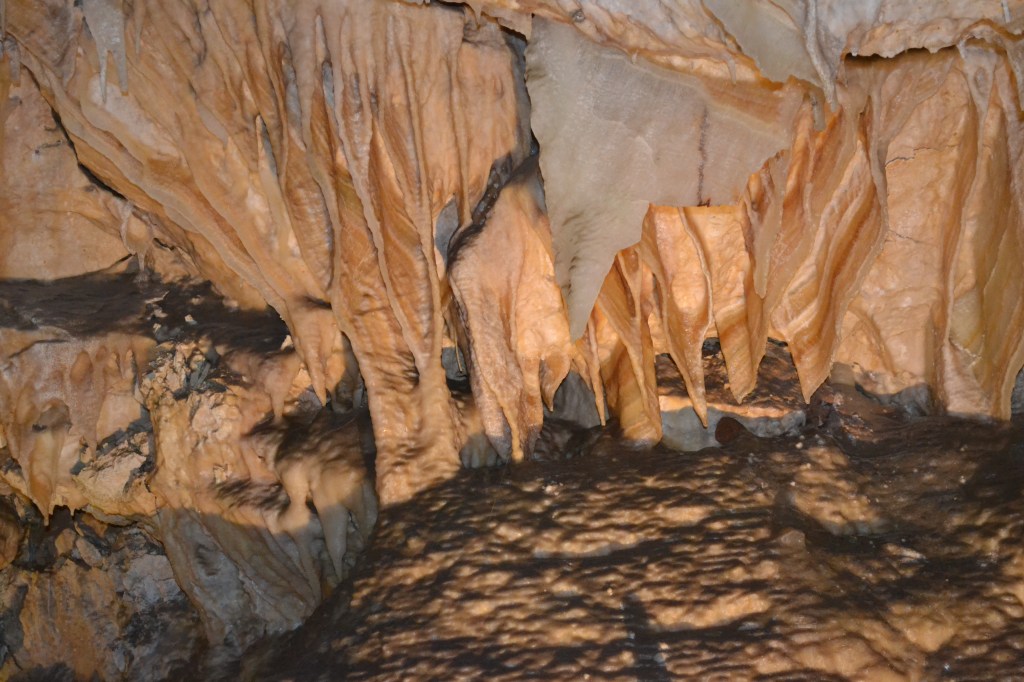
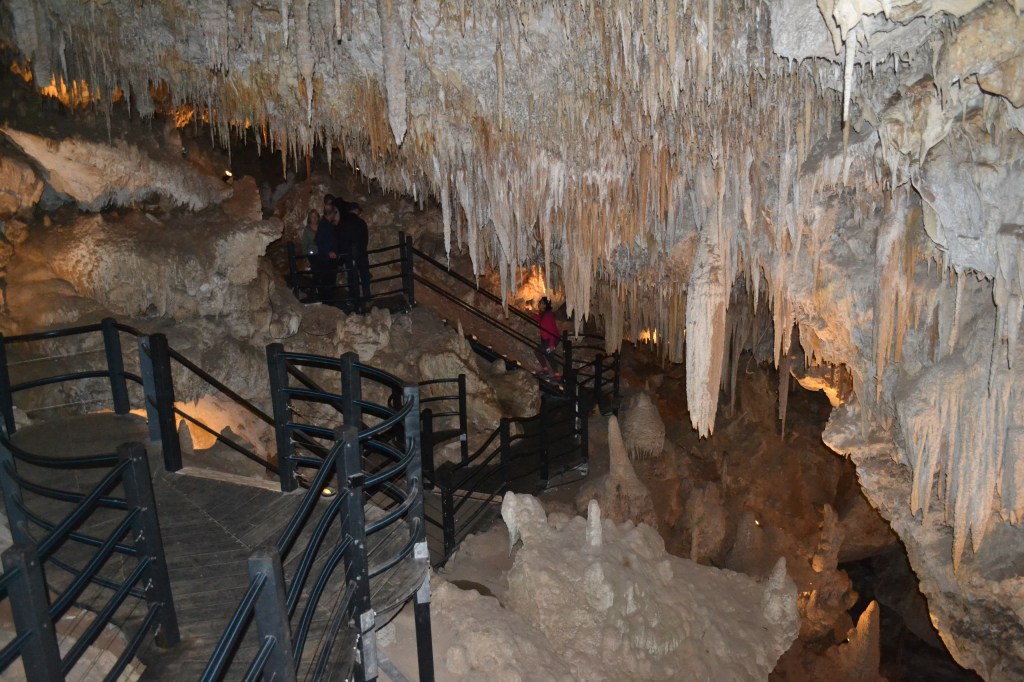
Starting early the next day, we drove to the Cape Naturaliste Lighthouse for a guided tour. Thirteen kilometres from the town of Dunsborough in the Leewin-Naturaliste National Park. As this is a working lighthouse a guided tour is the only way to see inside the building. There are around 59 small stairs to reach the top balcony and take advantage of the panoramic view of the Indian Ocean and the surrounding bushlands. The lighthouse is in very good condition and the original workspaces well preserved. Our tour guide was easy to understand and very informative about the history of the area, and the current work being performed at the lighthouse. The grounds are well kept, and an inviting coffee shop is waiting for you when the tour is done. Twenty minutes’ drive away we stopped at Yallingup to see the Ngilgi (pronounced niggly) limestone caves.  We have been in many caves in our lifetime but even though there are similarities we always find a uniqueness about each cave.

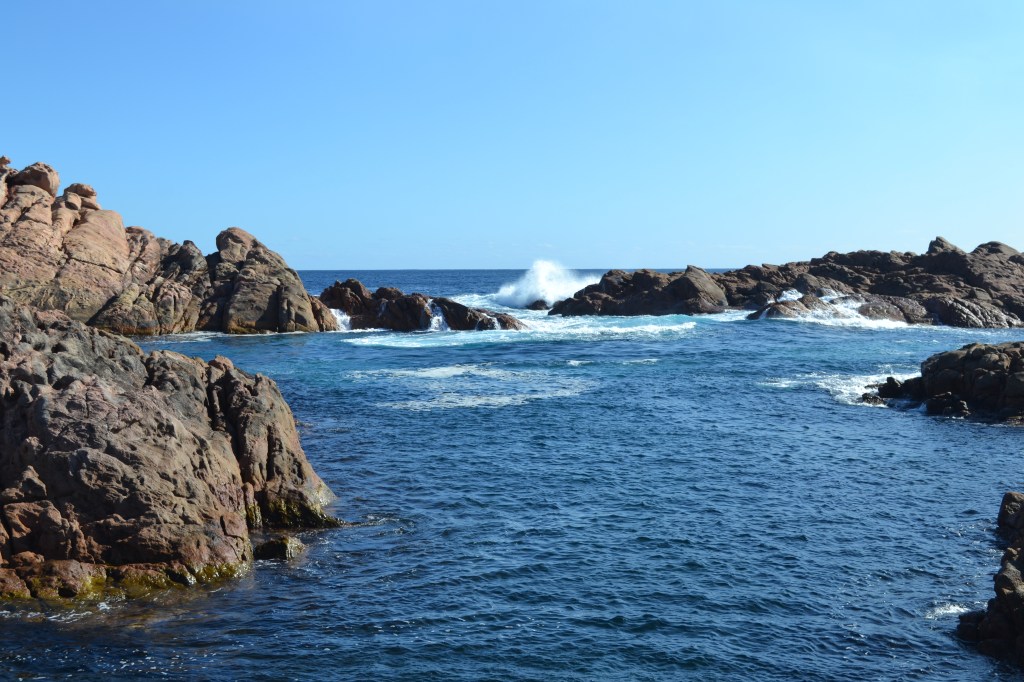
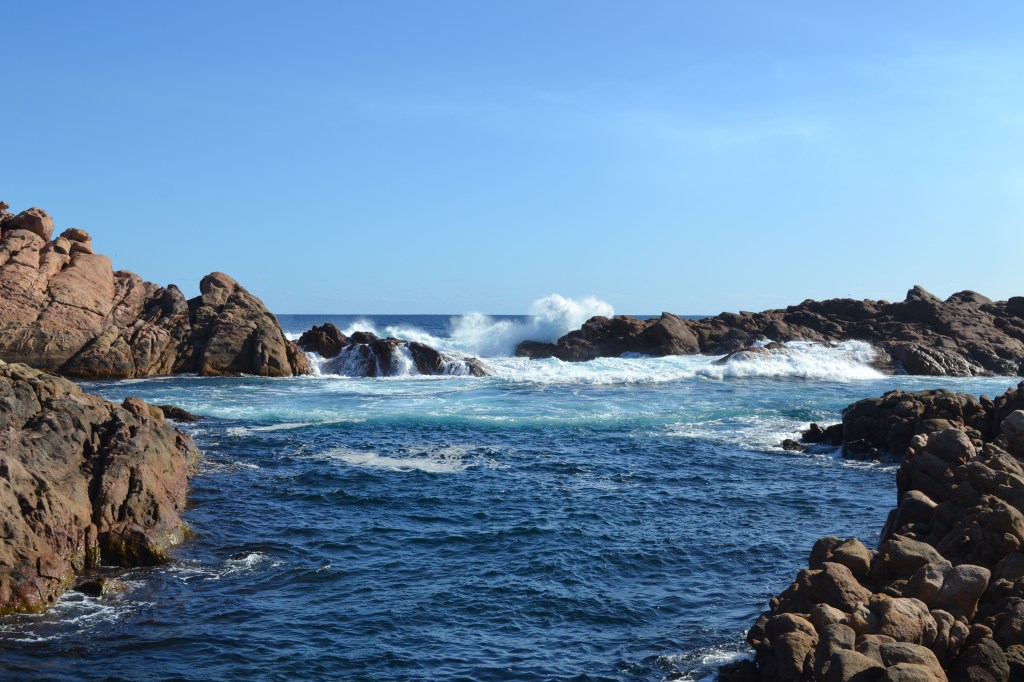
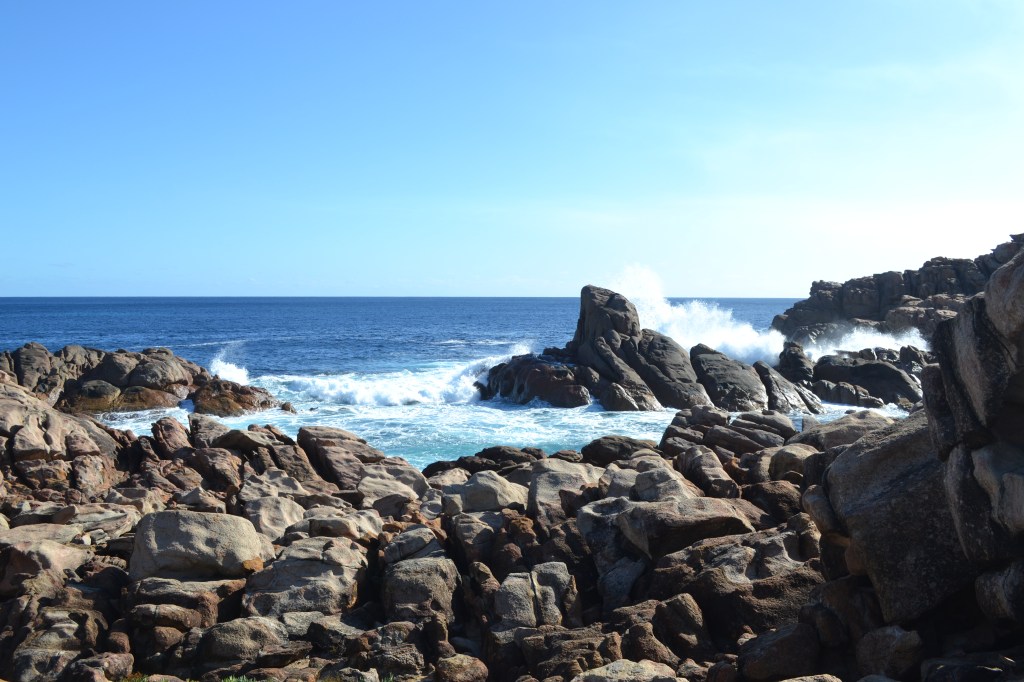
This one headed straight down into a small cavern where the guide showed us some classic formations, talked about the difference aspects of the cave, and then left us on our own to choose a path to follow. This is the best way to explore a cave as you get to go where you want and at your own pace. No waiting for twenty other people to take selfies before you can photograph without someone in the frame. After completely exhausting our-selves we eventually arrived at the exit. We thoroughly enjoyed the experience and discovered we were in desperate need of food and water.  We stopped for a Frankfurt and Sauerkraut roll with coffee, which was very tasty and took off for Canal Rocks. Another site in the Leewin-Naturaliste National Park, southwest of Yallingup. There is a man-made narrow bridge which crosses between rocks on Smiths beach and the ocean. At the end of the bridge one can  negotiate carefully over the rocks to get a great view of the ocean’s power as it hits the many canals between the rocks. Where Ken is happiest wandering through the bush, I can sit endlessly watching the ocean waves crashing on the rocks. Unfortunately, we were hampered from doing this, as a very rude woman and her family were blocking the entrance to the wilderness of the many rocky outcrops. We waited on the bridge for some time but eventually gave up as we heard her mention to someone that she was not giving up her vantage point. The longer we waited the more our fixation was on this woman rather than the view.  We were still able to see the beauty of the area and clamoured over other rocks to see different aspects of the waves.  It just leaves a bitter taste in your mouth when people are so selfish.

During our return drive we noticed the names of the towns had the same ending. Yallingup, Quindalup, Wilyabrup and Carbunup. Intriguing enough to have me googling. Apparently, the suffix “up” in the dialect of the Noongar language means “place of”. Satisfied now and thankful for Google we moved on.
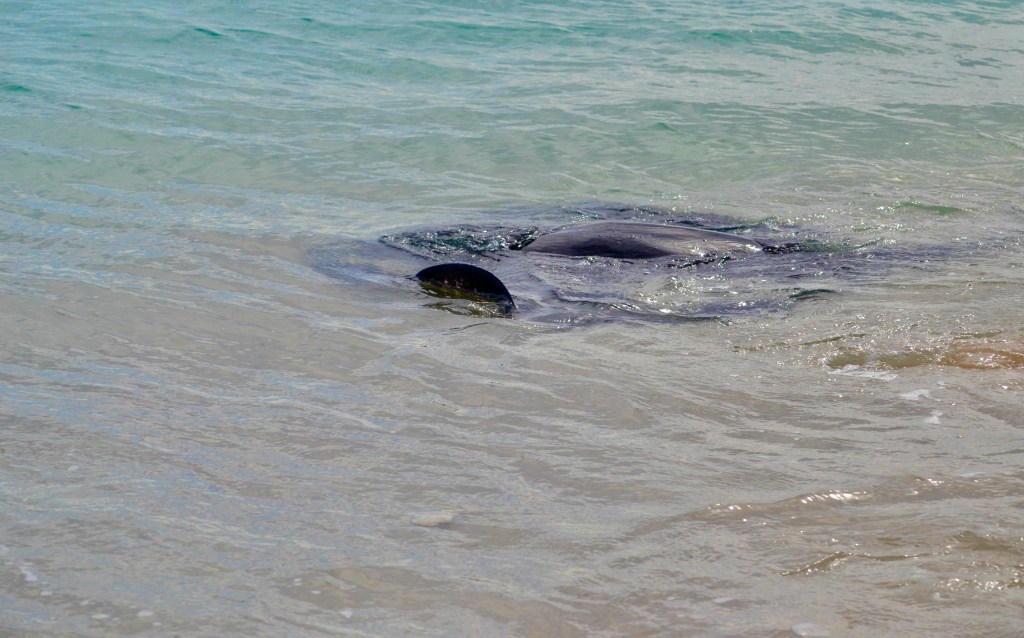
Our next stop was to be Margaret River, however we decided to give this area a miss. We had no wish to visit wineries, so we headed straight to Hamelin Bay with the hope of seeing the stingrays up close. As part of the Ngari Capes Marine Park, Hamelin Bay has shallow waters and perfect to view the stingrays mining for food. We had read clear and calm days were the optimum and of course we chose a windy and cool day.   With hope we headed to the water’s edge. We were in luck, a large and a medium size stingray were foraging in the water. They move quite quickly floating seamlessly just below the surface with undulating movements which allow you to see a little more of their body as they break the surface. Such beautiful creatures to watch. Once again though the view was interrupted by ignorant people doing what they should not. Signs on the way down to the beach say. Look but don’t touch, stay several metres away, don’t walk or swim near the rays. Several people standing within inches of them, one snorkelling on top of the smaller one. Our frustration levels soared once again to the point of arguing with one family who just laughed us off.  They did move away while we were there, but our guess is they were back at it as soon as we left.  Would I have been sorry if a stingray barb found them, definitely not. One can only hope.

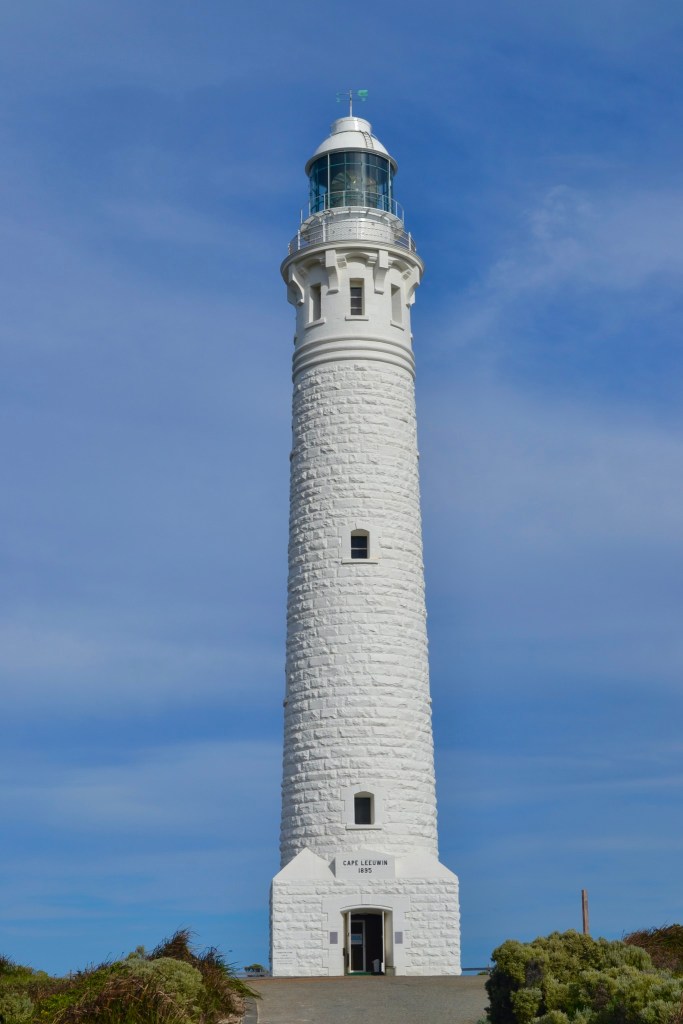
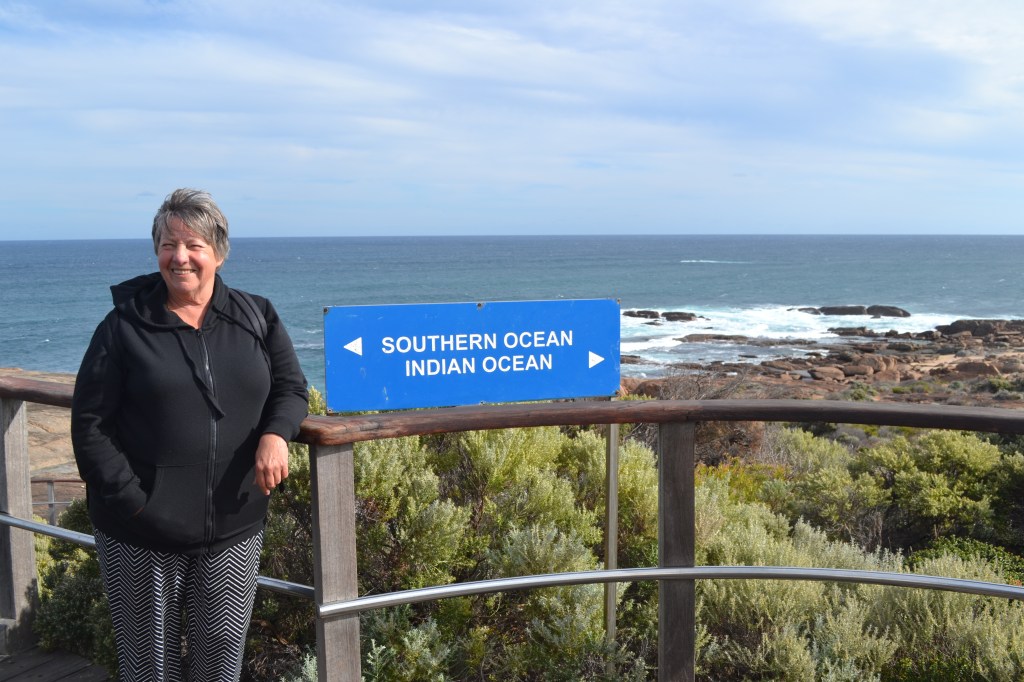
Venturing on we visited Leeuwin Lighthouse at the most south-westerly point of Australia, on our way to Augusta. It is also the tallest lighthouse in Australia at 39 metres. It is situated on a peninsular where the Southern and Indian Oceans meet. With Antarctica to the south and Africa to the west.

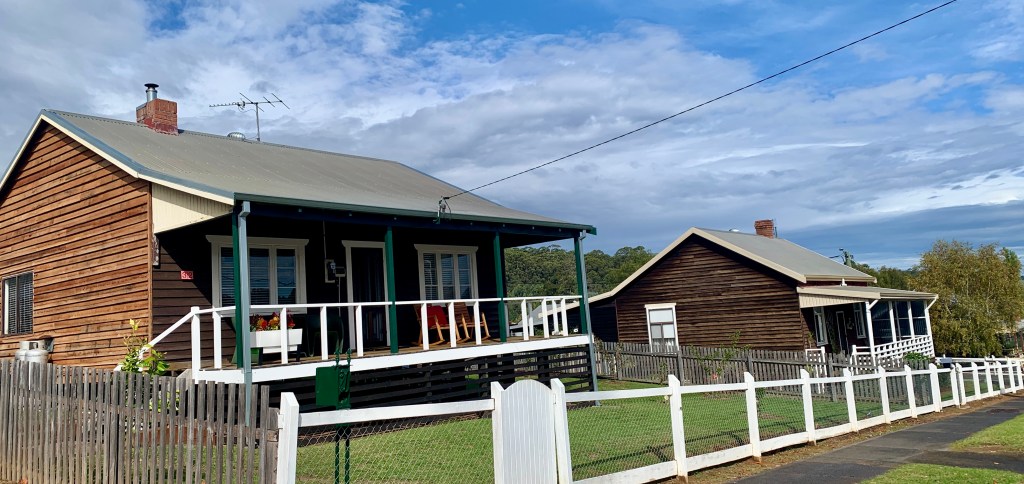
Thankfully I did not have to walk the steps in this one. We were happy to just see the view from the peninsular where it soars a mere 56 metres above sea level. Once again, the grounds are well maintained, the walk to the base of the lighthouse has great views of the surrounding area. There are a few of the old stone houses open for inspection and a café and gift shop on the way out.

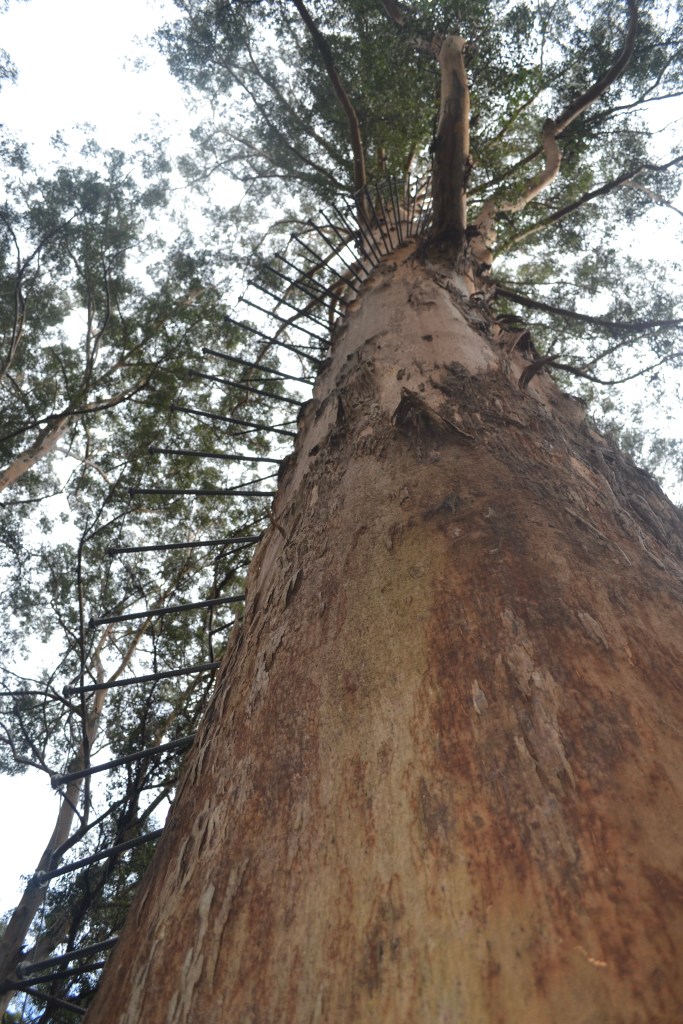
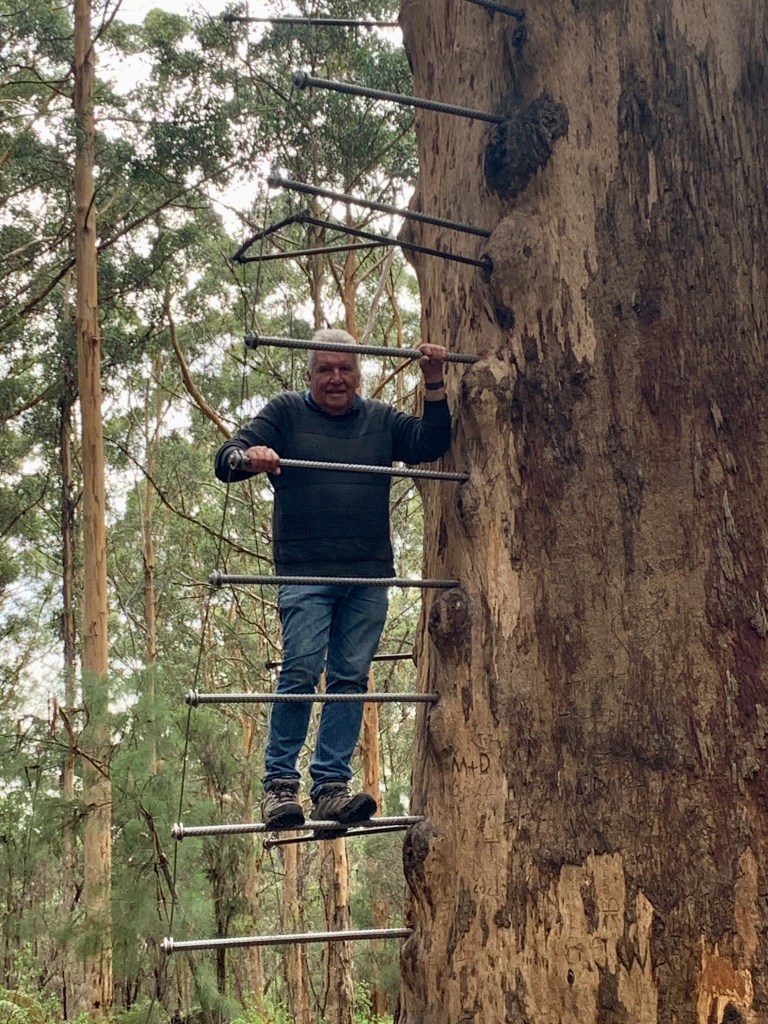
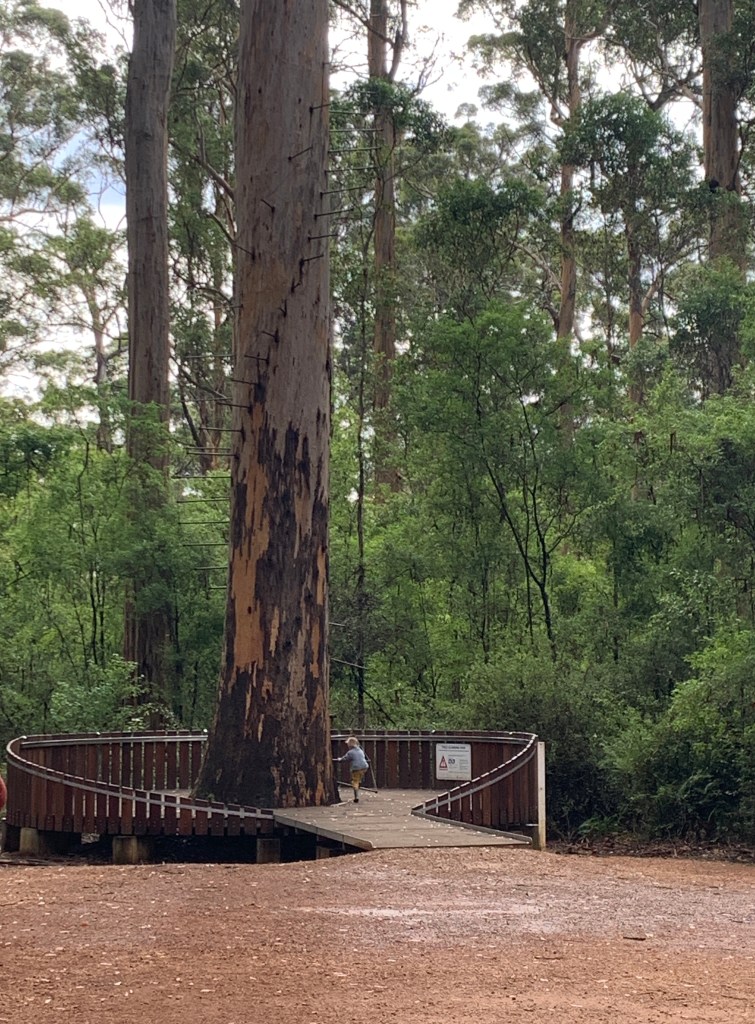
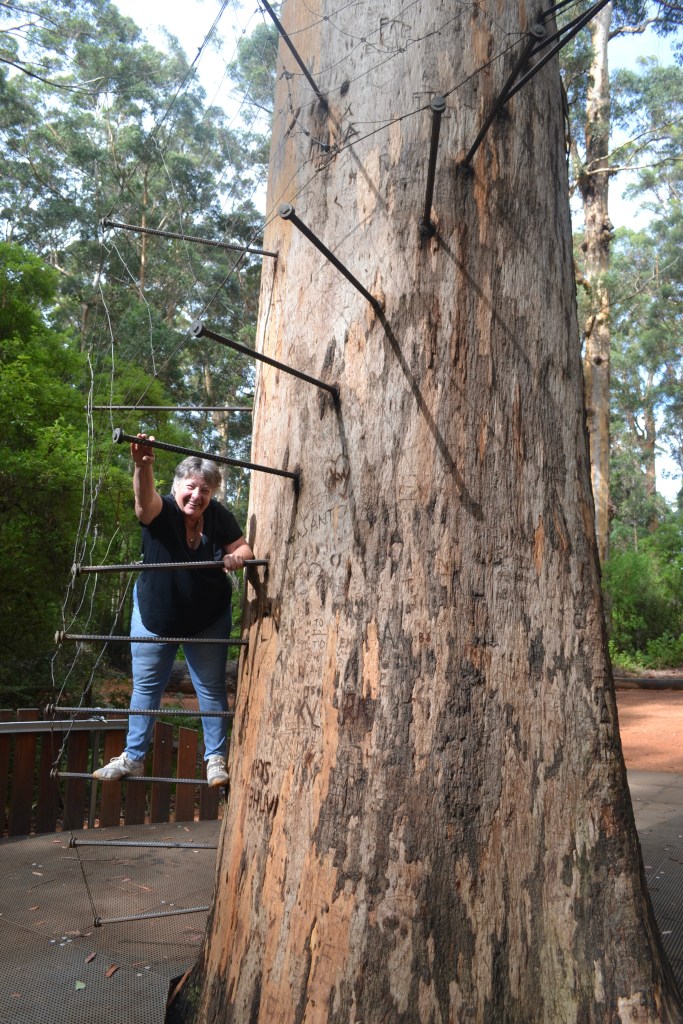
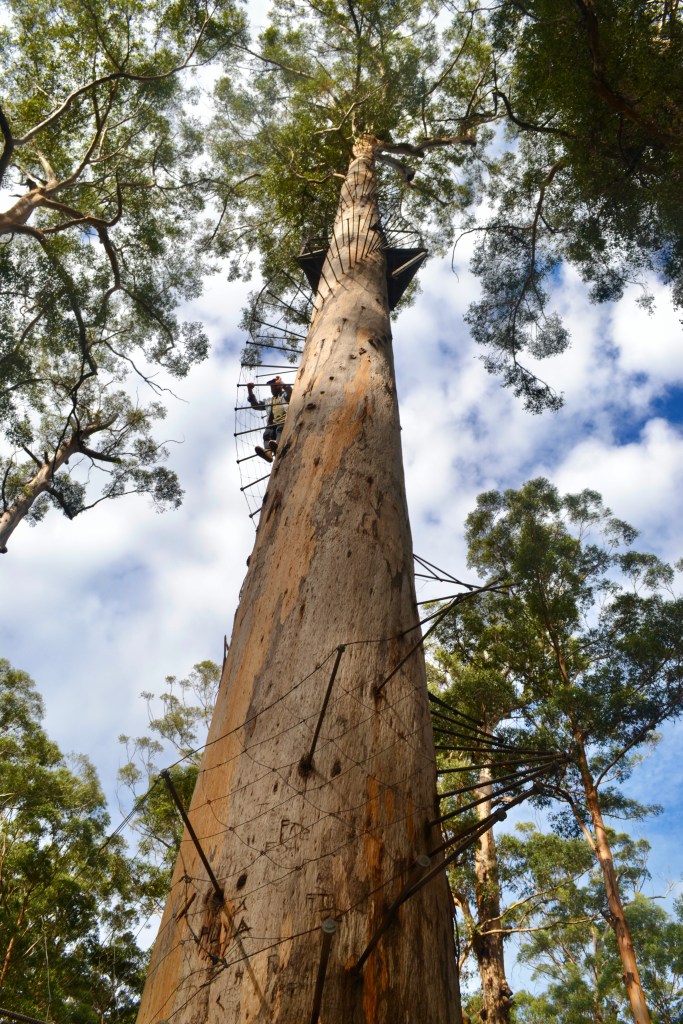
That night we camped out at Alexandra Bridge. A donation camp beside the river with beautiful natural bush camp sites, drop toilets and cold showers available. On arrival we were greeted by a couple of local ducks chasing each other around the campsites. The atmosphere was perfect for a campfire, so we dragged out the Drifta pit fire and settled down to watch the flames. It lasted an hour or so before a light rainfall forced us indoors. We were heading along the bottom of WA now toward Albany via Walpole.  An hour along the Great Forest Drive took us to Pemberton, a cute town, known for the popular Karri tree. Apparently, the 3rd tallest tree in Australia reaching heights of 90 metres. The town itself has a lot of appeal with parks and many café’s, art and craft shops lining the main street. It was drizzling rain that day so after coffee and muffins we decided to head for the Gloucester Tree climb. The tree has climbing pegs up to 42 metres reaching a viewing platform. It does go further again however it was closed for restoration that day. The pegs are quite a distance apart and my legs would only stretch so far. For the sake of a photo, 3 rungs were all I could handle. It is a magnificent tree and surrounded by natural bush setting with walks and picnic areas. The rain was only light, so we headed off to the Warren National Park where we found the Dave Evans Bicentennial tree. Another Karri tree, one of the 18 fire lookout towers spread out across the southwest forests. This tree was first used in this way in 1947. It too 6 hrs using a belt and climbing boots to reach the top.  Today it is a tourist attraction and can be climbed if you are game. We watched as a young fit guy mastered the 53 metres and back down again.

He was exhausted but exhilarated by the experience. We on the other hand were happy with a few rungs of the ladder once again. The rain had stopped now so we moved on to do the loop  walk to the cascades. Nothing spectacular but a nice, pleasant walk along the river.

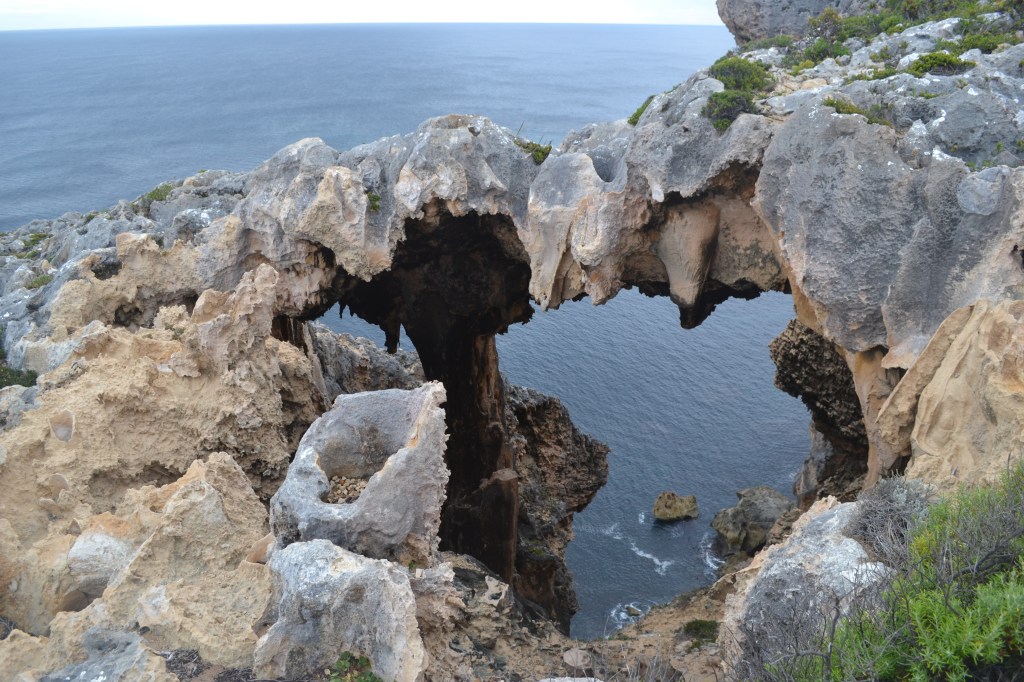
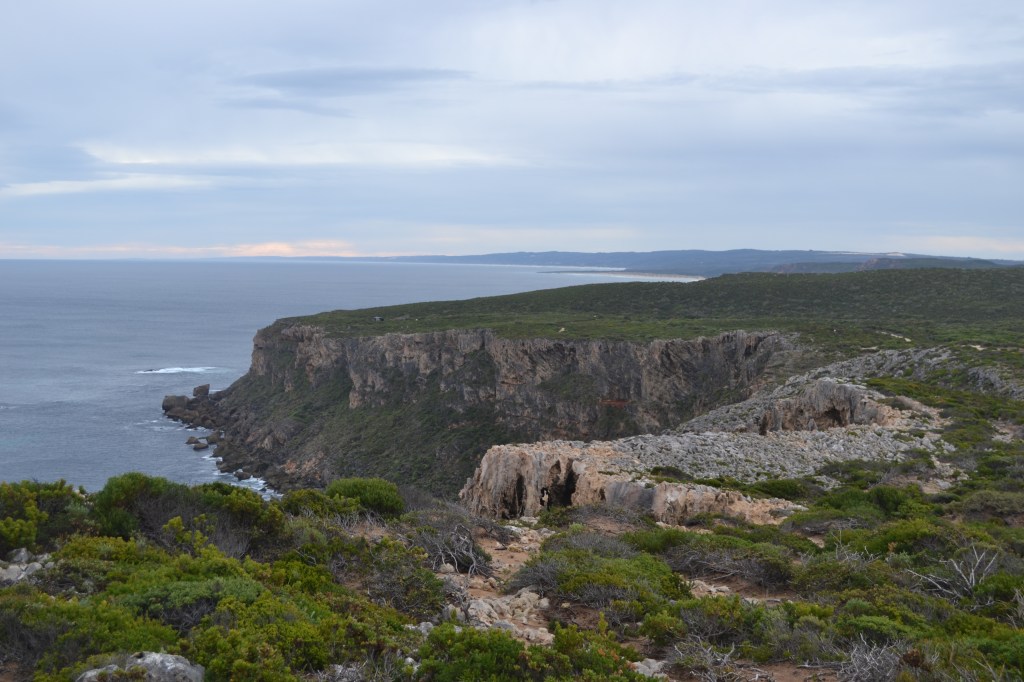
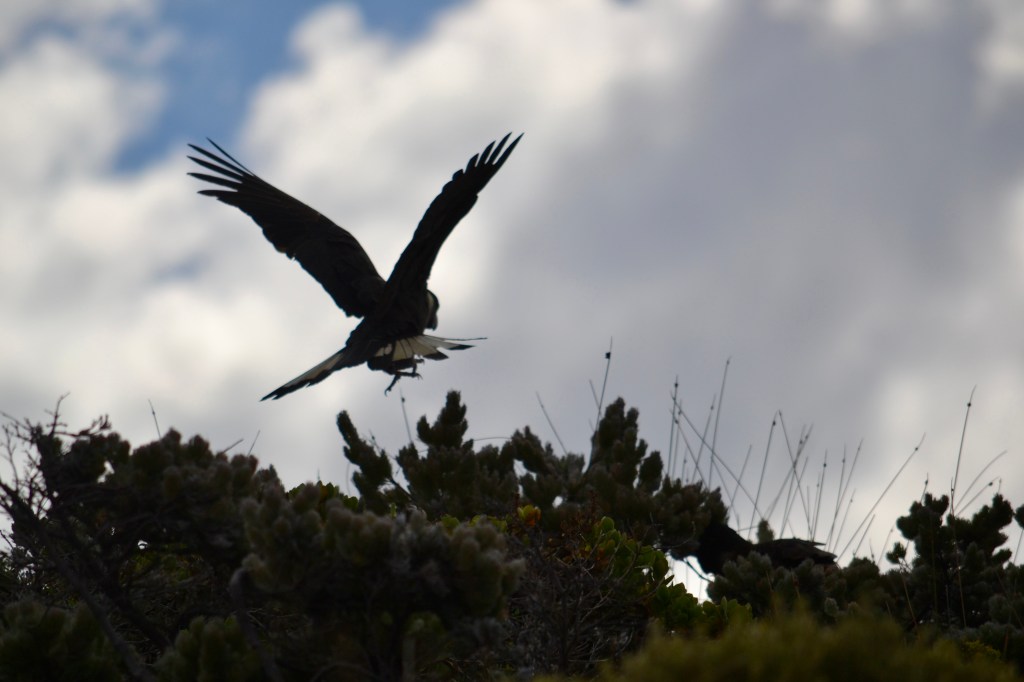
We had planned on staying in a free camp at Windy Harbour just 27 km south of Northcliffe. When we arrived the campground and the surrounds looked a bit neglected and isolated, so we were a bit unsure. We took a drive around within the D’Entrecasteaux National Park and discovered the walk to The Window. A path winding up to a lookout takes you to a point above a rocky crop with a gap showing the waters below. It is quite a rugged looking spot with a mean deep drop to the ocean. It is part of the Coastal Survivors Walk, which would be very appealing on a nice sunny day. We were not afforded that luxury but were happy with the view. On the way back to the car with umbrellas in hand we spotted a Hawk soaring above the waves, carrying something in his claws. With a quick scramble to get the right camera lens fitted Ken was able to get a few good photos.  A little too far away but enough to see a sizeable fish dangling from his claws. He would have eaten well that night.

We decided against staying at Windy Harbour and headed back to Northcliffe to find accommodation. Finally settling on an eco-caravan park which was a bit neglected but covered our needs for one night. That night it was a bit cold and drizzly, so we headed to the local pub for a meal. Only a couple of people in the pub but it was warm and dry. A simple steak and salad order arrived with a super serving of fresh vegetables and a well-cooked scrumptious steak. A  friendly chat with the owner and an elderly local lady sitting in the corner behind us who in a stern voice yelled for everyone to be quiet as she steadfastly watched the King’s Coronation on the TV.  (A bonus or maybe not) It was a pleasant night and one of the few nights Ken did not have to cook.
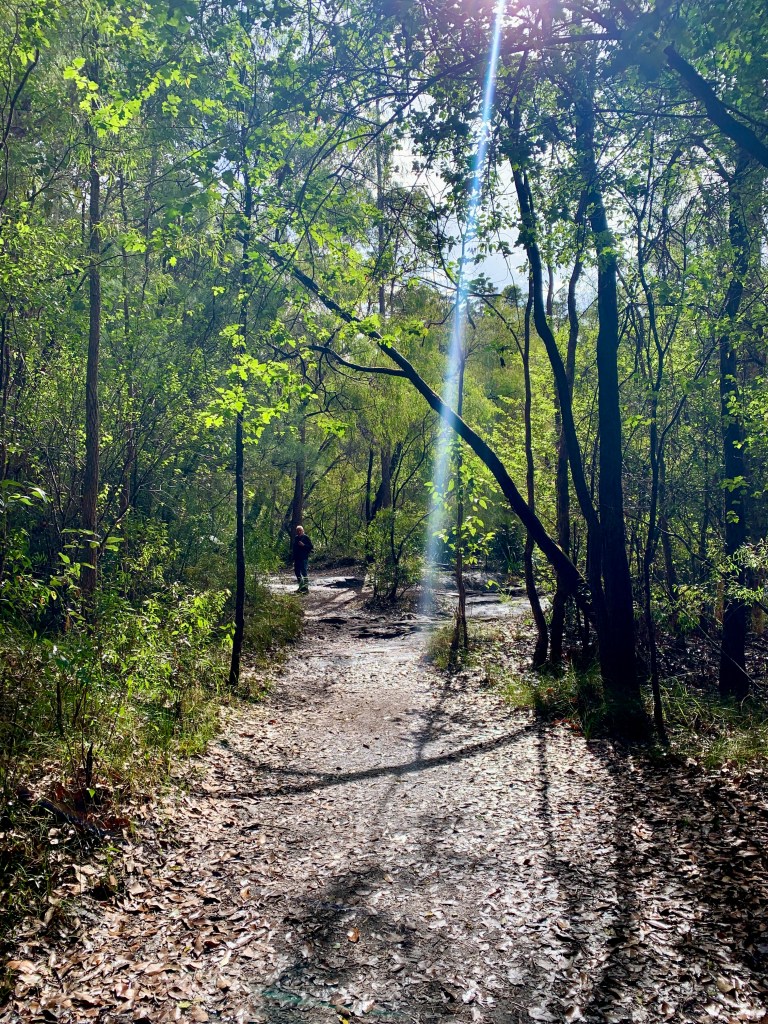
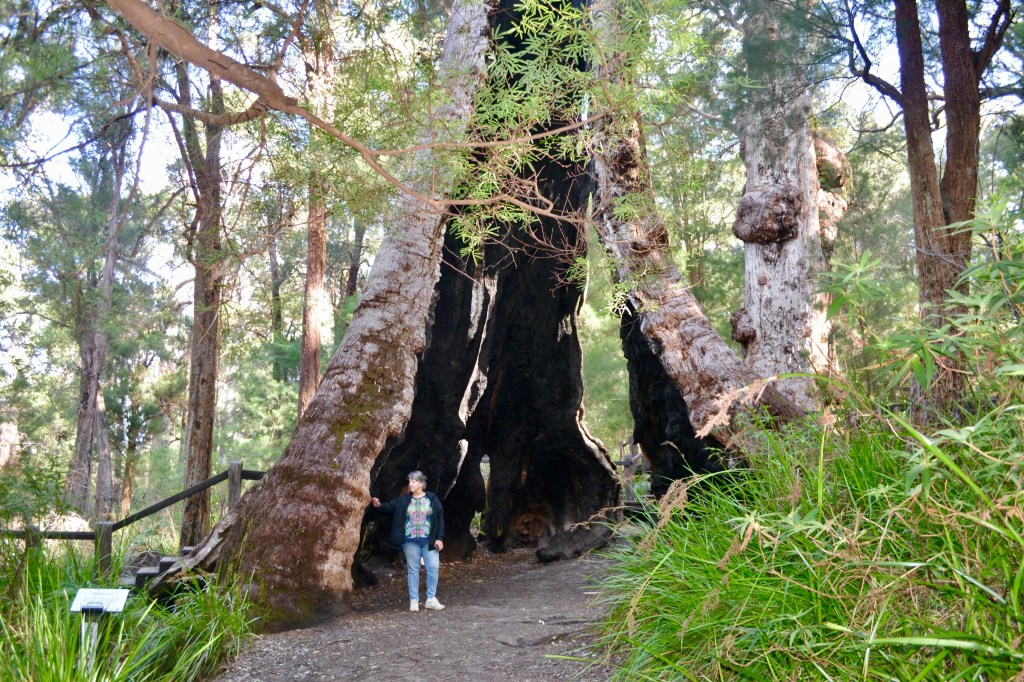
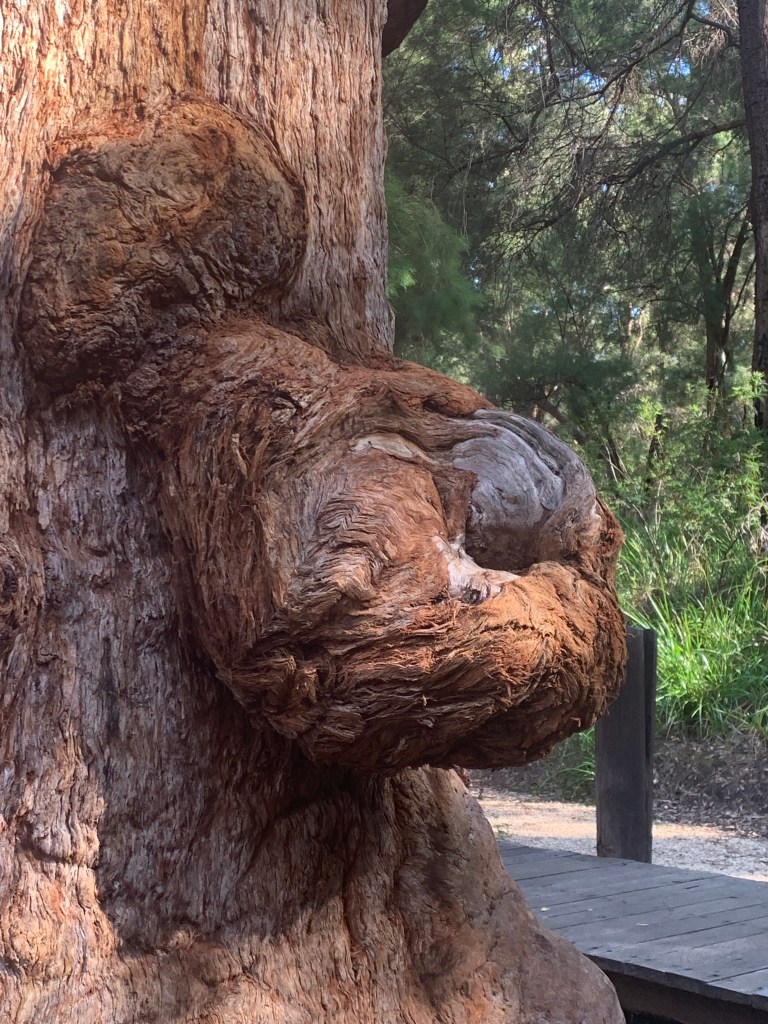
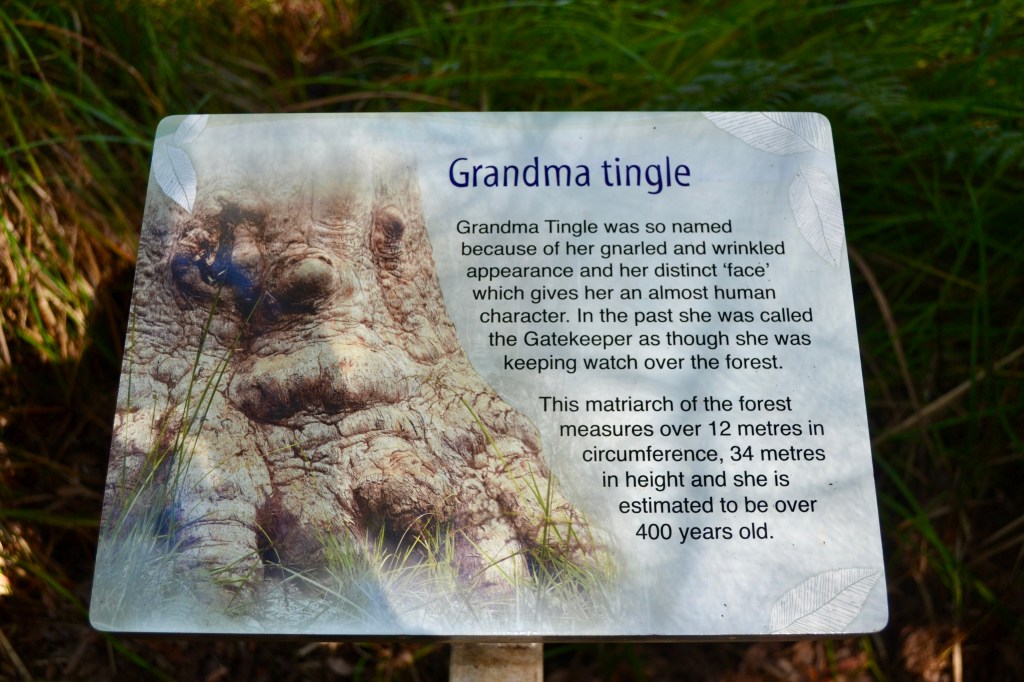
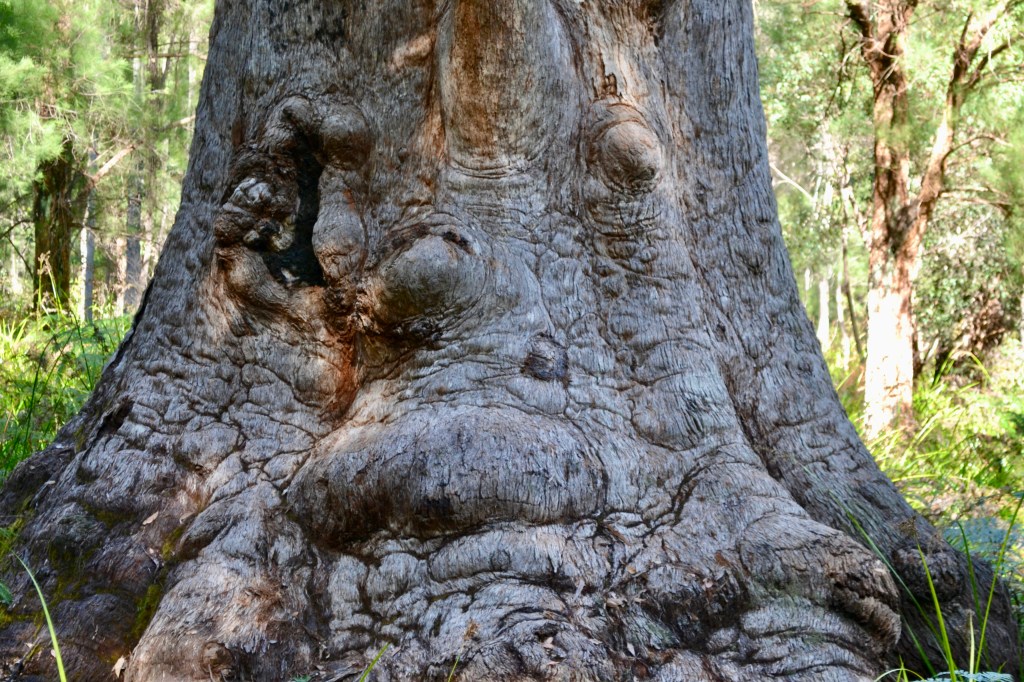
We headed off early the next morning to discover the wondrous trees of the Nornalup National Park, Walpole. We arrived at the Giant Tingle Tree Loop walk which was only a kilometre round trip. The trees are so tall and they glisten when the sun peeps through the trunks and hits the branches.  In the middle of the walk, you come across the Giant 75m survivor. The centre was a black charred mess where a fire had eaten away the middle of the tree. The outside stood strong and boldly continued to grow up to reach the sun. 

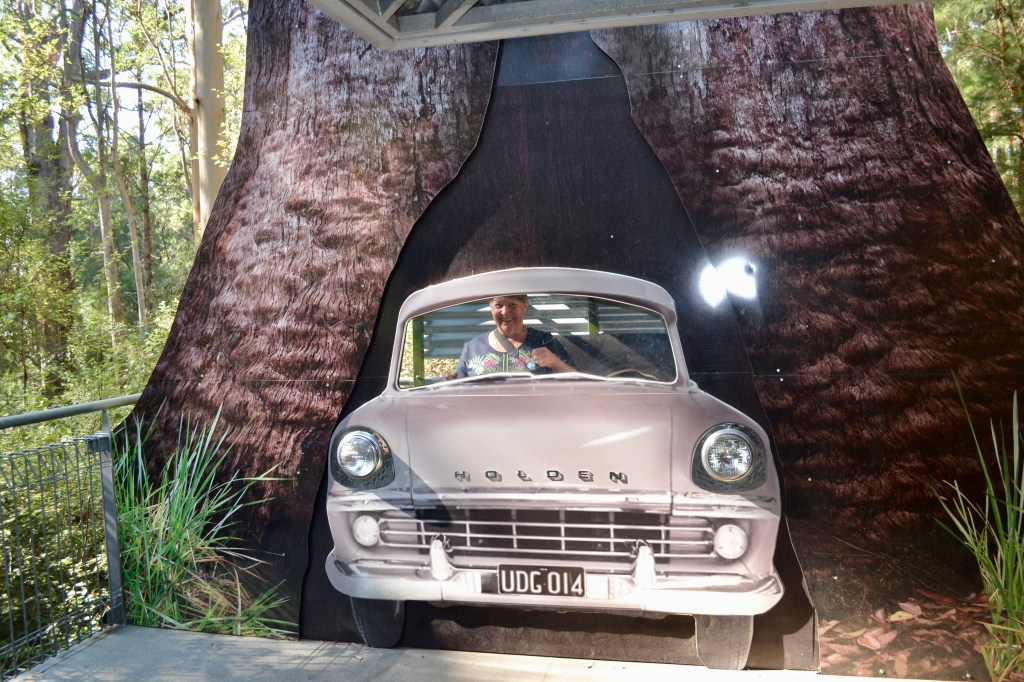
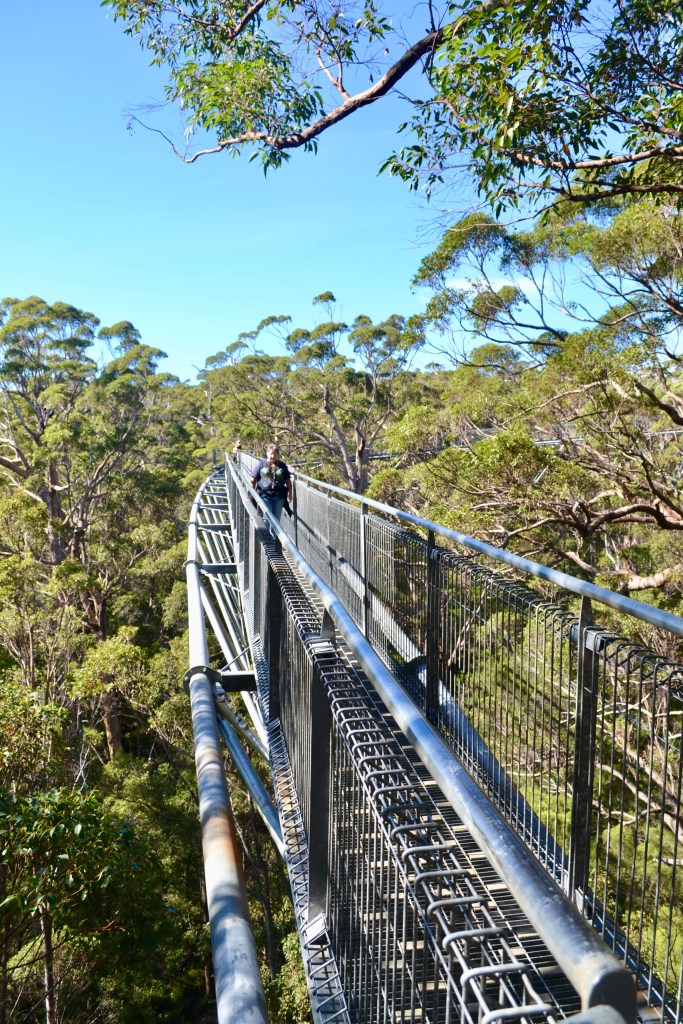
Turning off the Vasse Highway to the Southwestern Highway we stopped in at The Valley of the Giants treetop walk.  This was not Kens favourite place but one I was looking forward to. The walkway is suspended in the air 40 metres above the ground with the red tingle trees still towering above you. The walkway is strong and feels safe, but it  does sway a little so can be a bit unnerving.  It is not as spectacular as I was expecting but I was happy to have mastered it. Once on the ground again there is a lovely walk through the forest viewing some very huge grotesque and gnarly red tingle trees. Another large tree where the centre was missing was the pinnacle of the walk.  Personally, we thought the  earlier short walk through the forest was a  little more enjoyable as it was a lot less commercialised.

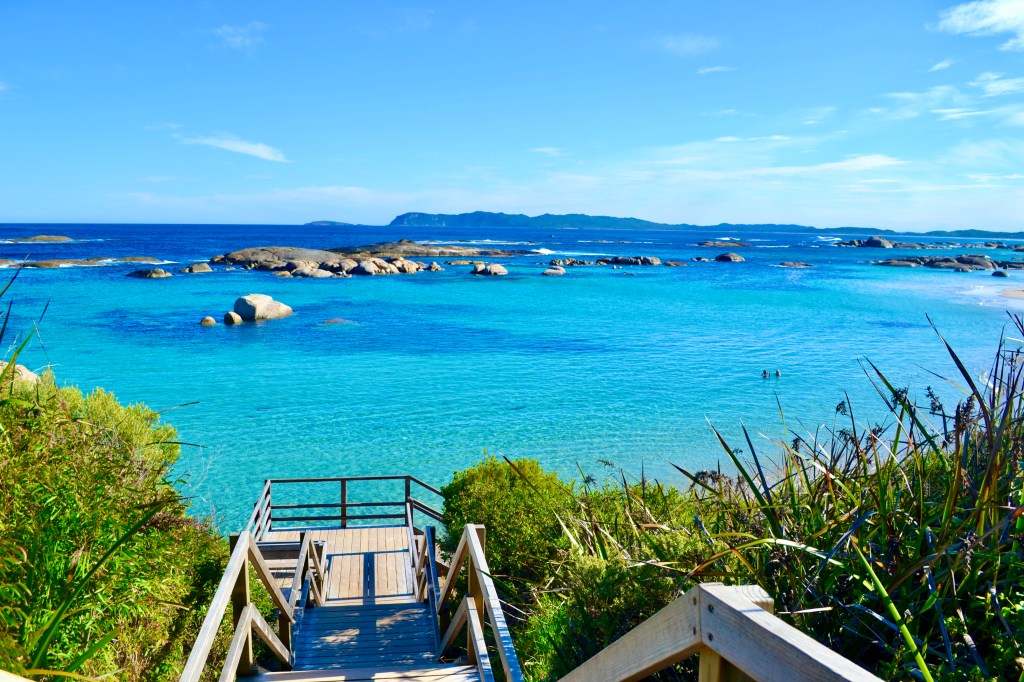
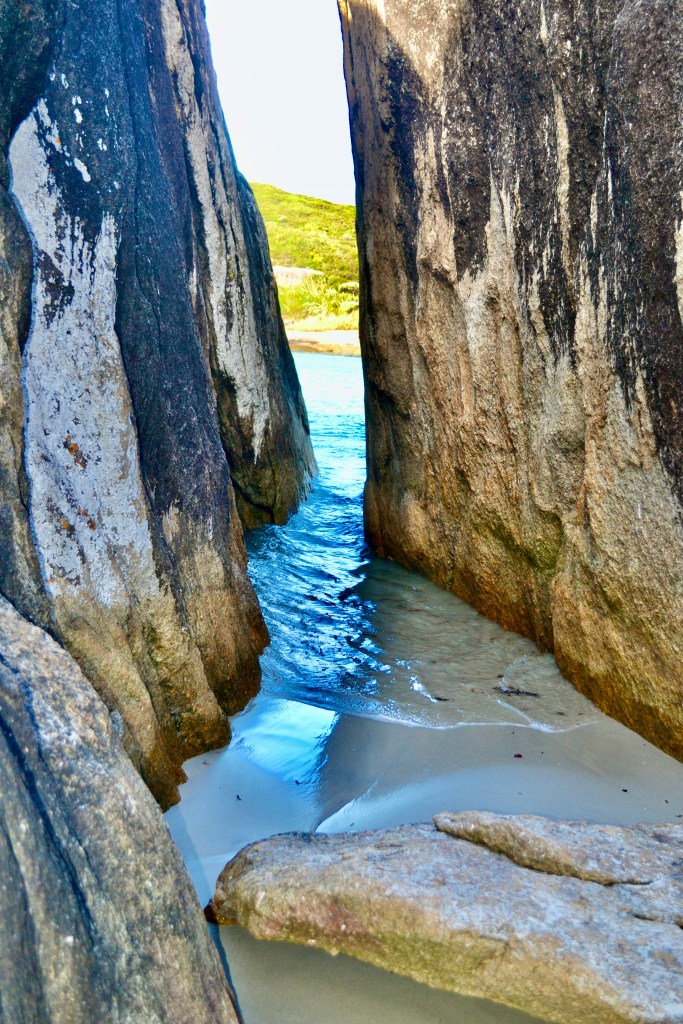
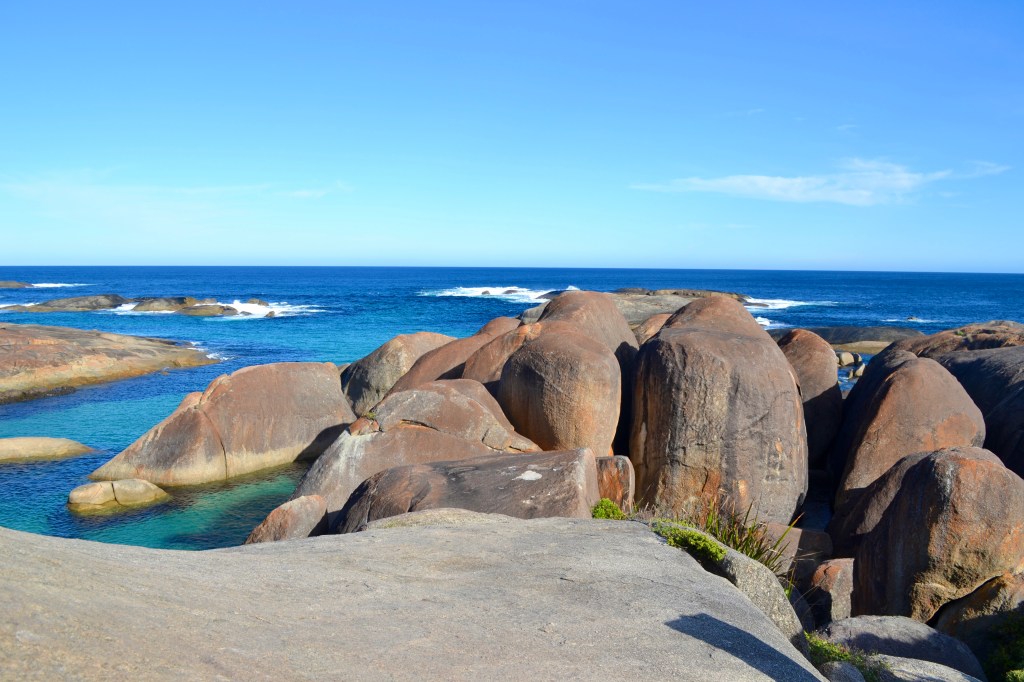
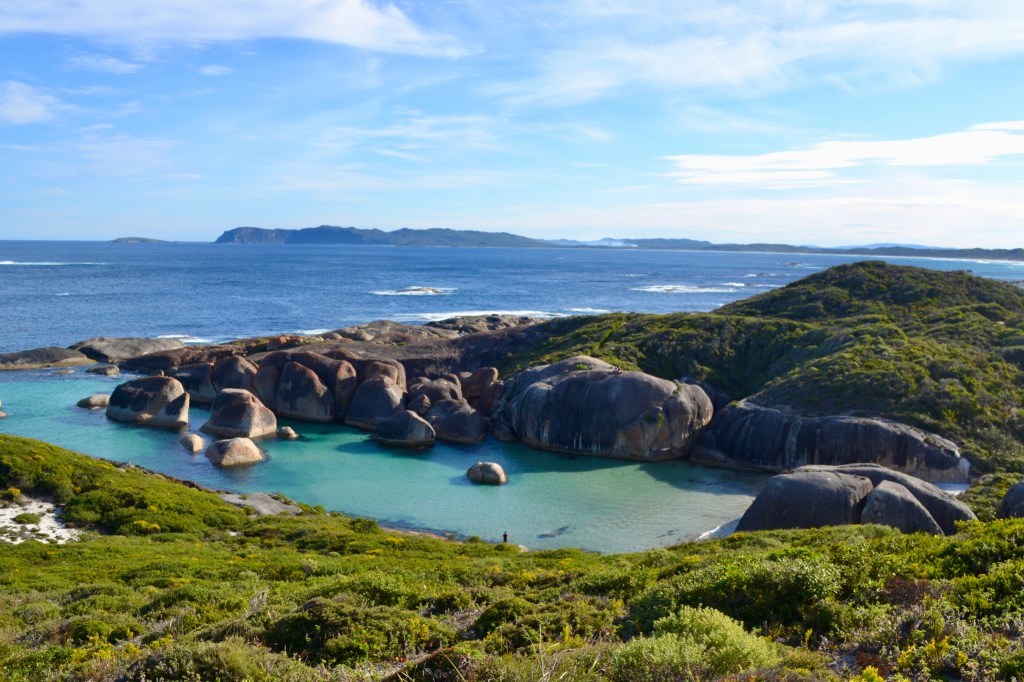
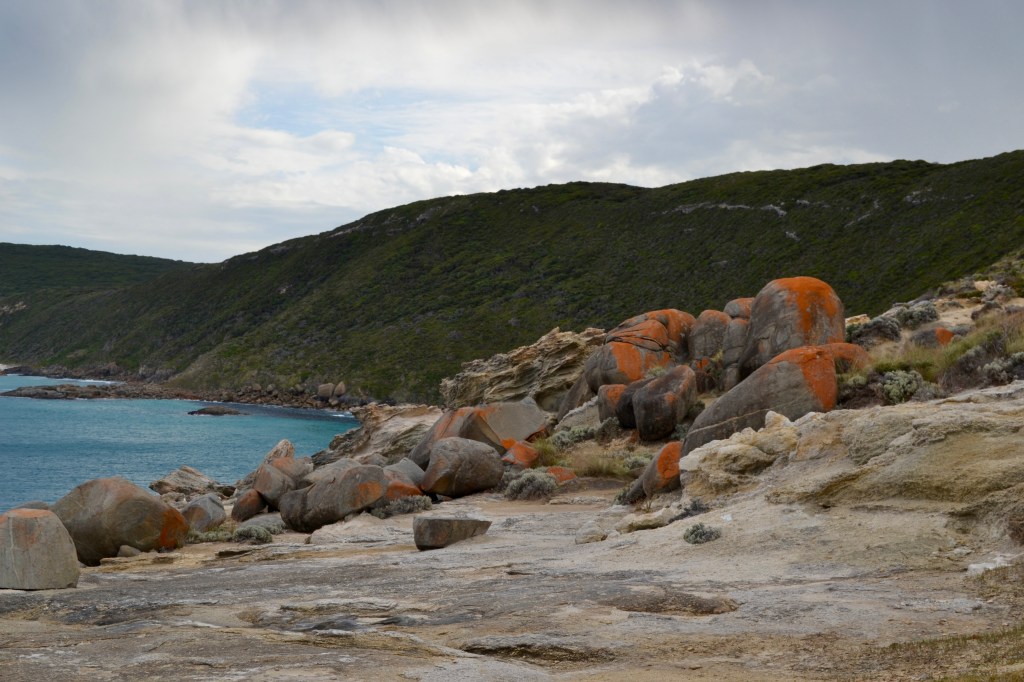
Moving on we arrive at William Bay National Park.  There are several walks from the car parks, one being to Elephant Beach. Walking toward the viewpoint on a sandy track is hard on the legs but eventually you get to a lookout where you can see the massive rocks huddled together looking like the rumps of several elephants standing side by side. Further investigating found a large expanse of rock to climb over and wooden steps leading down to crevices hiding a beautiful beach with turquoise coloured water. By this time my legs were objecting furiously so while I sat and admired the view on a bench, Ken wandered up and over the surrounding grassy hillsides searching for better photo angles of the beach and the rocks.  Although he found what he wanted I think his legs were burning on the return trip. A couple of hectic hours, finding accommodation and groceries and our heads had no trouble finding the pillows that night.

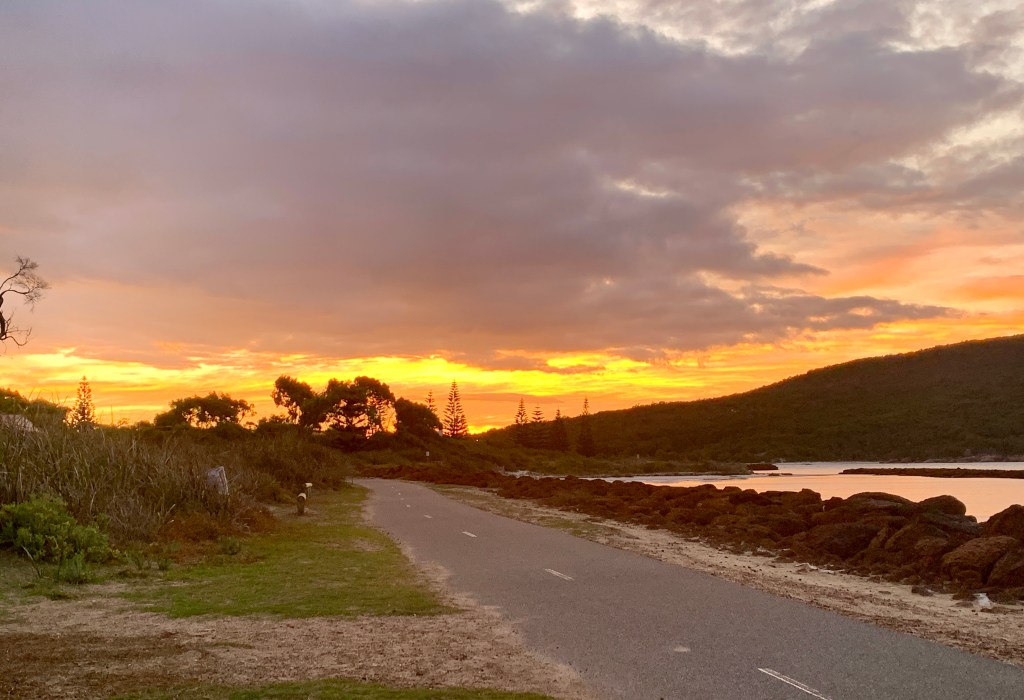
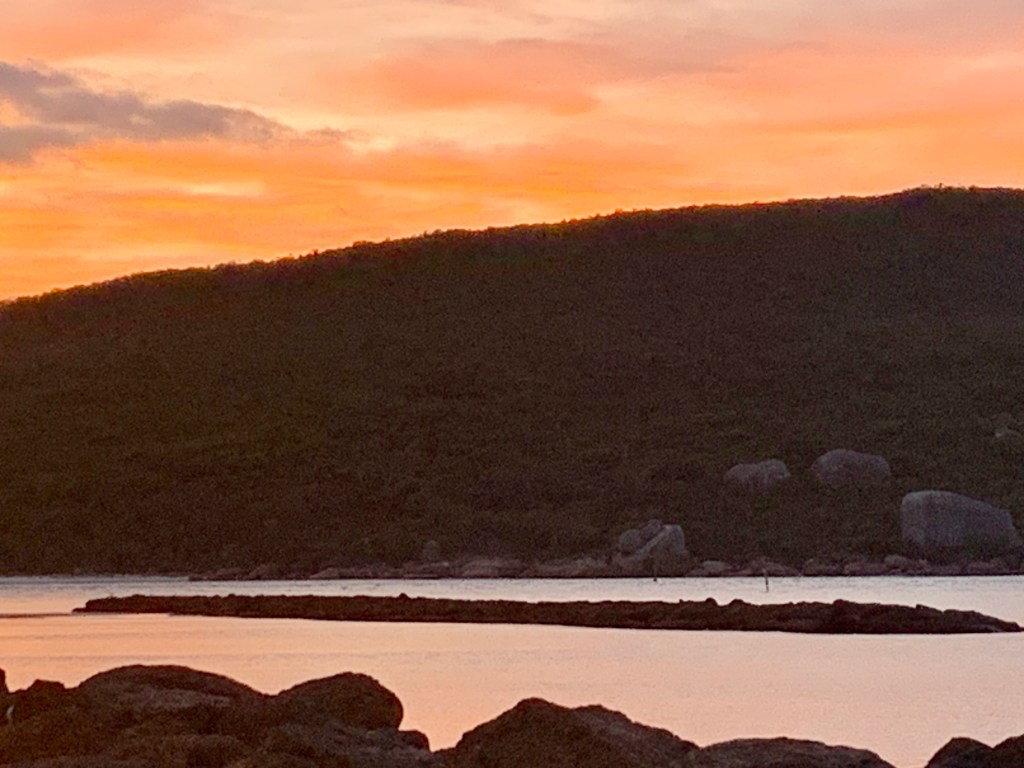
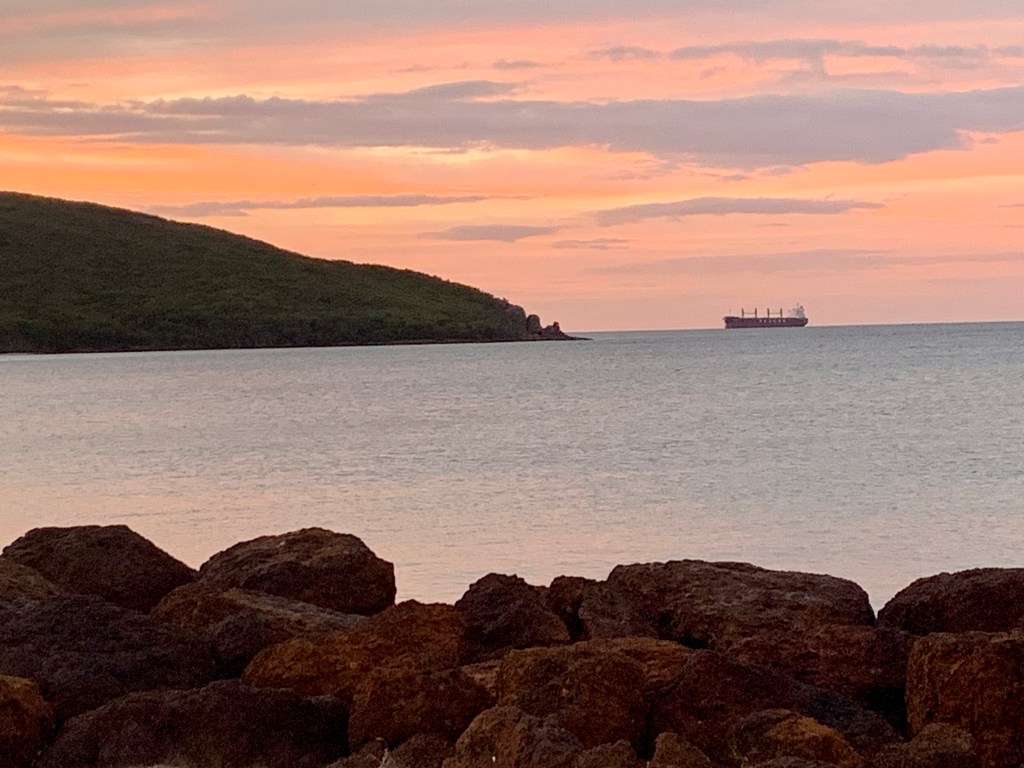
The next morning, I woke at 6.00am.  Sneaking a look out the window of the camper I saw the sun starting to rise. I quickly dressed and walked across to the beach front and sat on the bench to watch the skyline change its colours as the sun’s rays hit the ocean and the surrounding landscape. Several people jogged and walked past on their daily ritual, other than that the world was still and calm. With yellow, pink, crimson tones shining through the clouds it was spectacular way to start the day.

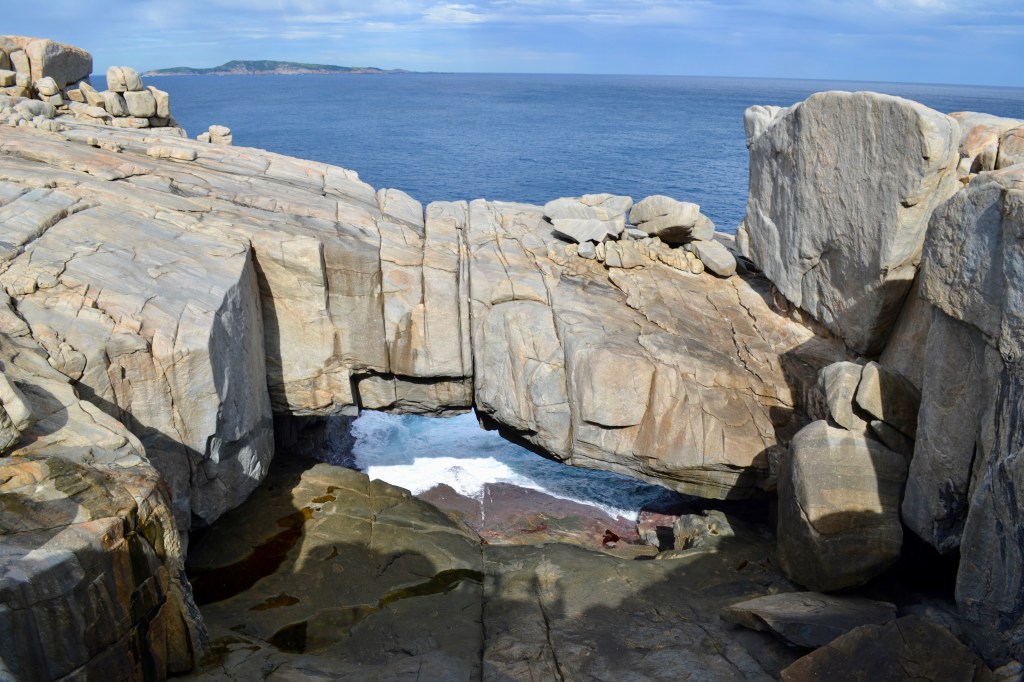
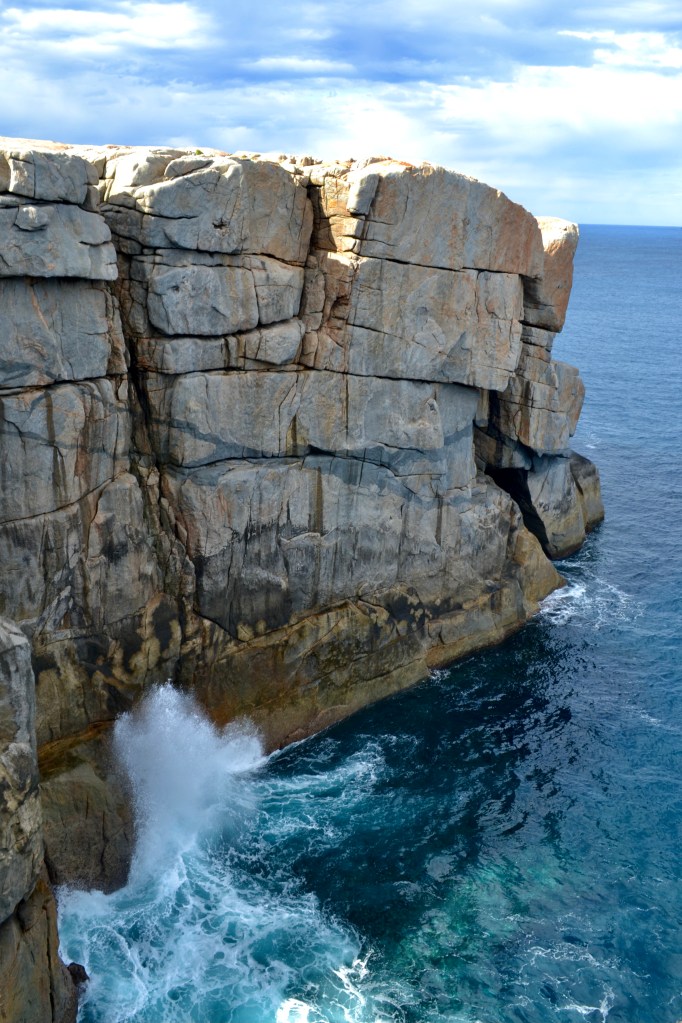
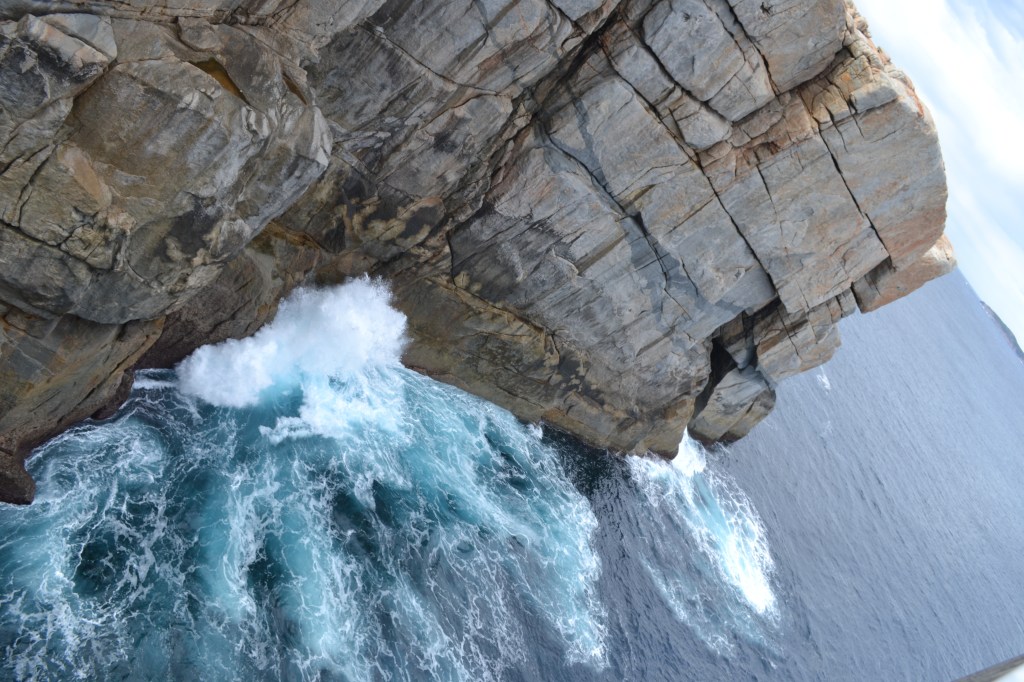
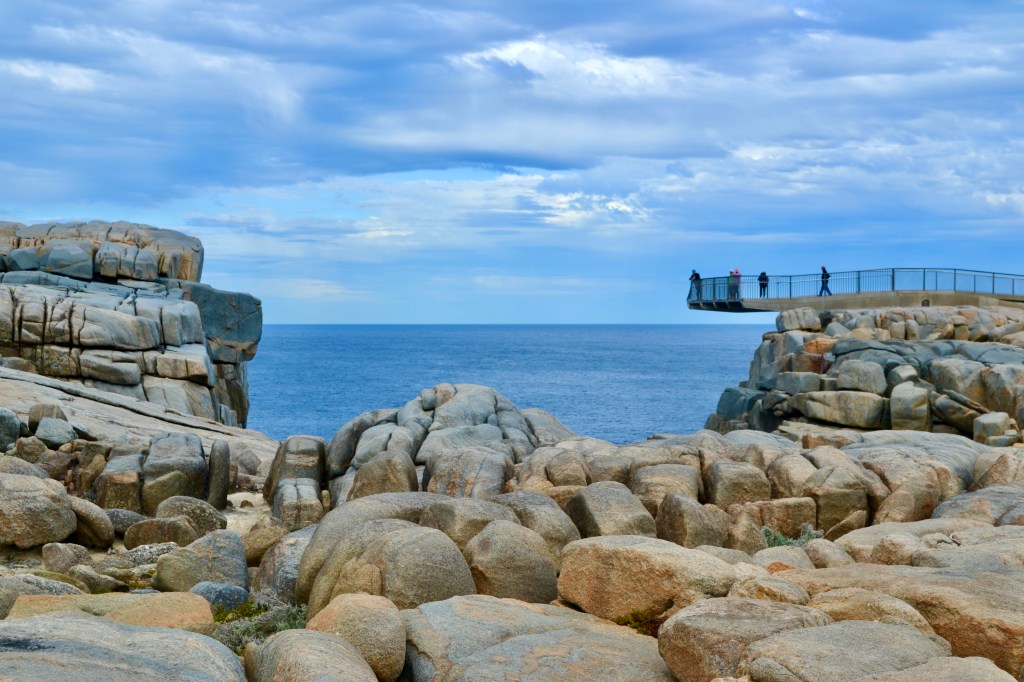
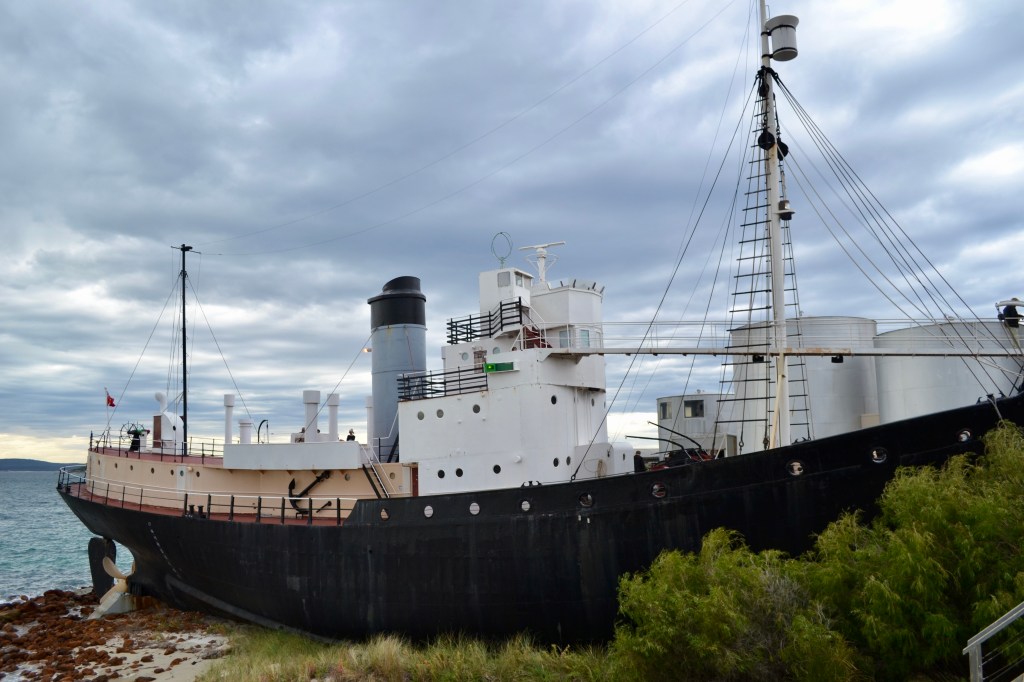
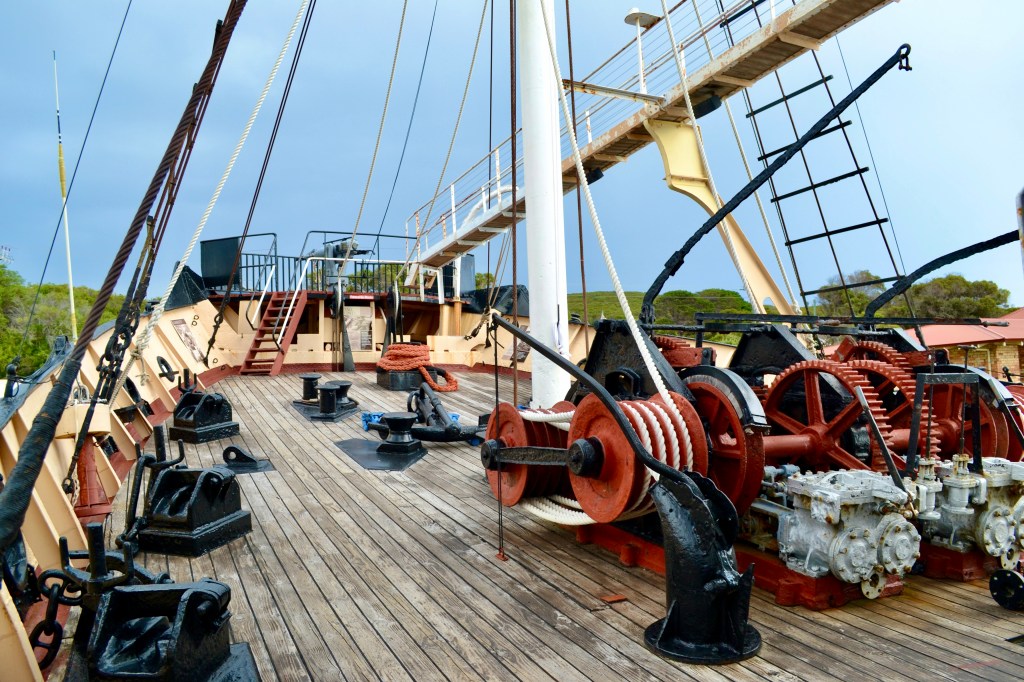
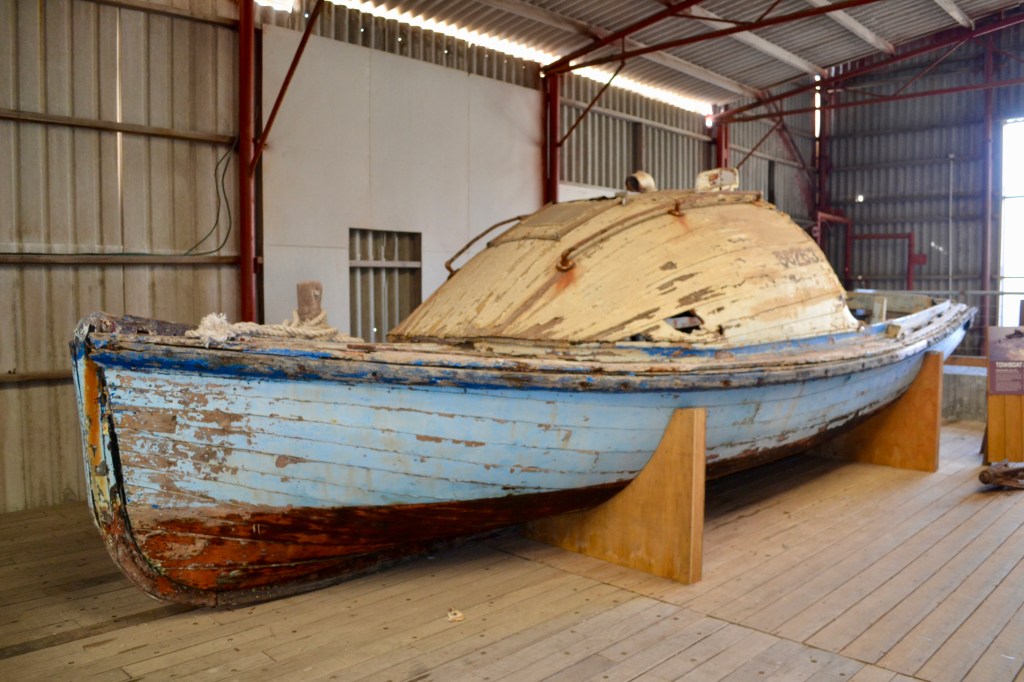
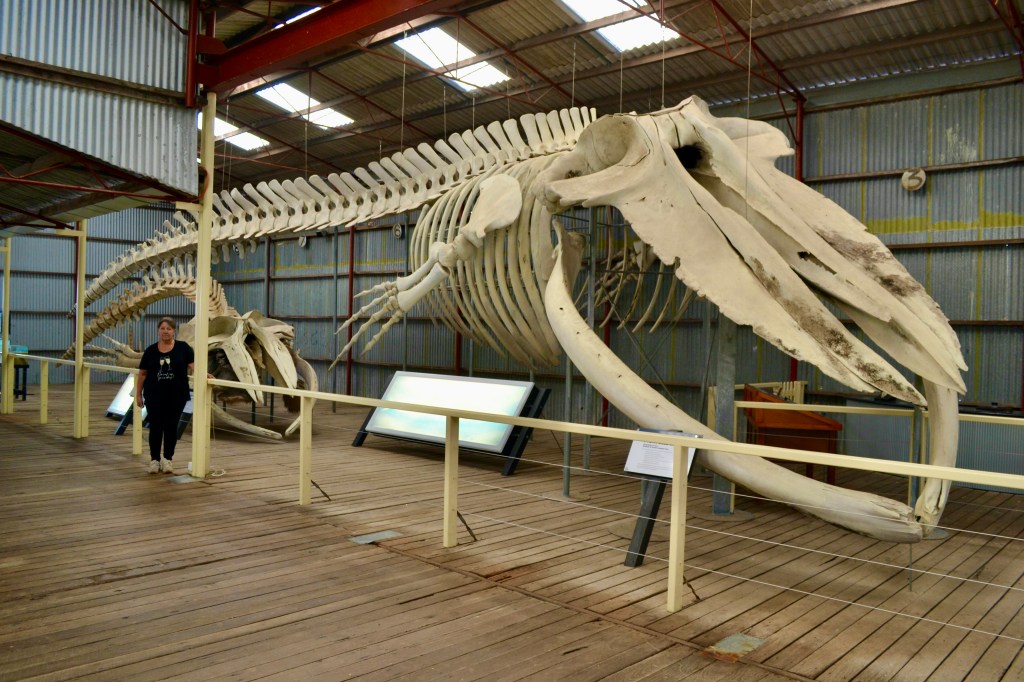
Another breakfast and the excitement started again. Today we are heading to the other side of Albany to visit Torndirrup National Park. Our first stop The Gap. Once again, the car park and walkways are well maintained and easy to navigate. The platform reaches out and over the surging waters below. The waves crash upon the 40-metre-high granite walls spraying water up the sides never to reach the top. Looking out at the walls you see what looks like huge building blocks sitting on top of each other, threatening to crash into the sea below. You wonder how they do not fall. Just opposite the pathway leads to another viewing platform. Here the waves have slowly eroded the granite over millions of years. Boulders have collapsed creating a bridge over the ocean. Again, another marvel that makes you wonder how long it has been there and how long it will remain. Next, we took the 1.6 return walk to see The Blowhole.  We were out of luck this time, but the view was lovely. The walk was hard as it was steep going down and of course felt steeper coming back up. We were lucky enough to hear and see a group of five Carnaby’s black cockatoos in the bushes on the side of the path and the views of Bald Head and the Great Southern Ocean. We headed back to Albany trying to decide whether to rest at the trailer for the afternoon or look for something else to see. After driving a little in the town, we came across the Whaling station. We were in two minds about going as morally it did seem wrong in some way. We stopped for lunch at their café and made our decision. So pleased we did as the whole experience was interesting and informative.  The first thing to explore is the Cheynes IV ship. The whole ship is open right  down to the bowels. There is a lot of information available, and you are then able to go through the surrounding factories. There are interactive displays, lots of pictures and stories of the whalers and their families. The demise of the station took its toll on many people who even though one does not agree with the killing of the whales it is sad to see the result of closing the process. What did surprise us was the huge sperm whale skeleton in one of the factory areas. Standing up close you feel insignificant against the mass of the bone skeleton.

I must mention here the slackness of two teachers who were obviously on a field trip with a dozen or so young students aged approx. 6 to 12yrs. We were there for a few hours and on many occasions saw the children running wild, both over the ship and around the grounds and factory areas. There was little if no supervision from the teachers and certainly no control over whereabouts of the children at any given time. I would hate to think this was a regular occurrence on field trips. It was very disappointing, and I doubt the students learnt anything that day.

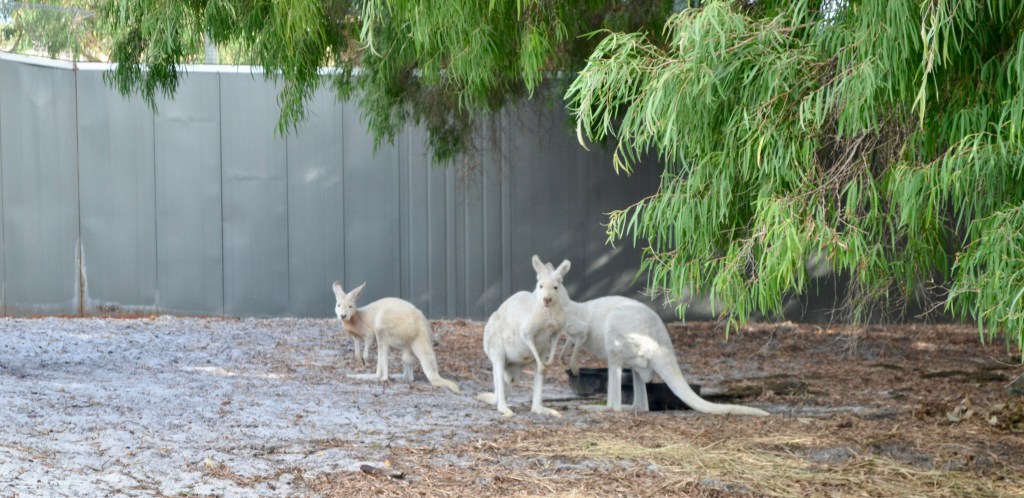
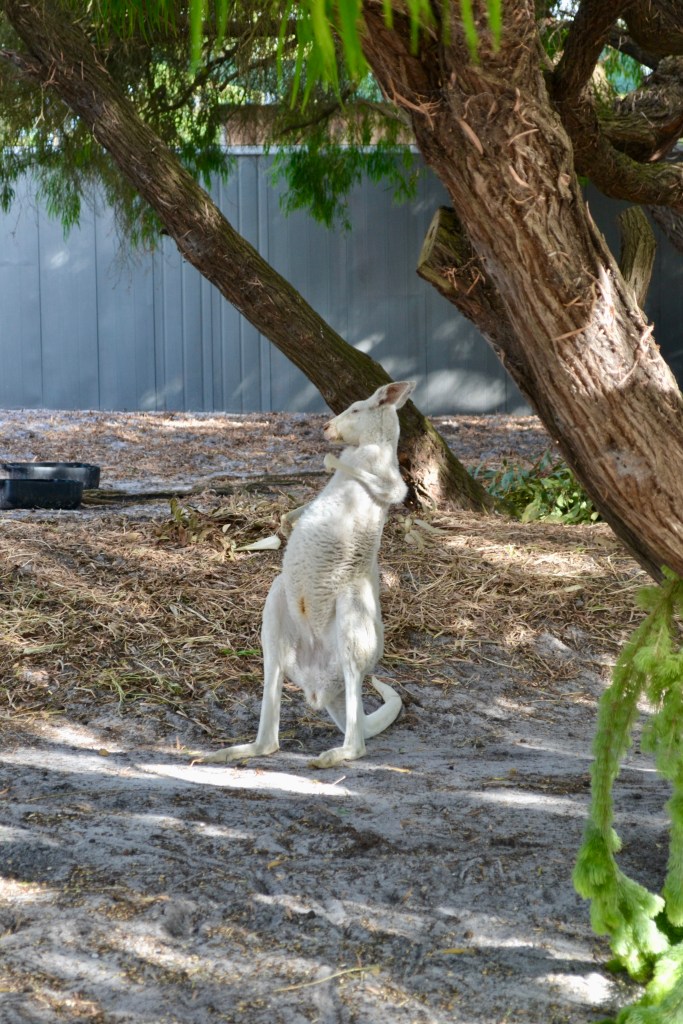
We left the station and wandered up to the small animal zoo attached. I read that the zoo is maintained by one lady. Although small it would be a big job for one to do alone.  The first encounter has four white kangaroos. In this case not albinism but leucism, a fault in the pigment cells which causes the fur to be white but usually the skin and eyes are not affected. Really quite stunning to see them. There were also other kangaroos, wombats, possums, birds, and other Australian animals. A short but nice visit and a good end to the day.  We were again exhausted and headed back to our trailer for an early night.
The next day we were heading inland to see some much-awaited landmarks. You will have to watch for the final part 5 edition find out where and find out about our escapades on our way home.  
Western Australia Part 2

Prt 2 WA-Cocklebiddy-Exmouth Including Eclipse

In Part 1 we had called into the roadhouse at Cocklebiddy,  before leaving I felt compelled to ask the shopkeeper if the population of eight shown on the sign was genuine, she assured me it was and quickly rattled off their names one by one. She added that occasionally there was more in busy times, The 8 residents all worked and resided at the roadhouse. Lovely friendly people who said it was difficult to survive sometimes. Covid nearly killed them, but they just kept on going. True-spirited Aussies doing it tough.

We were in the last stretch of the Nullabor. With another 219 km driven, we pulled up at yet another roadhouse. Quite a lively place with a caravan park, motel, and petrol station.  Balladonia where we had been advised to check out the museum apparently centred around the Skylab crash in 1987.

The museum was neatly presented although only a tiny section of the somewhat small display was concentrated on the Skylab crash with a replica of a part of Skylab. Not exactly authentic but interesting. It’s a good rest stop and breaks the long drive, other than that we cannot be more generous about it. On the last stretch now to Norseman. This is probably the most tiring section being another 220kms and I have to say less interesting landscape than previously. So, the Nullarbor is done, and the anticipation is now gone. The sense of achievement is good and the realisation that it is not hard, not boring and in fact quite interesting. The rest of our trip will see us cover many more kilometres of long stretches which would easily challenge the degree of difficulty of the Nullarbor.

Leaving the Nullarbor, we are heading further into the outback to visit the mining areas on our way to Exmouth. The first stop is Kalgoorlie, nearly 200 km from Norseman WA. The road was good, but the landscape was very sparse all the way with very few signs of civilisation. Out of the blue, a sign for a café grabbed our attention. We turned left and drove a couple of kilometres to our amazement we came across a small town with every facility you could need,  Motels, a caravan park, Woolworths, a gym, and sports ground, etc.  I believe the town was Coolgardie, but we have no idea where the residents resided. Later in our trip, we realised there are a huge number of mines pretty much hidden all over the countryside and other than the odd fence sign you would not know they were there. Obviously, a lot of workers needed supplies, hence the town of Coolgardie.

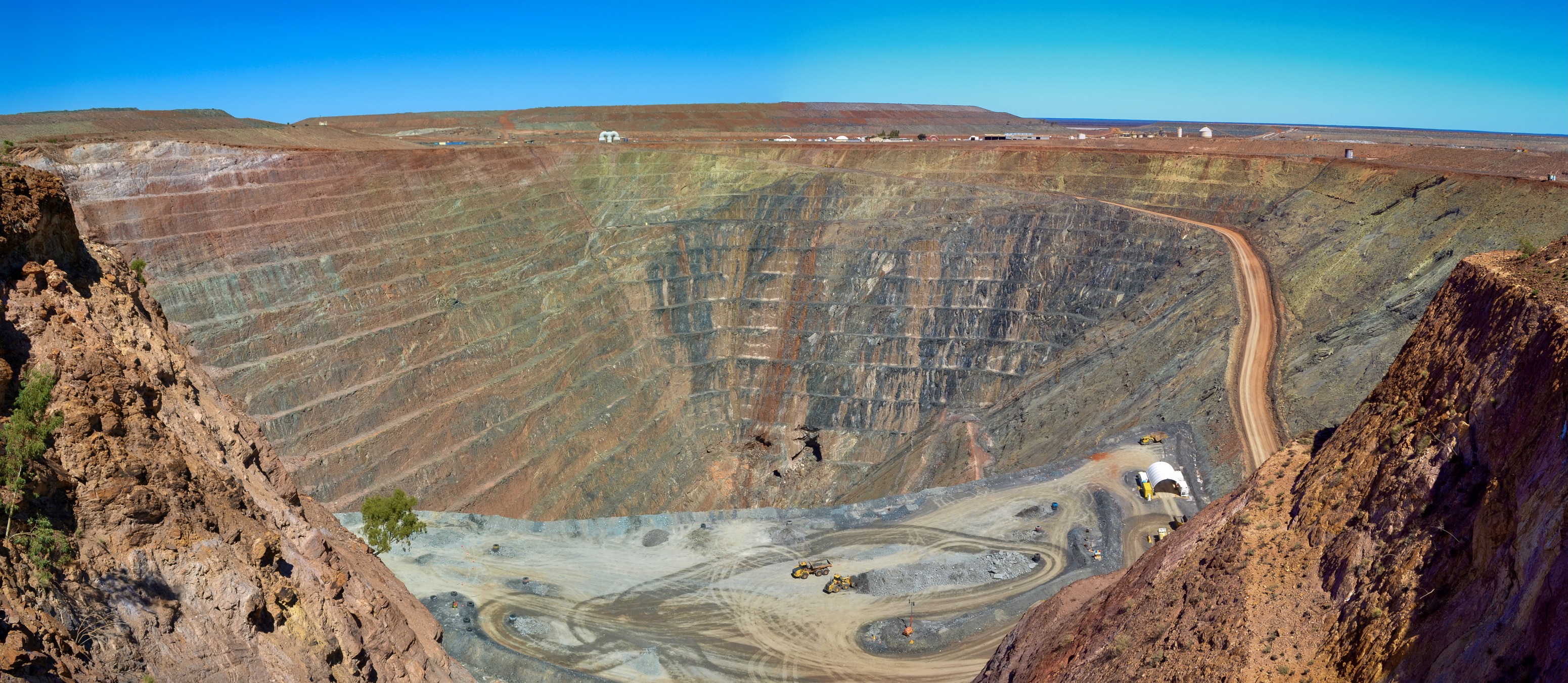
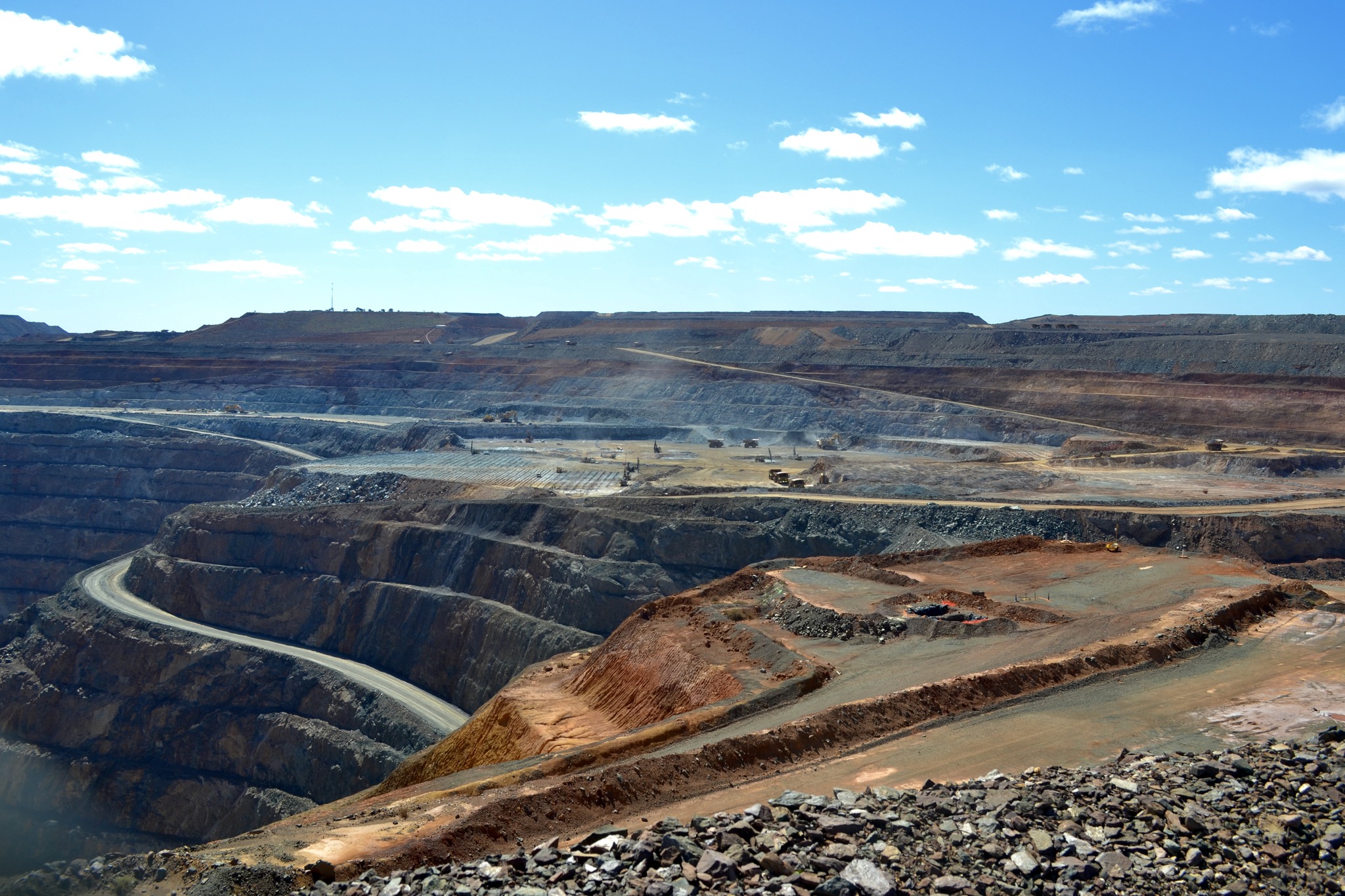
Next, we arrive at Boulder/Kalgoorlie. My first thoughts are it is a grubby town with lots of old equipment, old buildings, and disjointed infrastructure. Pretty much what we expected. We immediately came across the road to the Super Pit. It was blowing a gale at the top of the hill but thankfully there is a large, covered area over the information boards and a fantastic viewing platform that looks over the mine. Taken from one of the boards:- “In June 1893, Paddy Hannan, Thomas Flanagan, and Dan Shea found nearly 100 ounces of gold in the dry red soil of what is now Kalgoorlie-Boulder. This sparked a gold rush and the discovery of the area known as the Golden Mile, which is one of the richest gold deposits in the world. By 1903 there were 49 operating mines, 100 headframes and more than 3,000 km of underground workings on the Golden Mile.”

Looking through the window you are faced with a  huge deep cavernous hole with walls layered in varying gold, red, grey, and brown layers of colour. Dotted with yellow trucks together with red and yellow hard hats, you could be forgiven for thinking you were in Leggoland with model trucks using makeshift roads to move the endless piles of potential gold from one layer to the next. Surreal and yet an actual working masterpiece. After checking out some of the older buildings in the town we stocked up on fuel and groceries. I have to say there was a large contingency of Aboriginals congregating around the local community centre and shopping centre who were becoming quite boisterous we did hasten our steps a little.

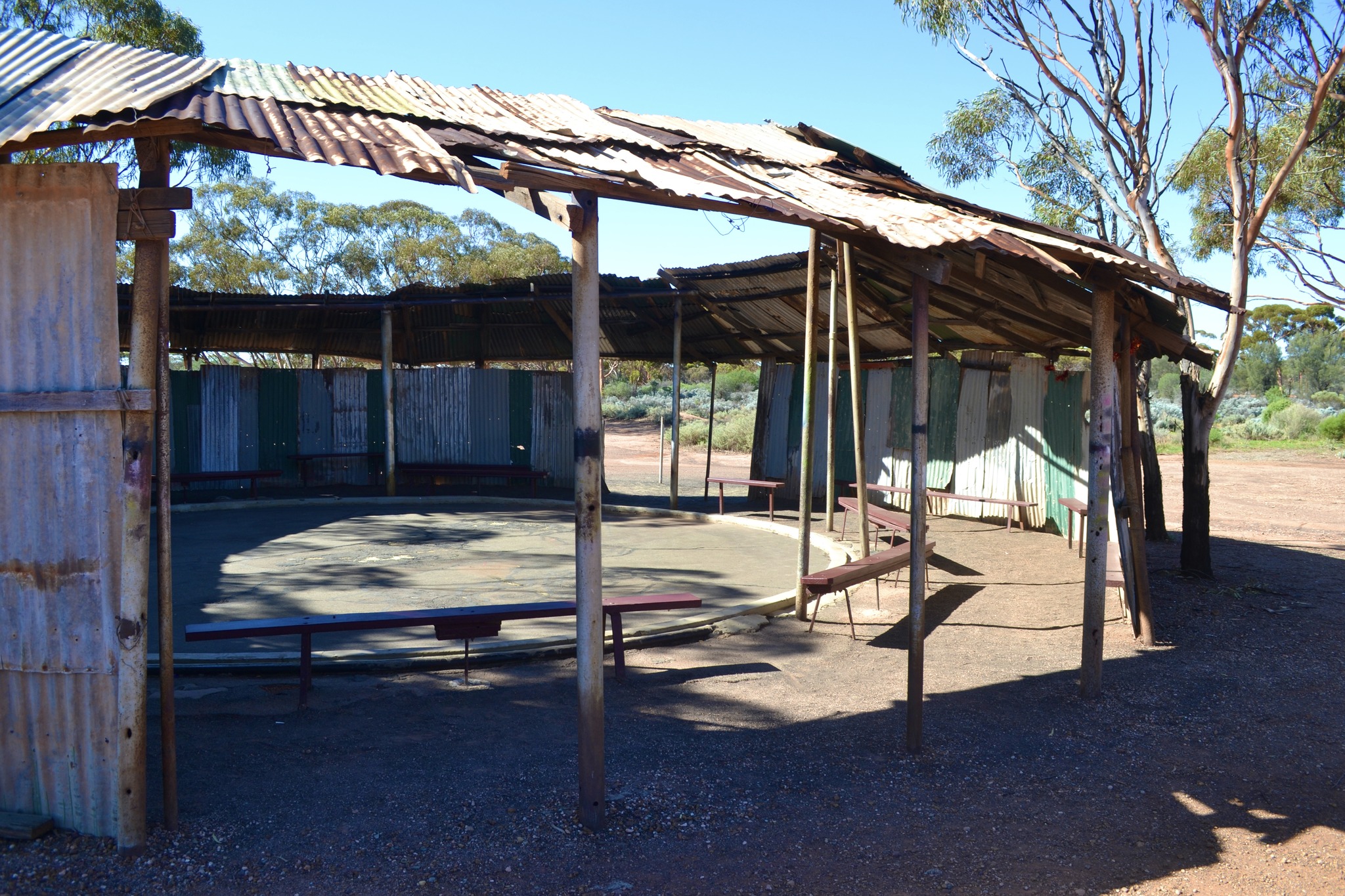
As we were moving into more remote places, we decided a map of WA was a good idea. The mobile had been good to date, but when there is no reception and many km of road seemingly going nowhere a printed map is vital. Popping into the Information centre, I had a chat with the local expert and found out about a couple of interesting sights to visit as we continued along this Golden Mile. Approximately 8 km out of town we pulled onto a dirt road and drove a couple of km when we came across a very large circular tin structure. Two large openings and bench seating following the curve of the shed led our imagination to a very verbal and boisterous game of two-up. I believe considerable dollars had changed hands here on many occasions. To the right was a dilapidated tin lean too with a painted sign “Mens” and further over another sort of structure which we believed to be the ladies although not marked as such.  The interesting part is knowing that this dusty piece of land was still being frequented every Sunday in the present day. I can only imagine the value of the cash passing hands today.

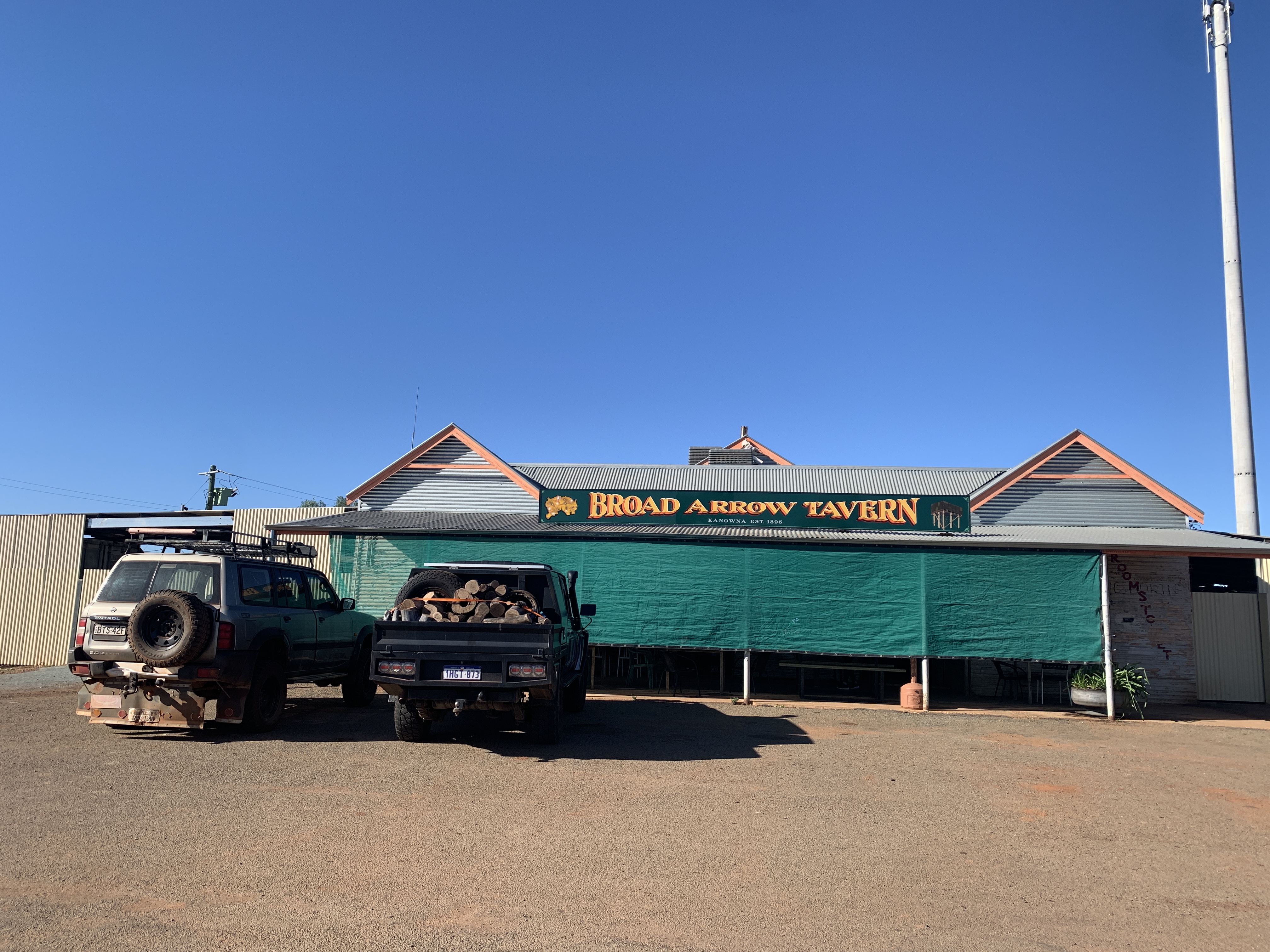
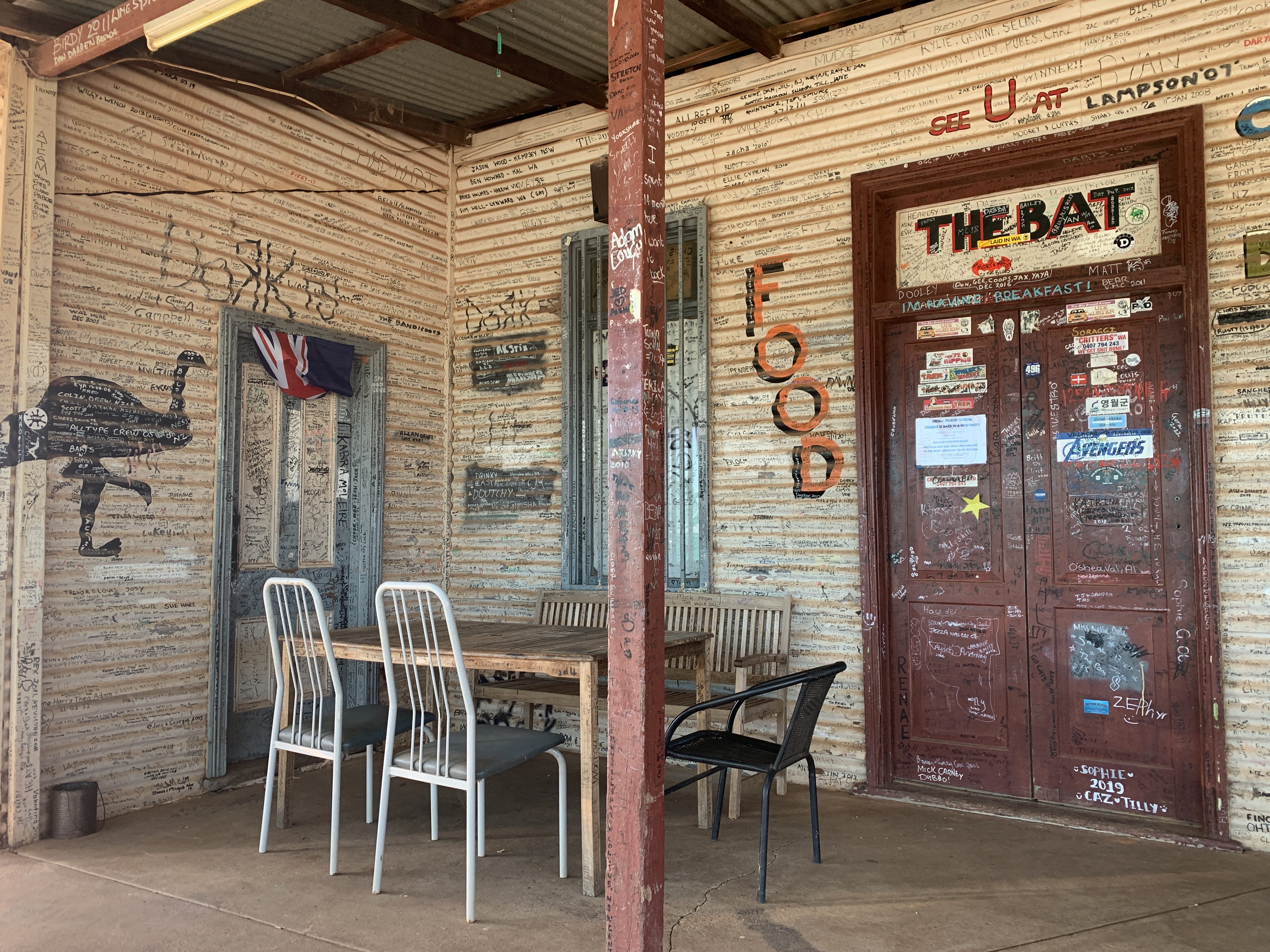
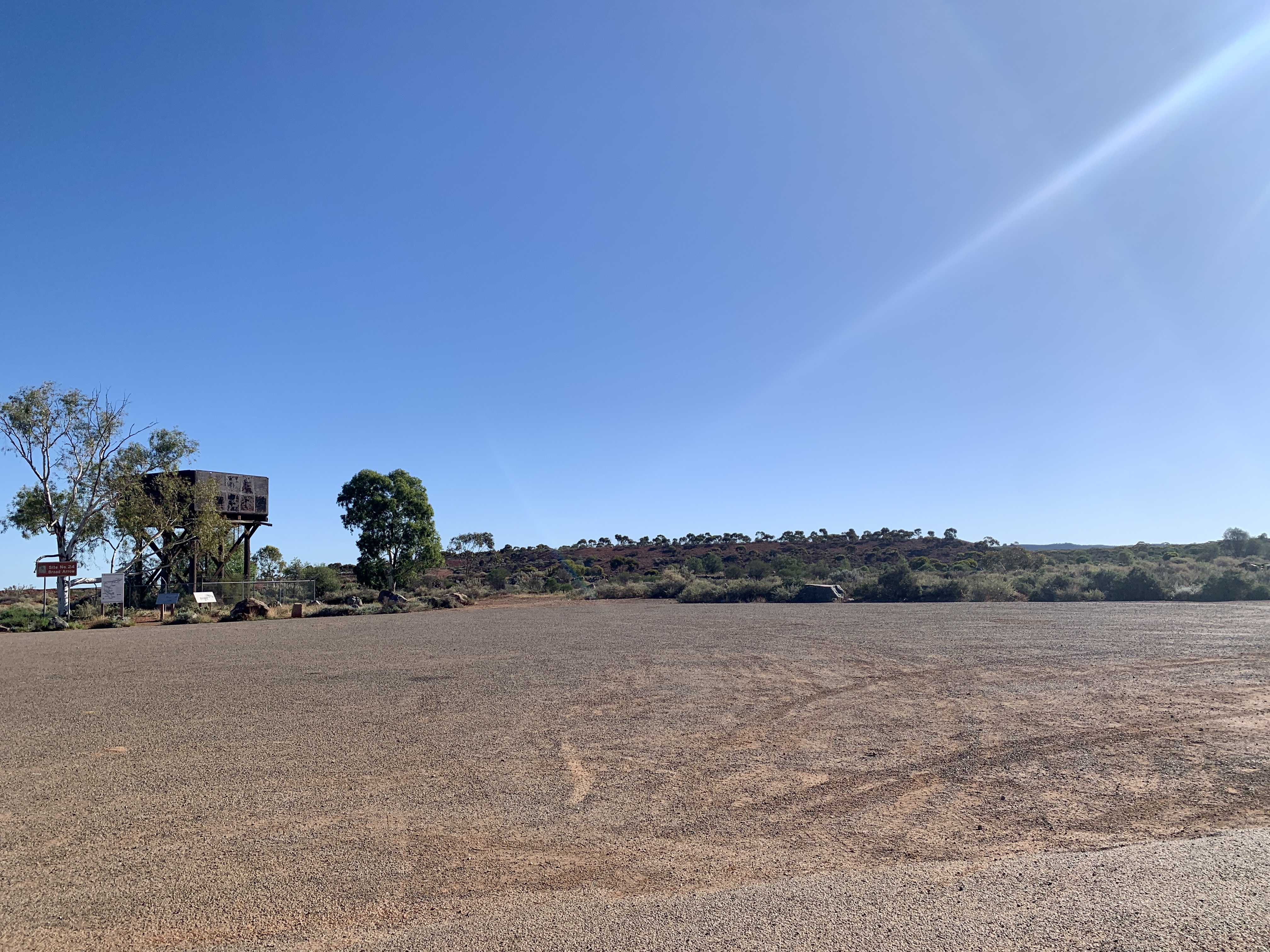
A little while later we turned off the highway at Broad Arrow to visit the local tavern. Nothing much there but a whole lot of evidence of who had been there. The beer was cold, and the locals came and went. Both the inside and the outside walls were totally covered in scribbled names and messages. Not a patch left bare that I could see. Such an intriguing establishment. The stories that must have been told on those bar stools would surely be worth hearing.

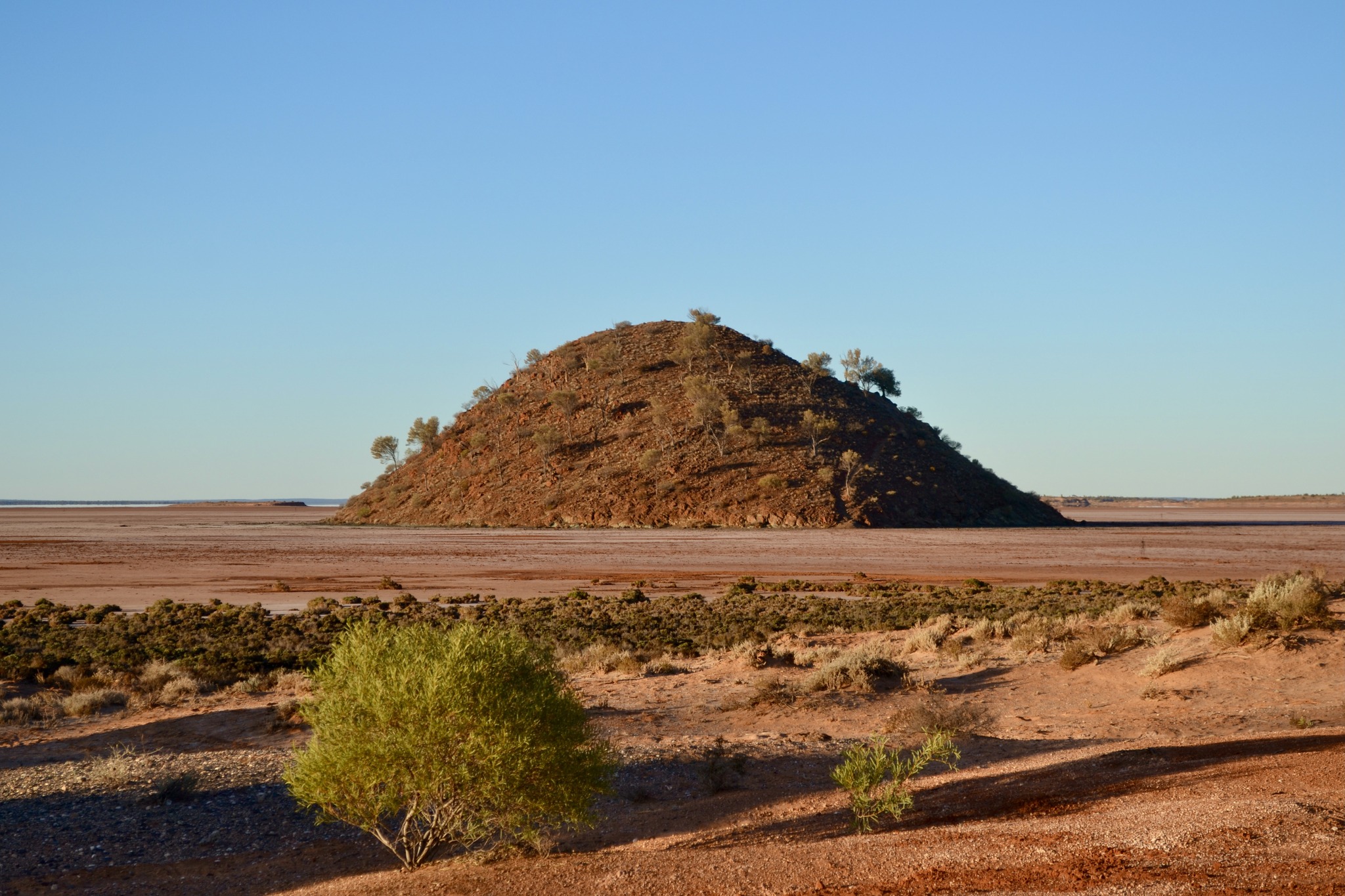
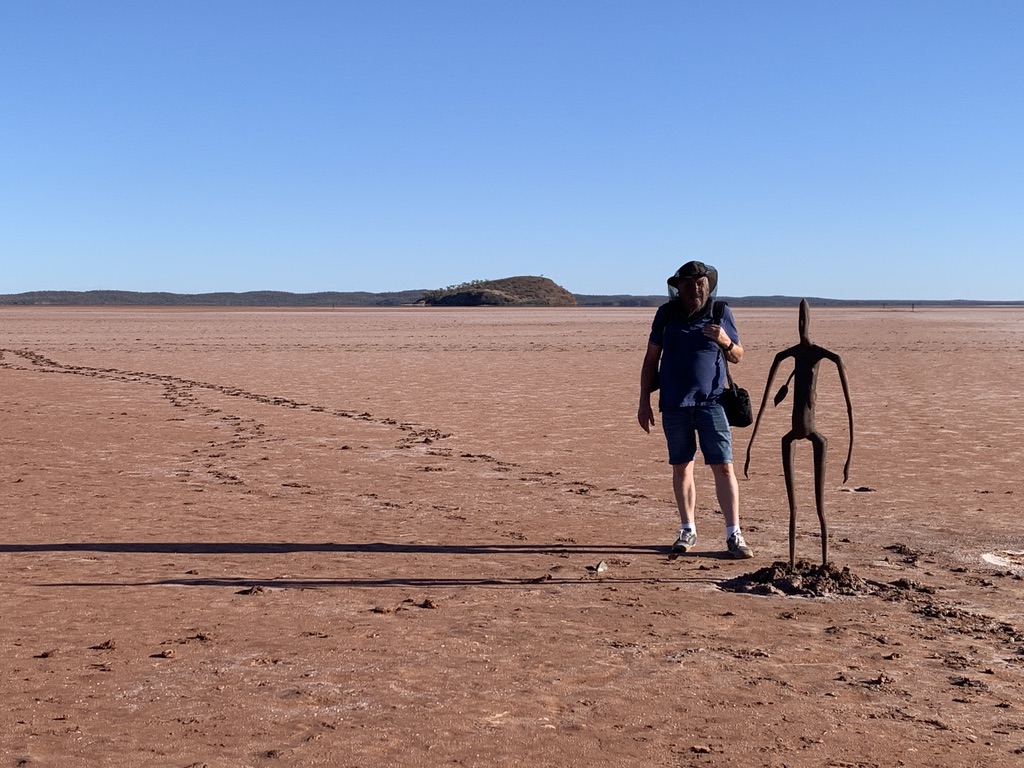
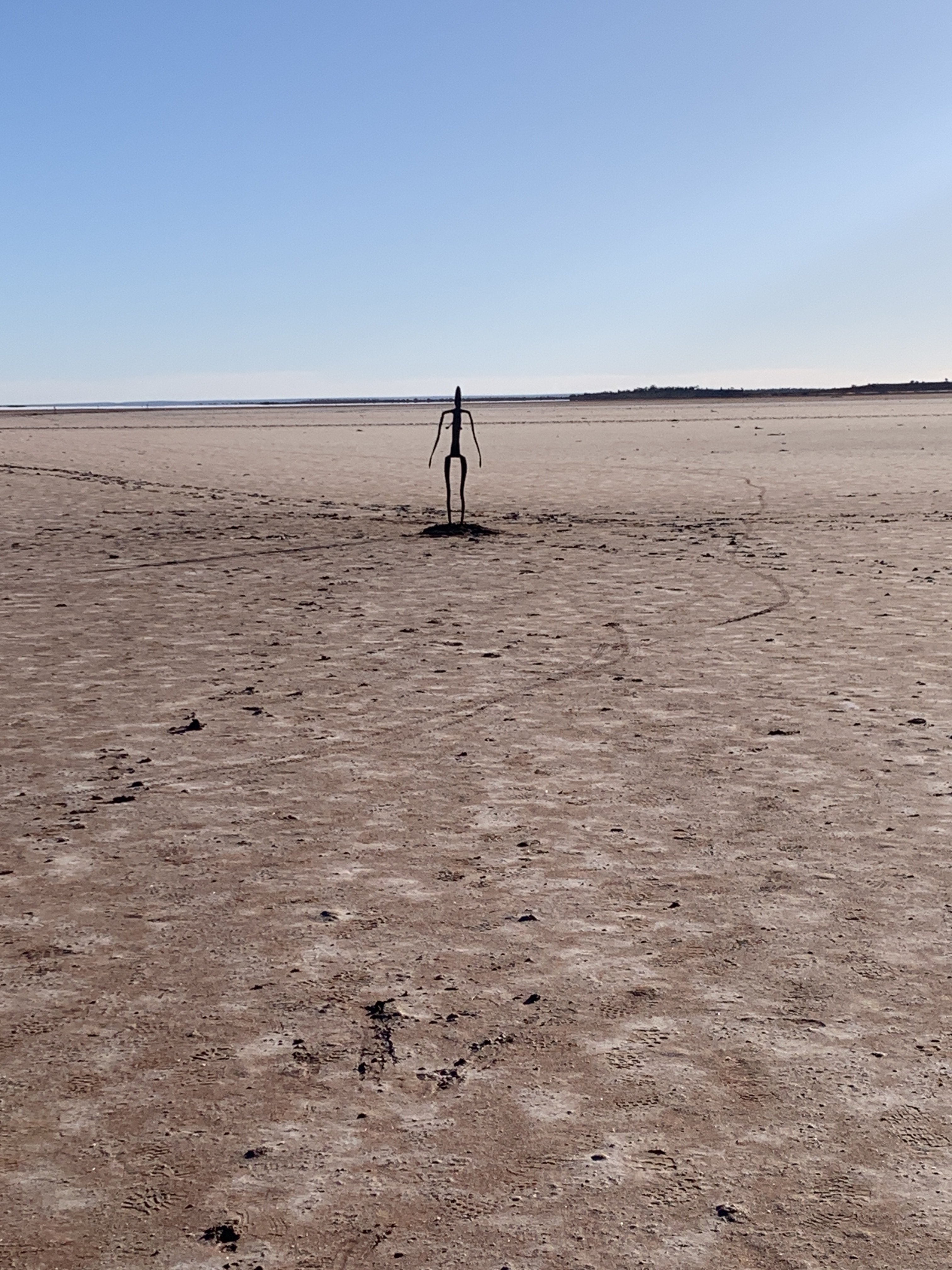
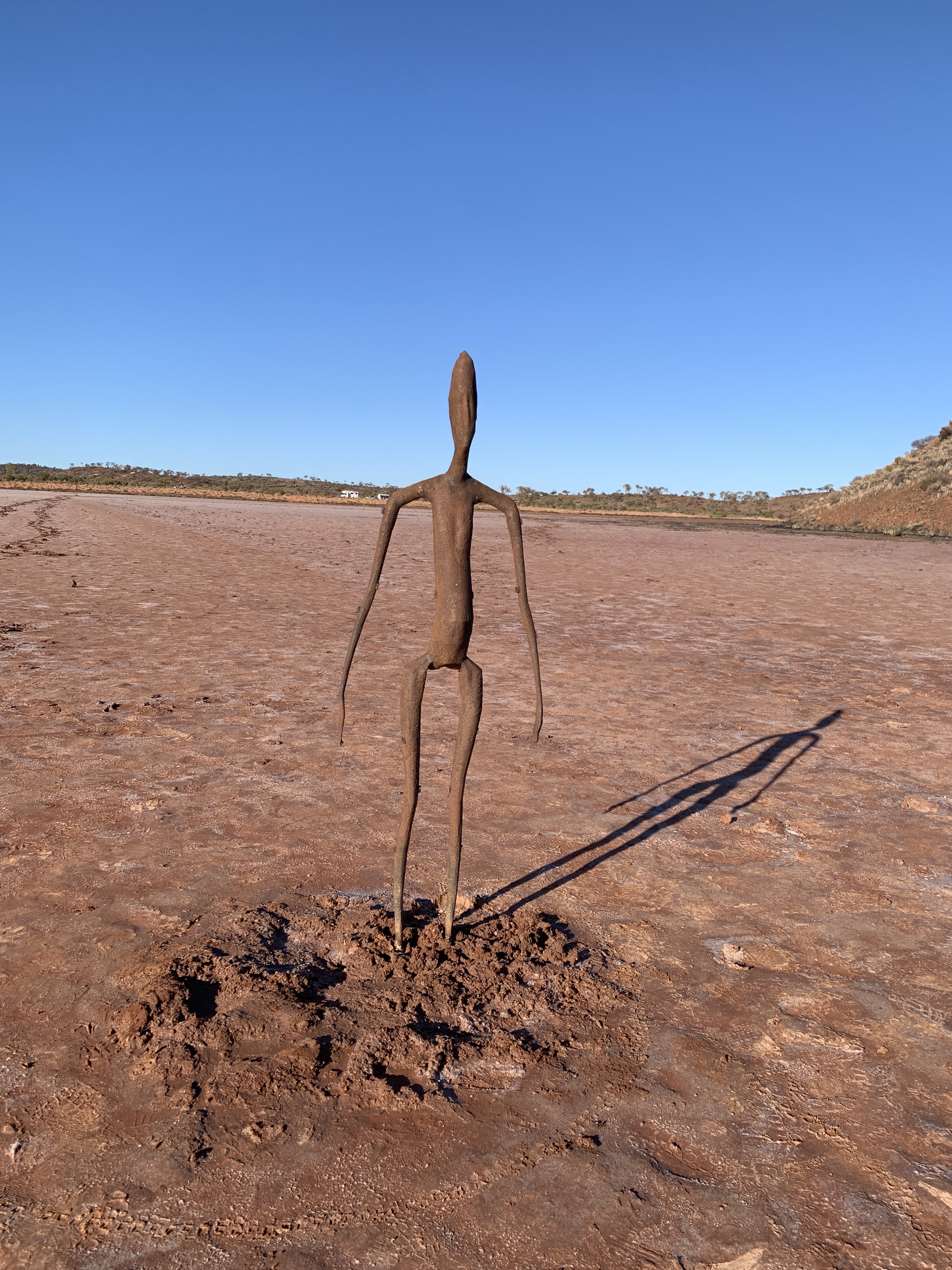
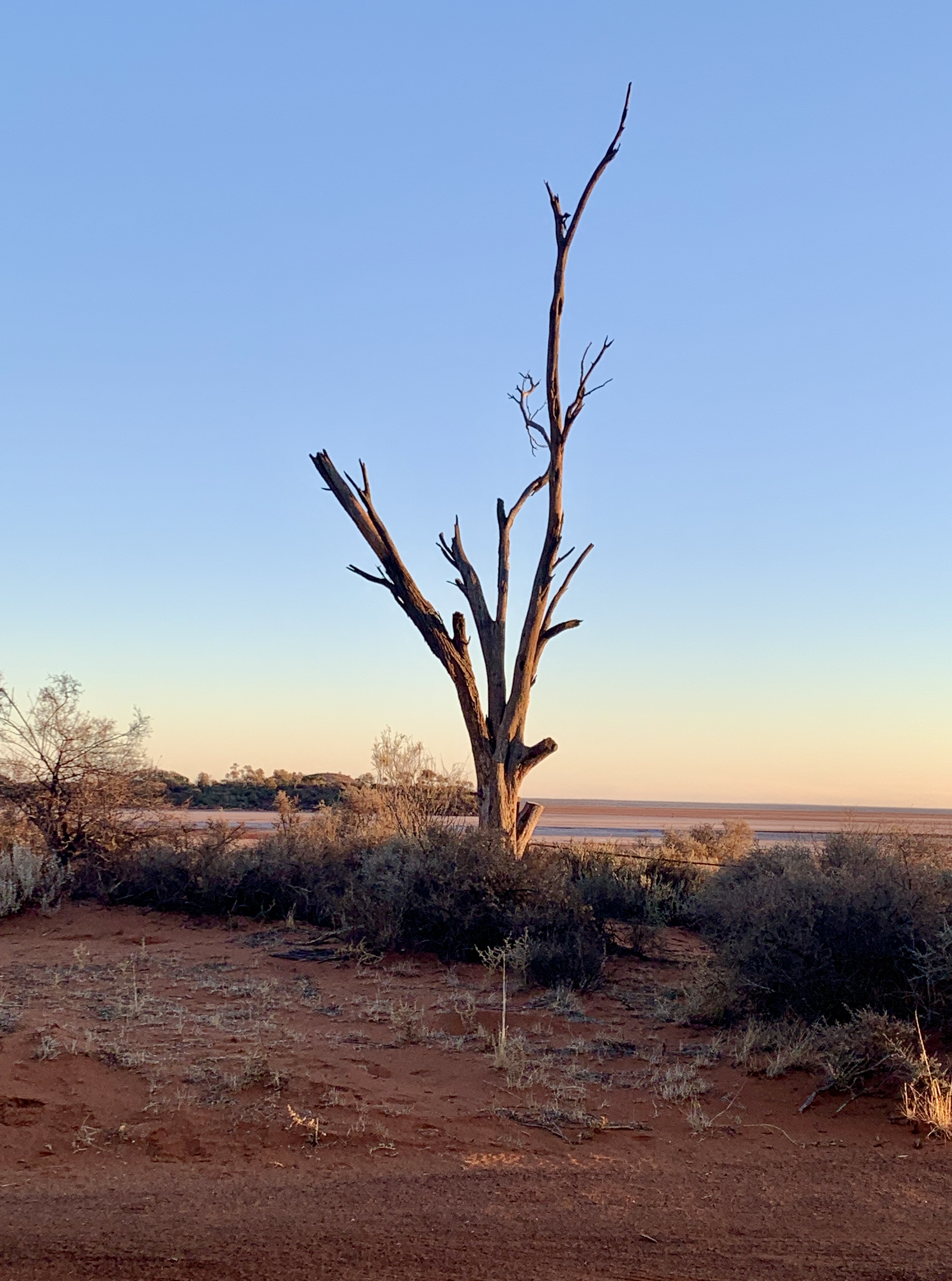
Menzies is another tiny town, and we were only passing through on our way to see the sculptures on Lake Ballard. It was late afternoon when we arrived but just enough time to check out a couple of the 51 iron sculptures placed all over the 7 square kilometres of this vast Salt Lake. Absolutely fascinating concept. If the rain had fallen it would have been a red muddy and unpleasant walk, but we were in luck it was dry and hard and therefore easy to navigate. Free camping is allowed, with drop toilets available. The night was pitch black with the stars shining brightly. There was absolute silence even though there were several caravans and campers scattered around. The next morning, we woke to a clear day, and an eagerness to explore. Antony Gormley was the British artist responsible for the stark black steel family of sculptures. Apparently, each one represents previous residents of the town of Menzies. They are all a little different, men, women, and children each now connected by the millions of footprints in the red salty ground.  What also makes It interesting is the out-of-place conical-shaped hill that seems to rise out of the dry Salt Lake. Covered in scrub and rocks it was quite a scramble to the top which I did attempt but gave up very quickly. Ken managed to climb up about ¾ of the way but the continuance of little avalanches of rocks deterred him from reaching the summit.

Another pleasant sight was a young boy on a bicycle having a lot of fun riding on the Salt Lake and a large brown dog expelling a lot of energy running endlessly over the dry lake.

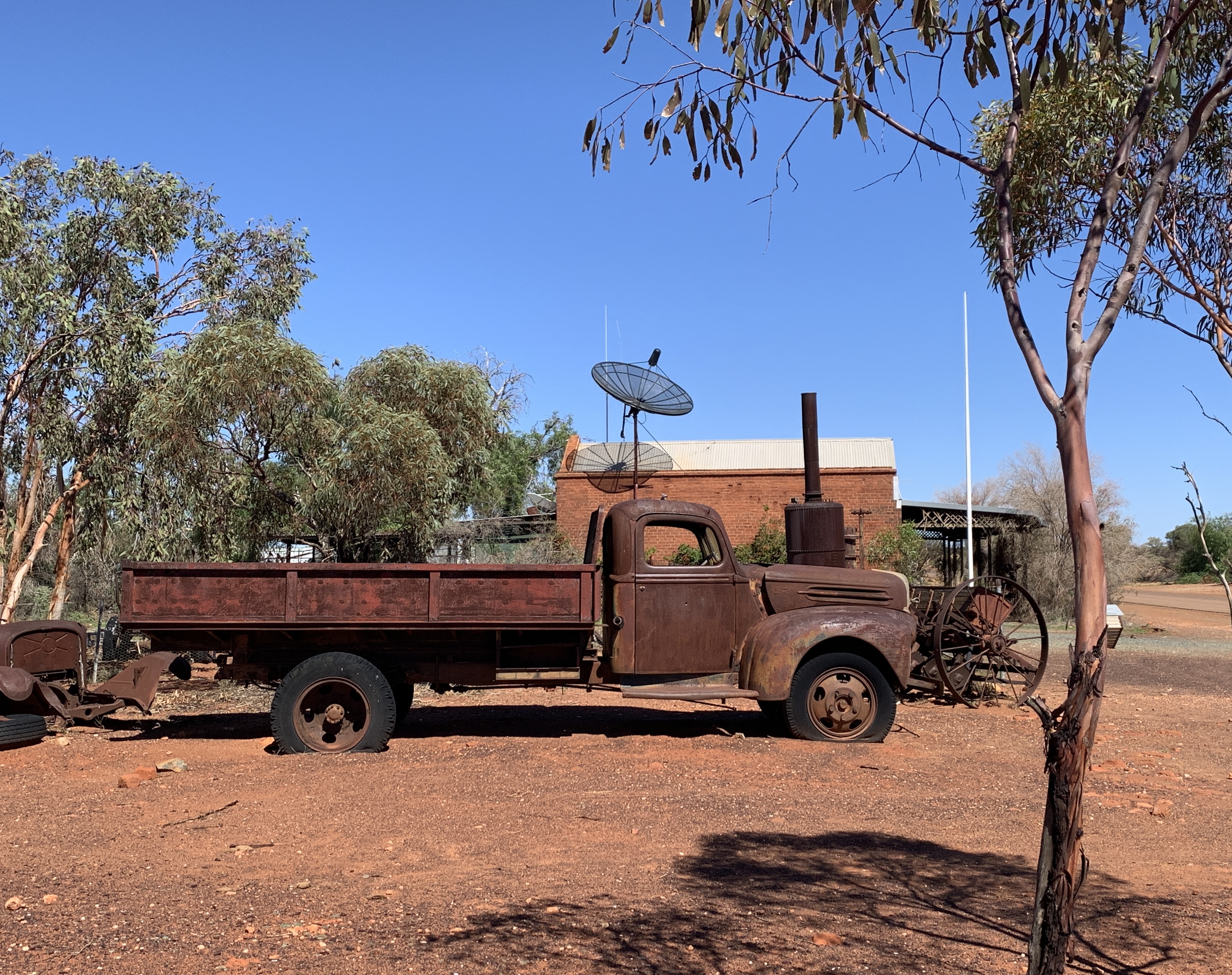
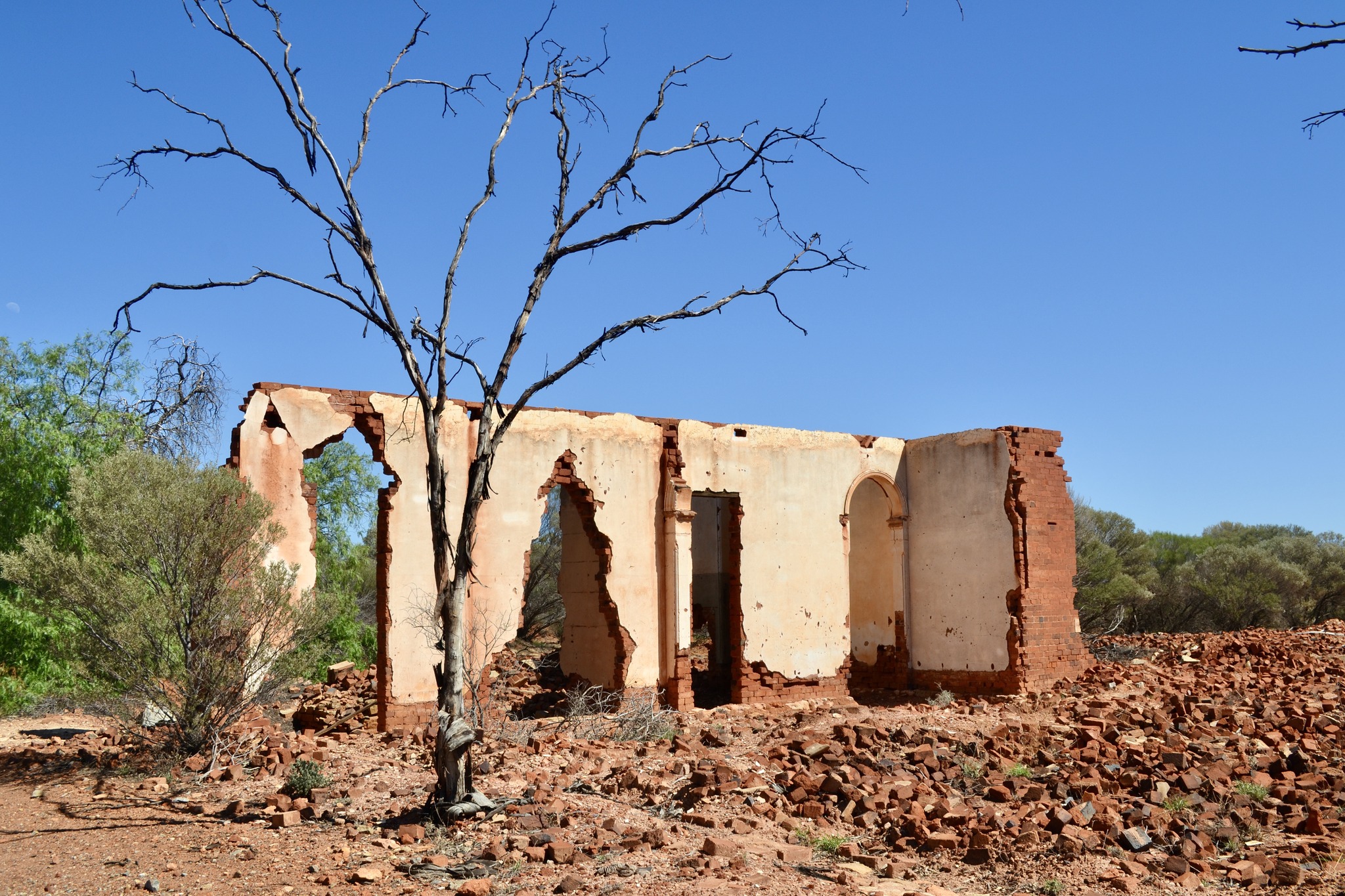
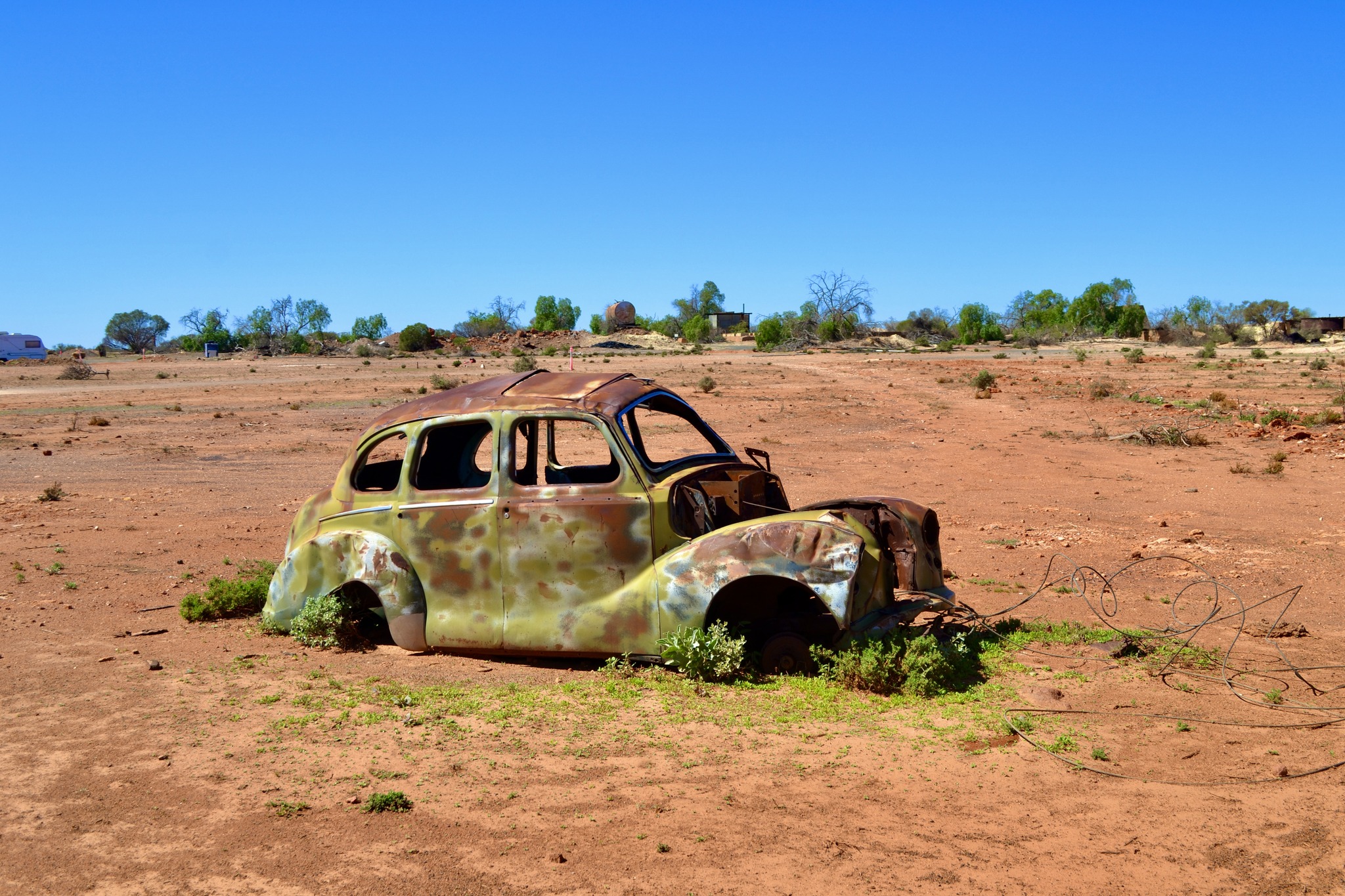
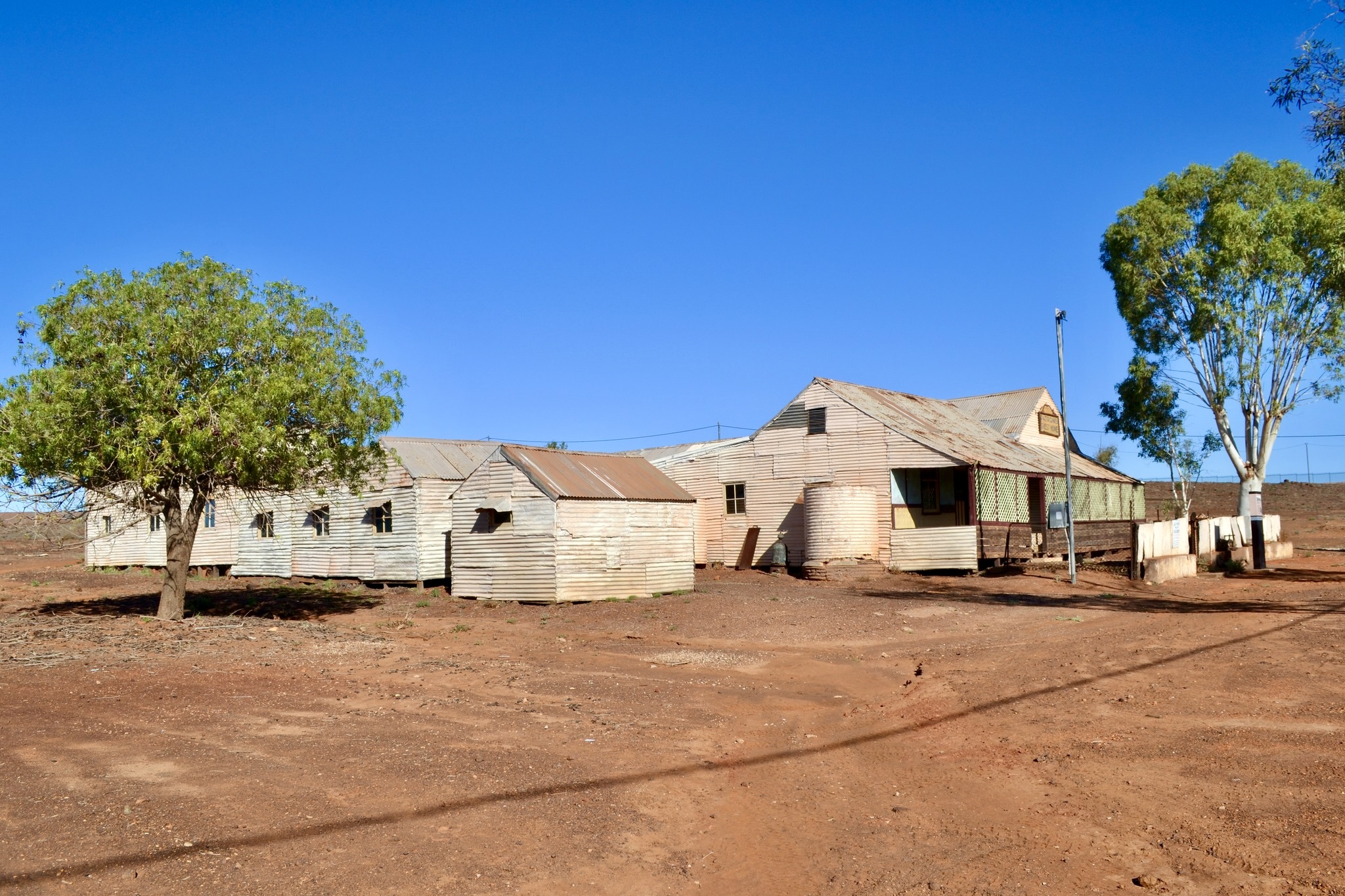
After returning to Menzies our next stop was Kookynie town. It has been labelled a ghost town but the fact that 20 people still lived there refutes that fact.  It was quite a way off the highway and a little disappointing once we arrived. History depicts a flourishing and vibrant working town and certainly, you can see the remnants of that, but many of the buildings have fallen apart and replaced with information boards. There are some brilliant rusted-out vehicles together with plant and machinery. The brochures indicate the town is growing and I hope for their sake this is correct however I do doubt its prospects. A drive out to the Niagara Dam surprised us by actually having water in it, to date we had seen a lot of dry water holes. It was quite hot and dry but an easy walk across the dam wall.  Apparently, as soon as work started on building the dam, the town discovered an underwater bore and therefore the dam was not actually needed. Such a waste but hopefully as Wikicamps has it listed it will be enjoyed by more travellers as a free camp down near the water’s edge under the shade of the trees.

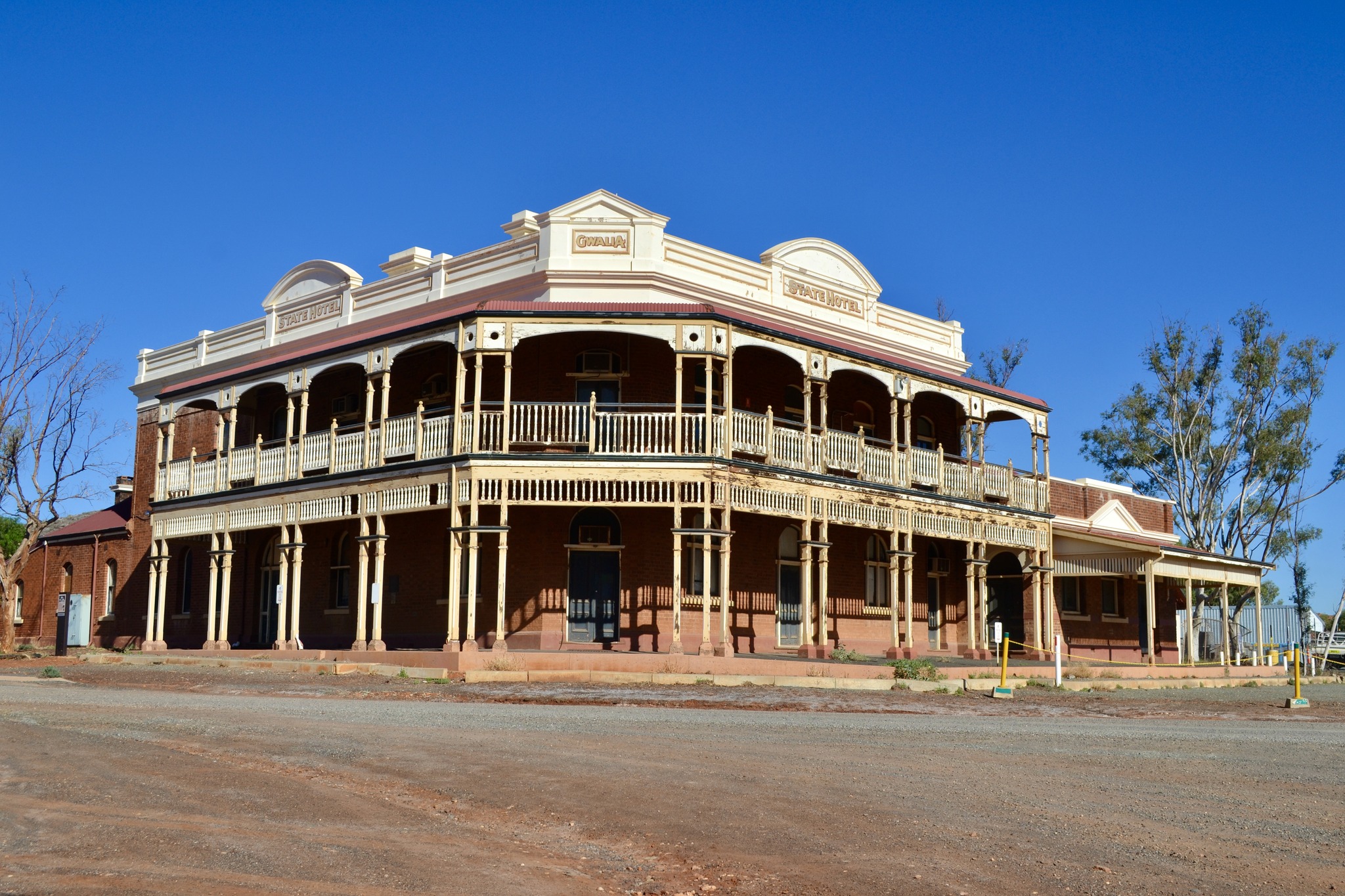
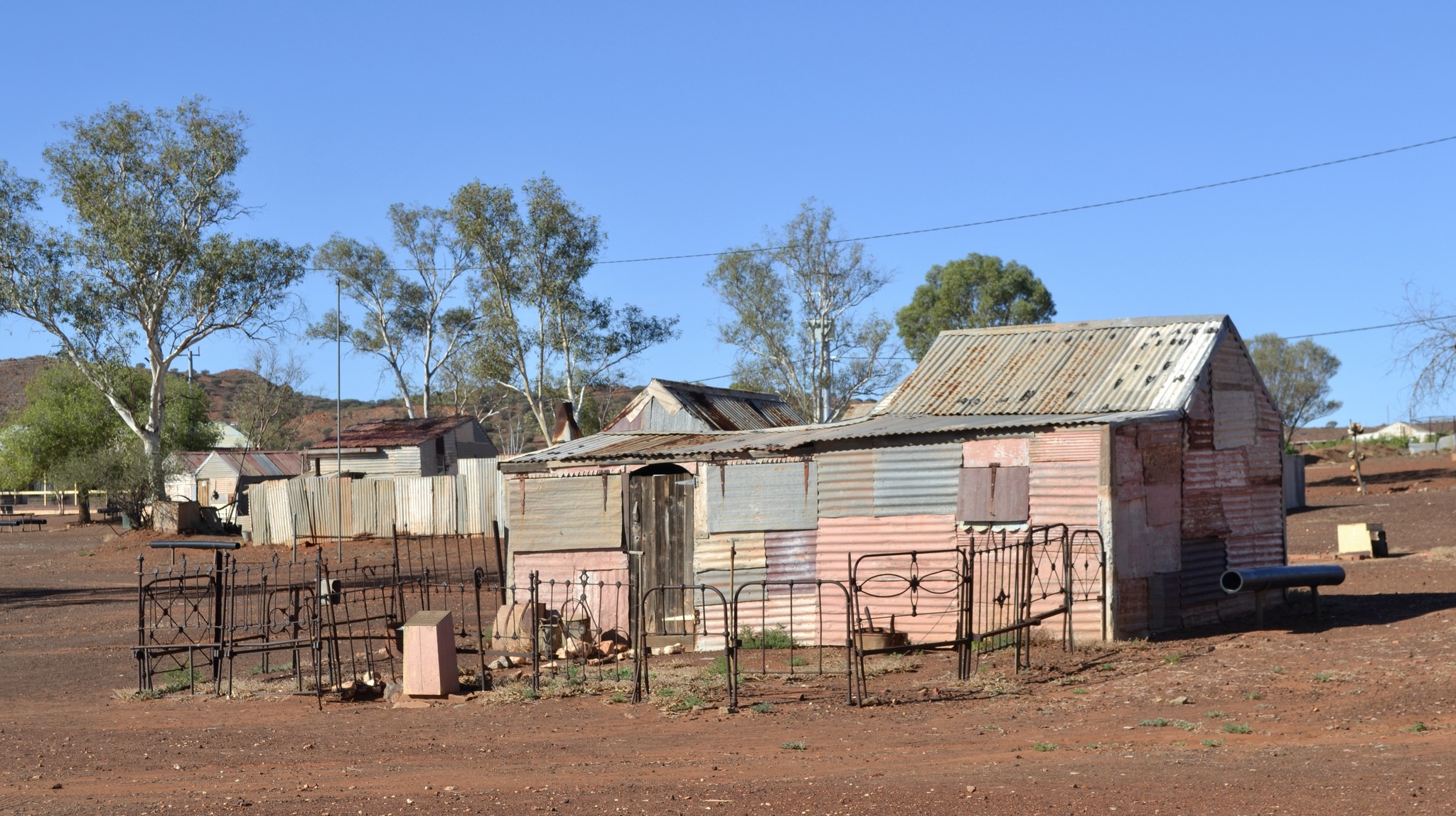
Gwallia is a mere 152 km north and it is an actual Ghost Town. Right on its edge is another very large mining exploration happening today. Luckily, they have seen fit to preserve the buildings of Gwallia as they were. There is a grand hotel, some old shops, houses, and other establishments.  We visited the reasonably thorough Museum of the Times, with a café in the old heritage home visited by Edgar Hoover before his USA presidency. It was beautifully preserved, and the tea and scones would have been thoroughly enjoyed had we not been sitting on the wide-open veranda which had a pleasant breeze to cool us down but unfortunately, the flies had the same idea. an Australian staple we were quickly tired of. Time for working and washing again so we booked a caravan park at Leonora,10 minutes from there.

The advertising for Leonora was such that I was expecting a well-looked-after town with some interesting things to see. I can honestly say this was not our experience. The people we encountered were lovely but there was little to see and the caravan park we were booked into had razor wire topping the entire perimeter. This is a little unnerving. The party started late afternoon/ early evening as some of the locals become extremely verbal. A lot of screaming, aggressive music and abusive language continued through the night.  We were going to stop for 2 nights but chose to limit it to one and hopefully find a free camp further along. I did manage to get some work done, the washing finished, and we had showers so no complaints but obviously did not sleep well that night.

Our plan at this stage was to continue our way to Karijini national park despite the current cyclone off the coast of WA above the national park. We were following it closely but at this stage, the forecasters were indicating a move to the Northern Territory, so we stayed on our planned itinerary.

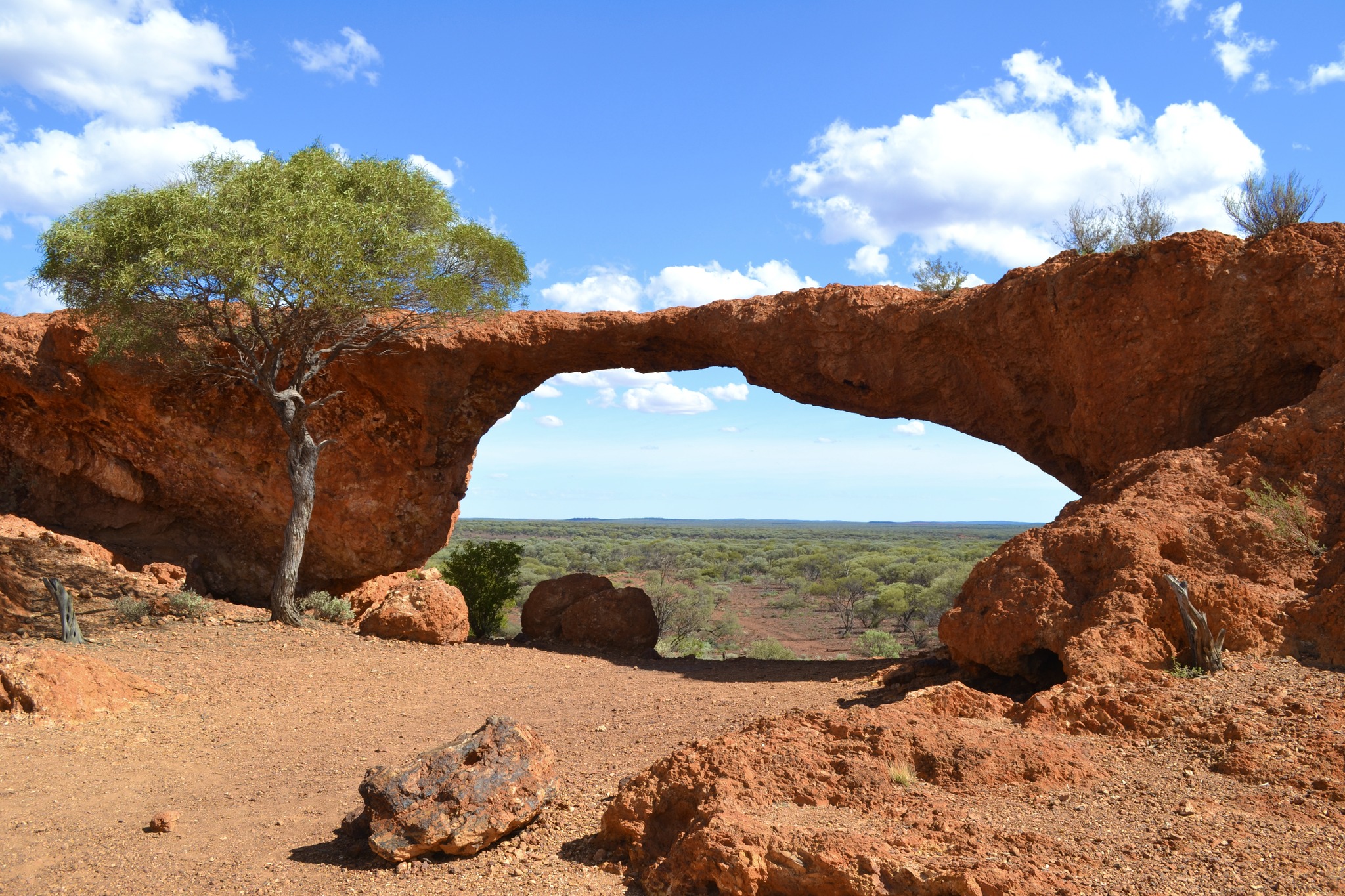
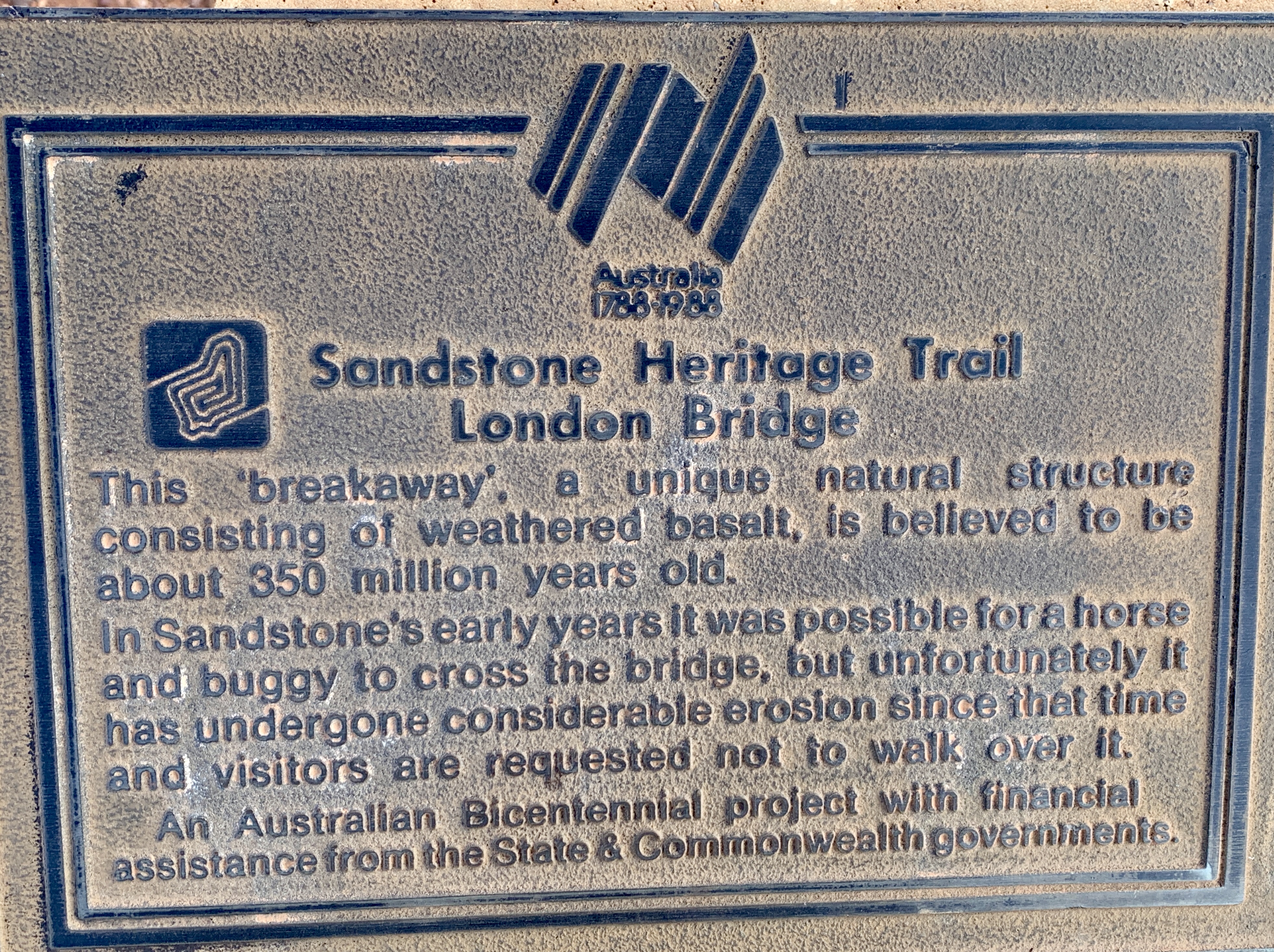
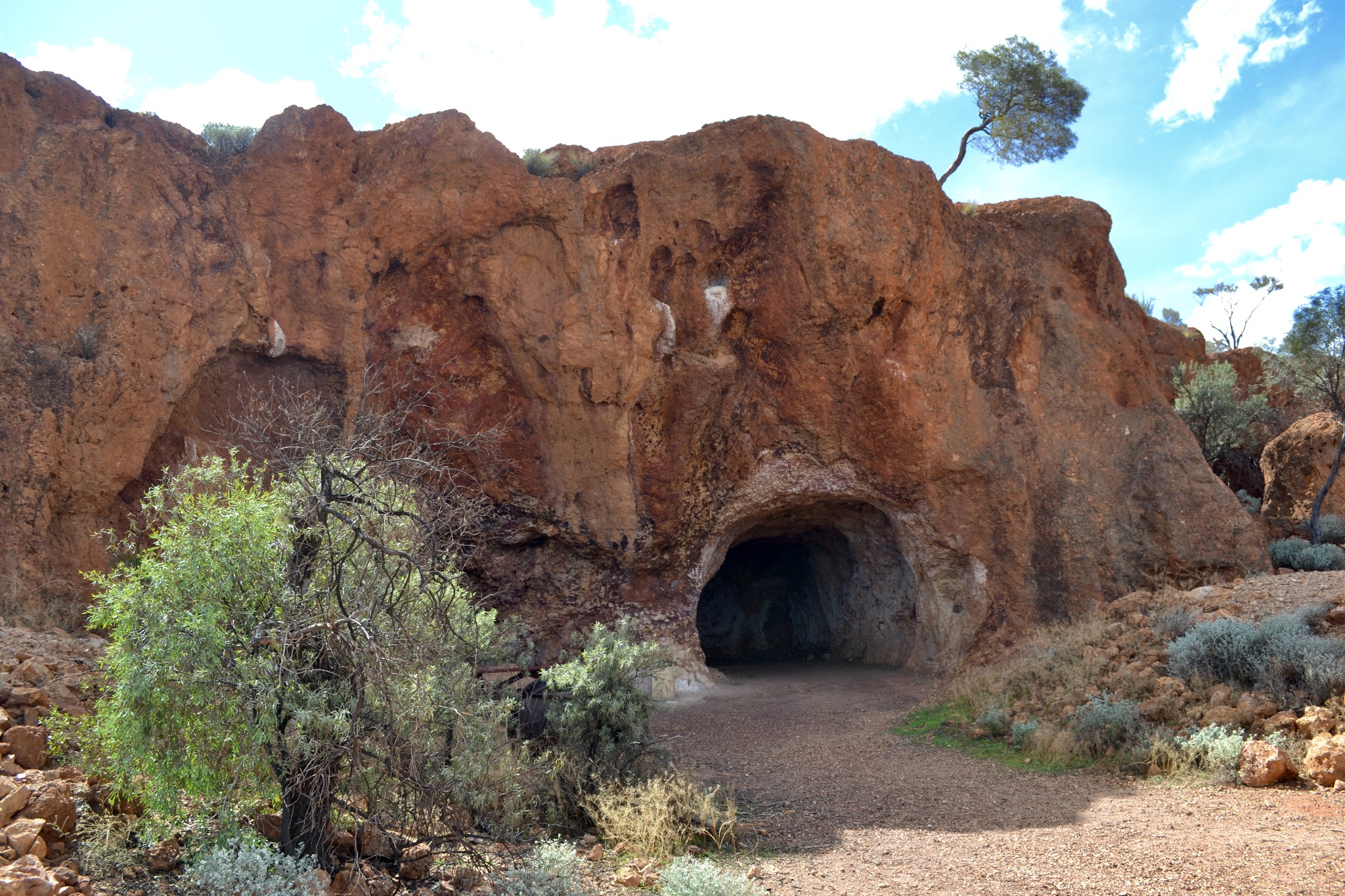
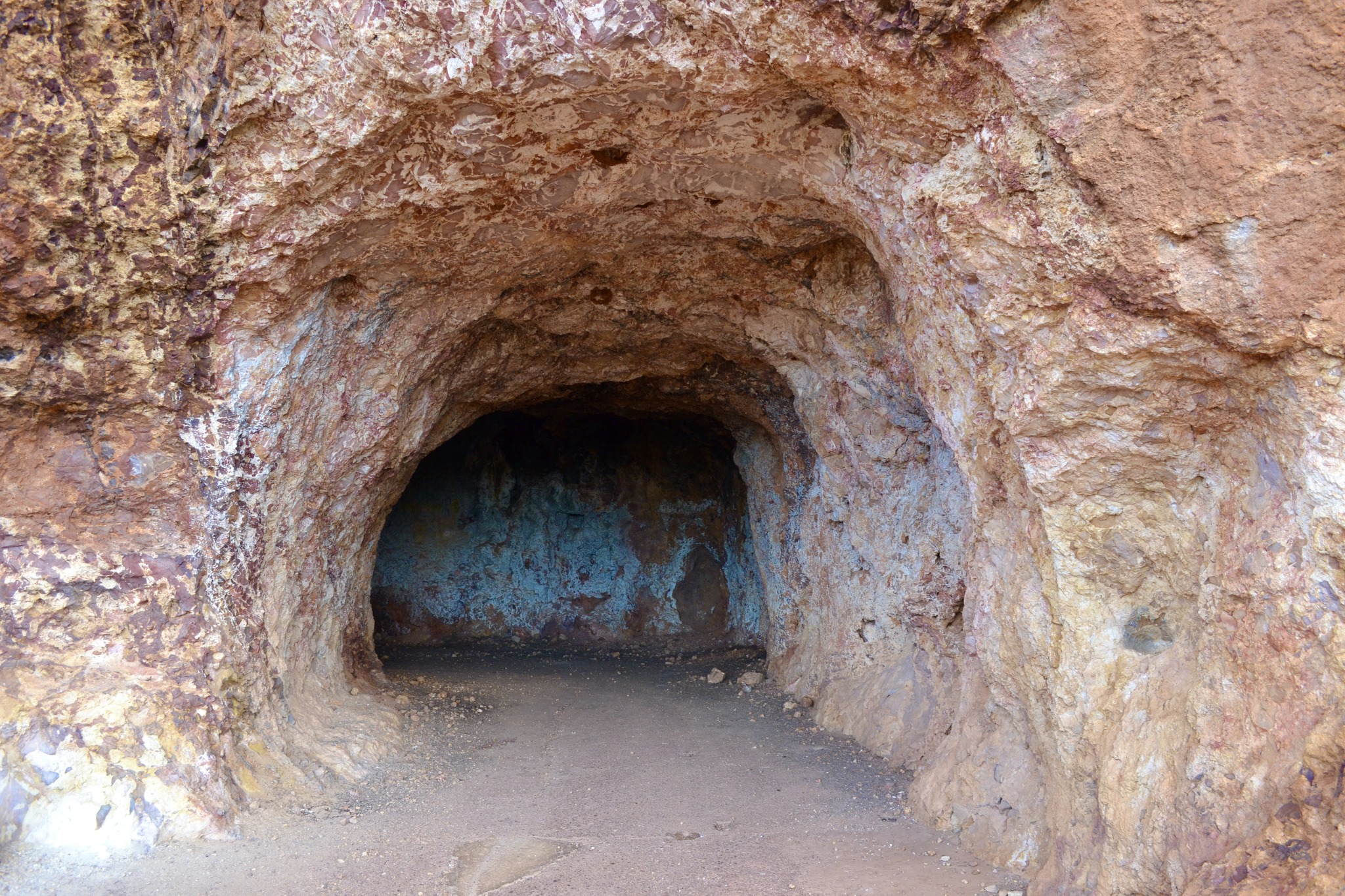
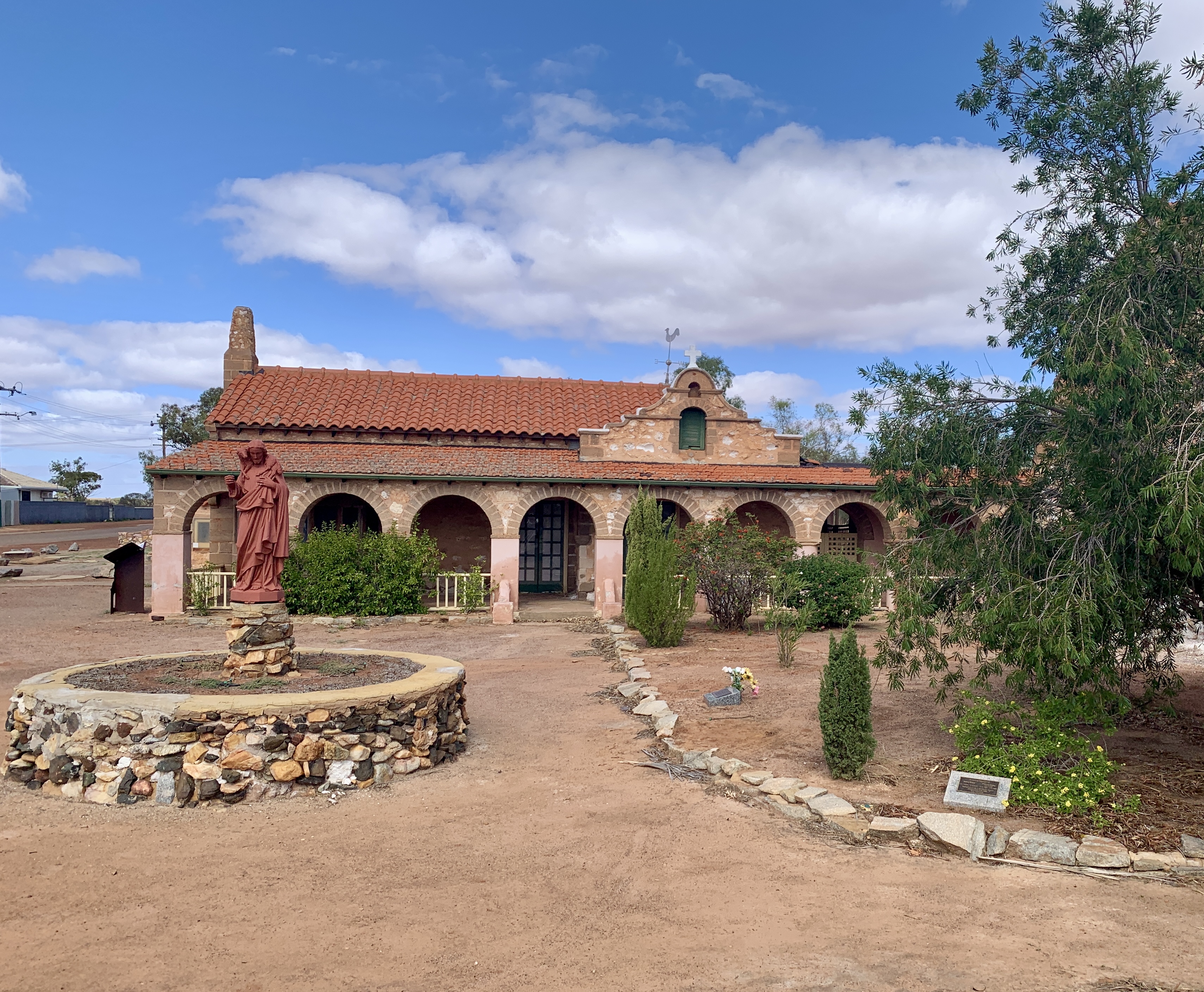
Our next main stop was Mount Magnet some 432 km to the west. About 280 km along we pulled off just before the town of Sandstone following an advertised tourist trail. Sandstone was formerly a gold rush town and later nearly a ghost town, however in 2021 its population was 109 people who apparently are very proud of their town as the homes are neatly kept and overall, the town is nicely laid out and well looked after. Its claim to fame today is the greatsights you see on The Heritage Trail. Just two of the things we liked were The London Bridge and the Cave Brewery. London Bridge is aptly named and worth the drive. The scenery is wonderful and needless to say a frequently photographed tourist attraction. The Brewery is intriguing. Developed by an Irishman who built the pub at the top of the mound of limestone rock and then ran the pipes down to the cave below to keep the barrels cool.  This place is very remote and hard to imagine people going that far for a cold beer. Ken pointed out there would have been many gold seekers in need of a thirst-quenching beer after the tiresome effort of searching for their fortune all day in the summer heat.  It was getting to mid-afternoon, and we hurried on to our free camp which was not far out of Mount Magnet. Once we arrived it was a little rockier than the reviews on Wikicamps and of course, while trying to decide on the spot we gashed a rather large hole in the front tyre. We were just over half an hour from town, but it was late in the afternoon. A quick call to the local mechanic led us to believe he may be able to get us a replacement tyre. Hurriedly changing the tyre to our space-saver spare tyre, we drove the distance to the town. Alas when we got to town, he had closed along with the rest of the town, so we had to stay at a caravan park. Luckily, we were able to find a spot. Again, another caravan park that was monitored by police. A couple of phone calls the next morning convinced us we needed to drive the 350k to Geraldton as nothing was available anywhere else.  As it turns out our plan was to head for Karijini national park, but we were concerned as a cyclone had crossed into an area a couple of hundred k’s short of where we were headed. At least going to Geraldton, we would miss the bad weather from the cyclone but sadly we would miss the opportunity to see Karijini National Park. This was bitterly disappointing but unfortunately, we had no choice.

So off we went, bright and early and made it to Geraldton in time to get the new tyre. Thank you to Tyrepower who fit us in, changed our tyres around so they were evenly matched and did not overcharge us. A consolation was that the cyclone did in fact hit land nearer to our original destination than we would have liked so we were saved from some very treacherous weather by heading to the coast.

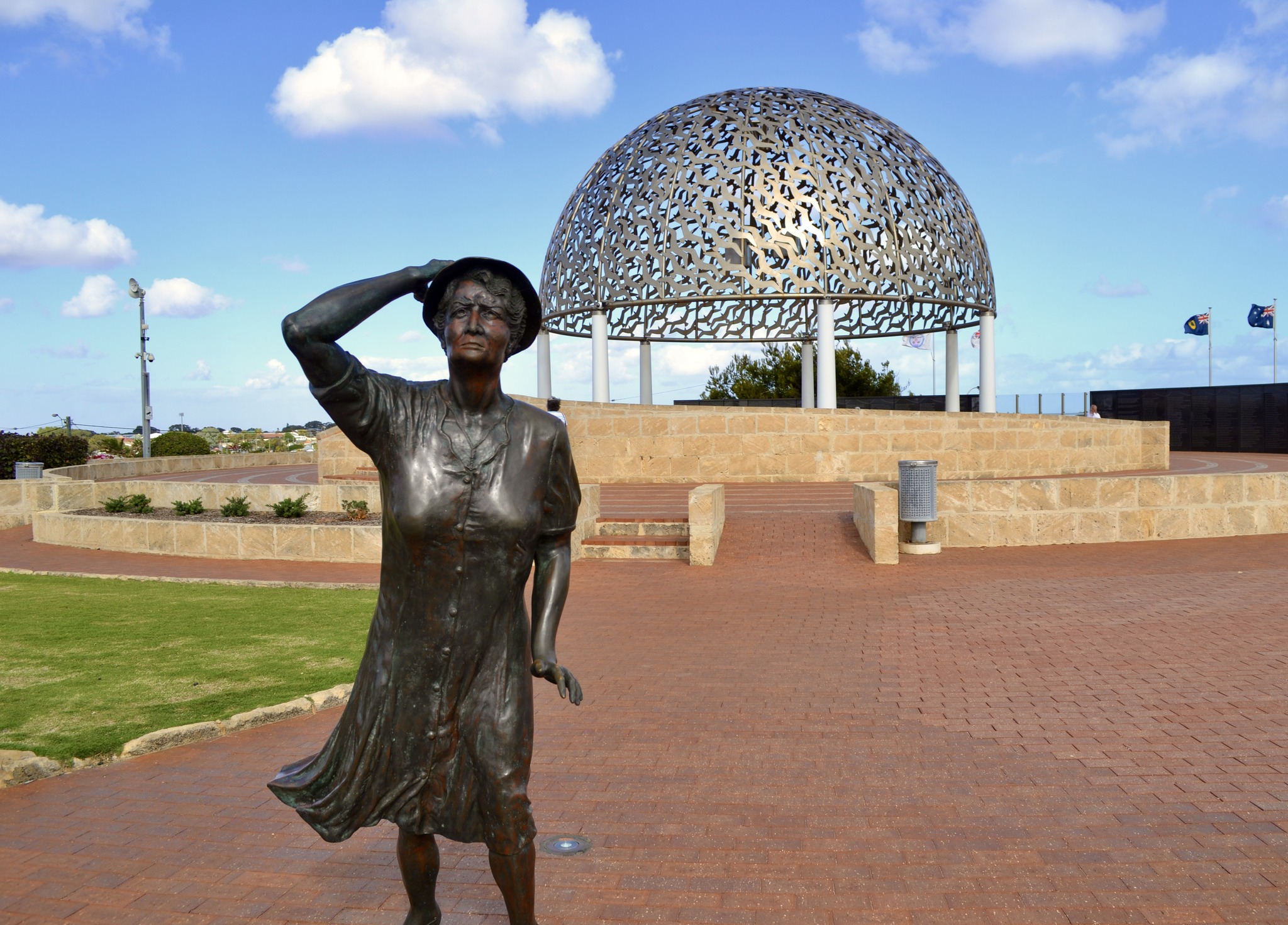
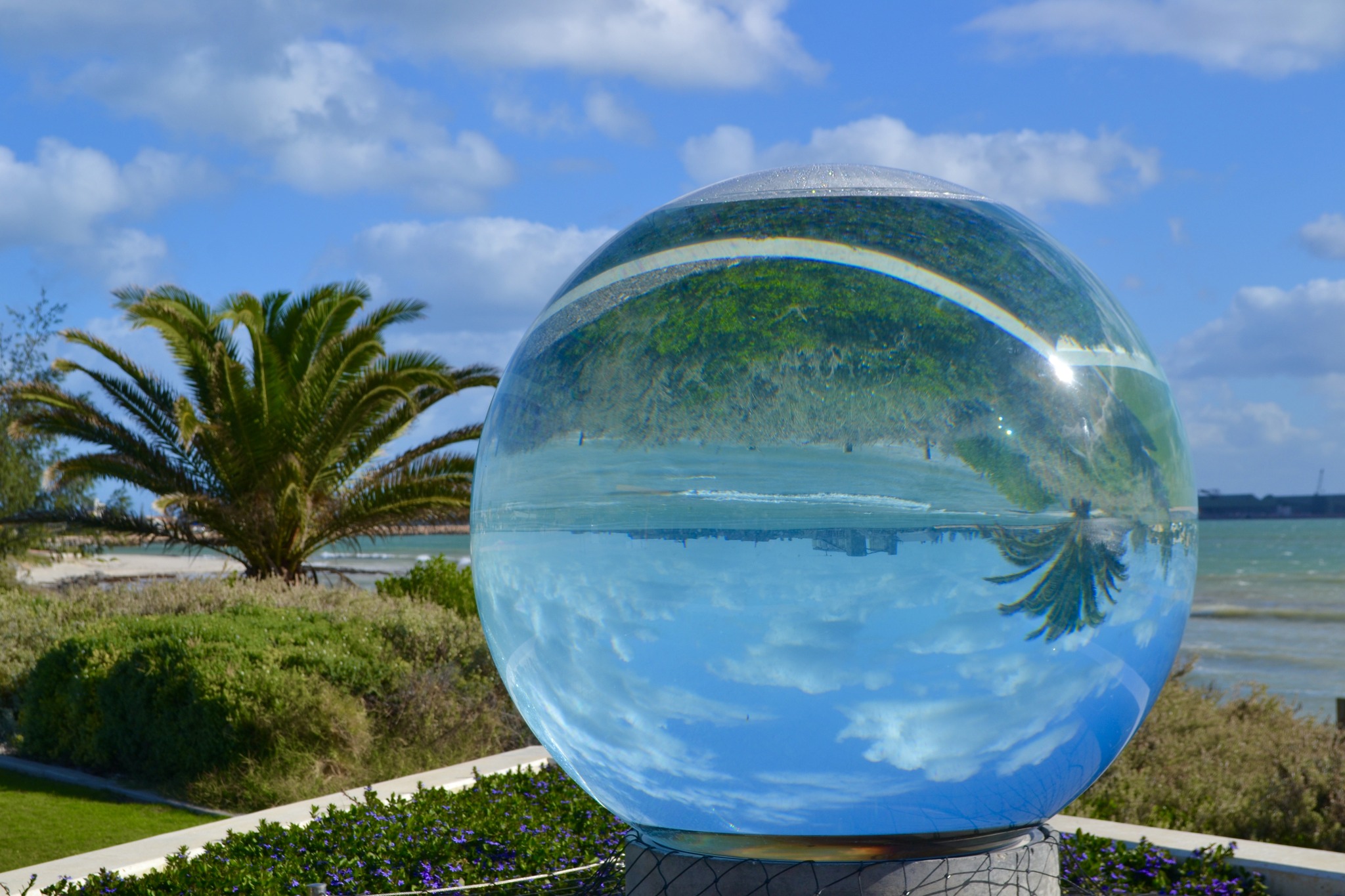
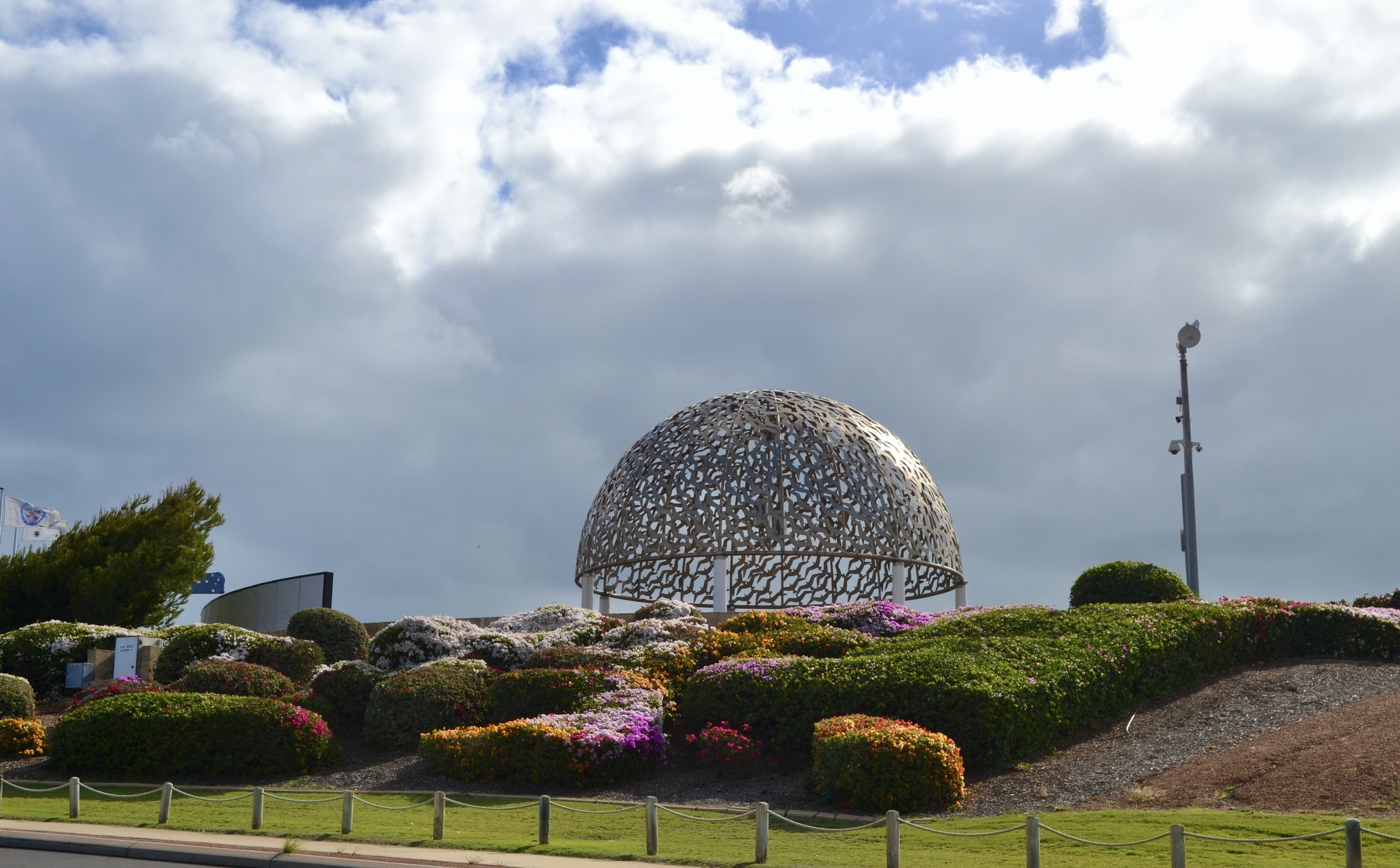
While in Geraldton we checked out the memorial for HMAS Sydney. This is quite large and beautifully designed.  The gardens surrounding it are nice and the lookout is quite appealing. Leaving here we drove down to the Esplanade. The sun was hot, and we stretched our legs with a walk to the end. Here we found a huge Crystal ball on display. Depending on the angle you can see your reflection and the ocean through the glass. Really neat and different.

Now where to stay, it was getting late, so we headed just out of town to a camp referred to as an Eco camp. We drove in and there was a house unattended and a sign to say park and leave your donation. Showers, toilets, and a camp kitchen. We drove around an oval and found some old numbers on trees which we determined were campsites. Picked one which was near the camp kitchen and set up. There was quite a large group just near us who were using the facilities and turned out to be a rowdy bunch. As the facilities looked old and unkept we decided to just use the toilet. I am not sure of the meaning of Eco camp but looked more like ‘Look after yourself Camp’.  We were up and out of there early the next morning.

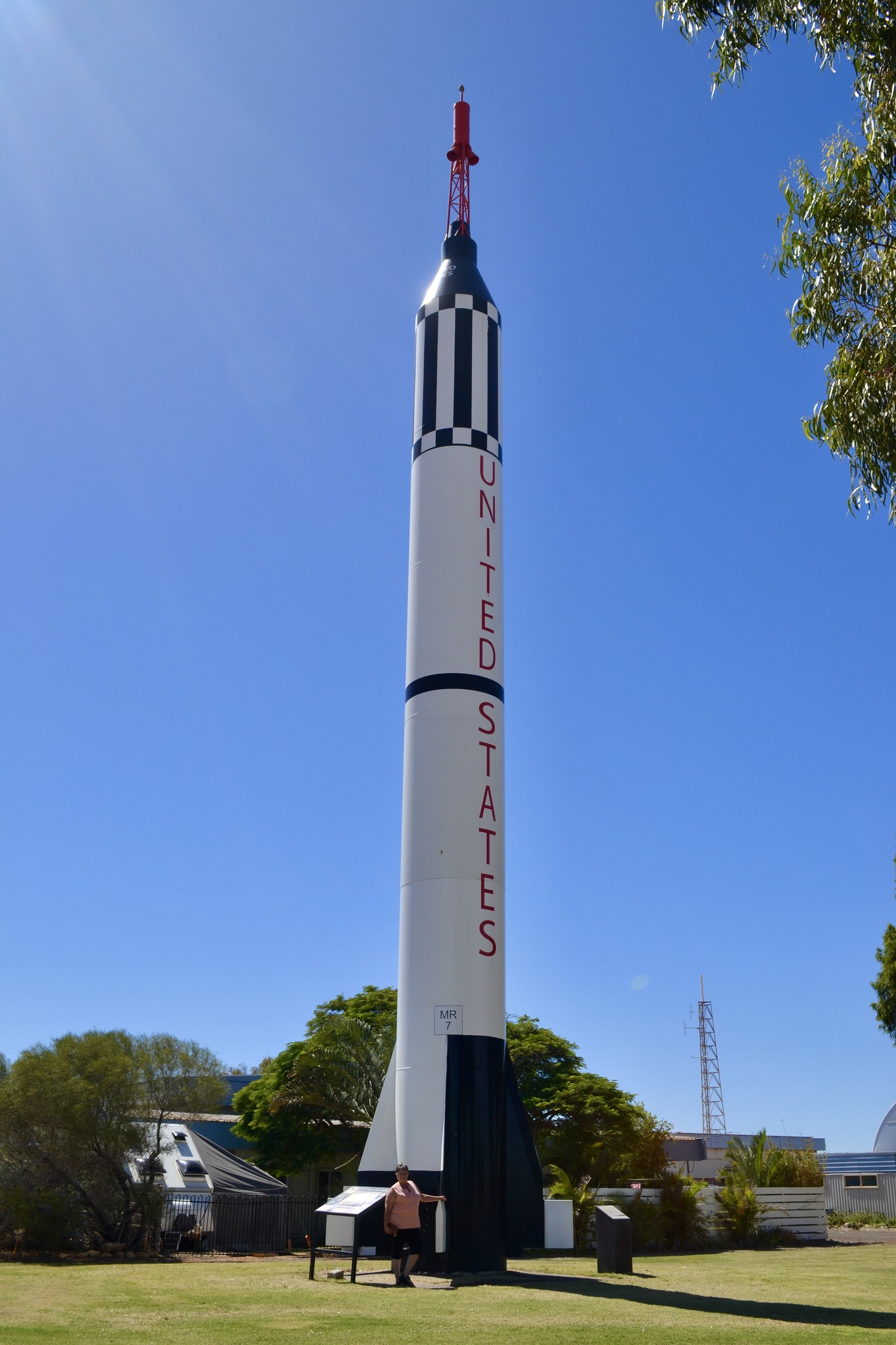
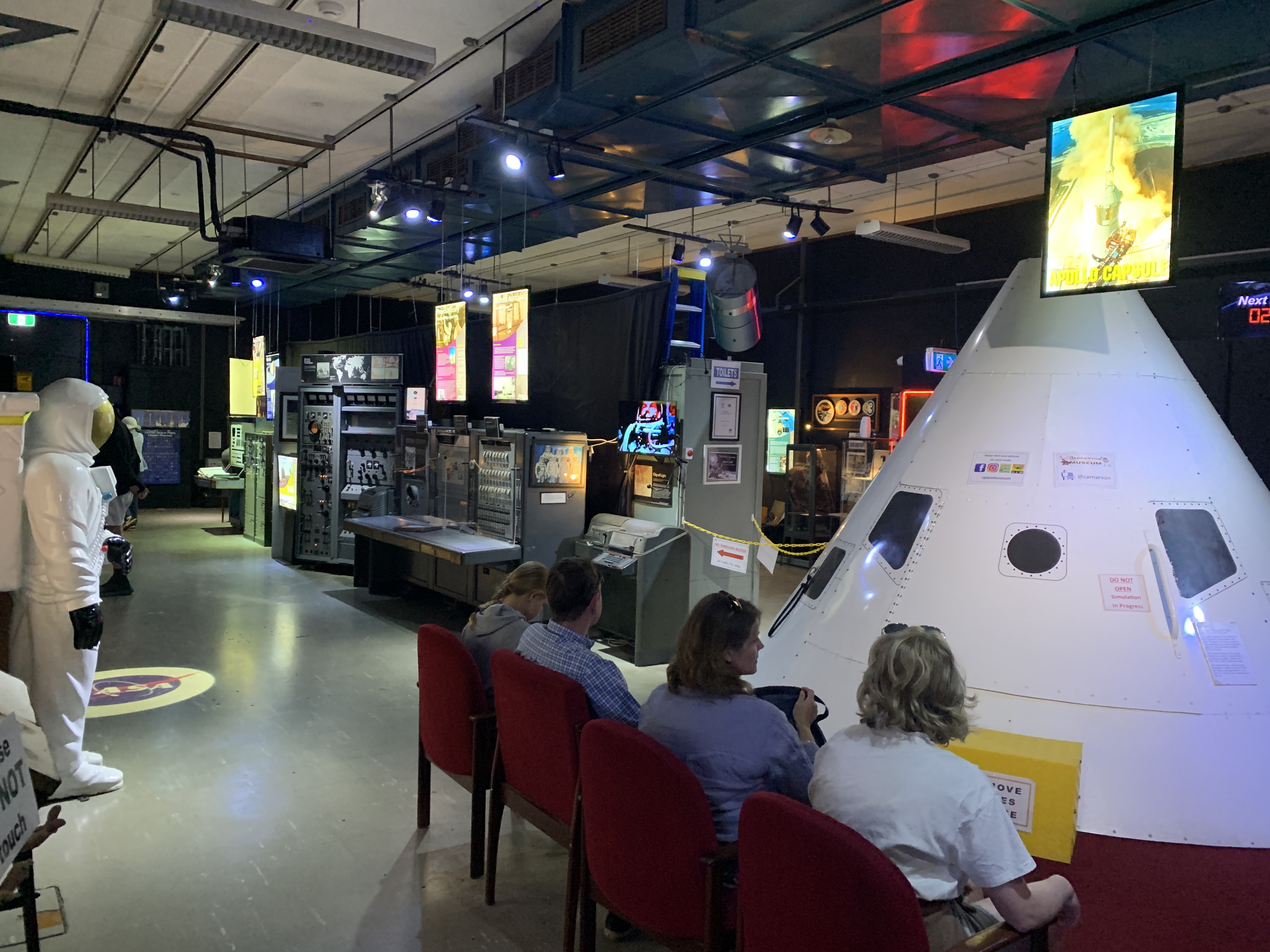
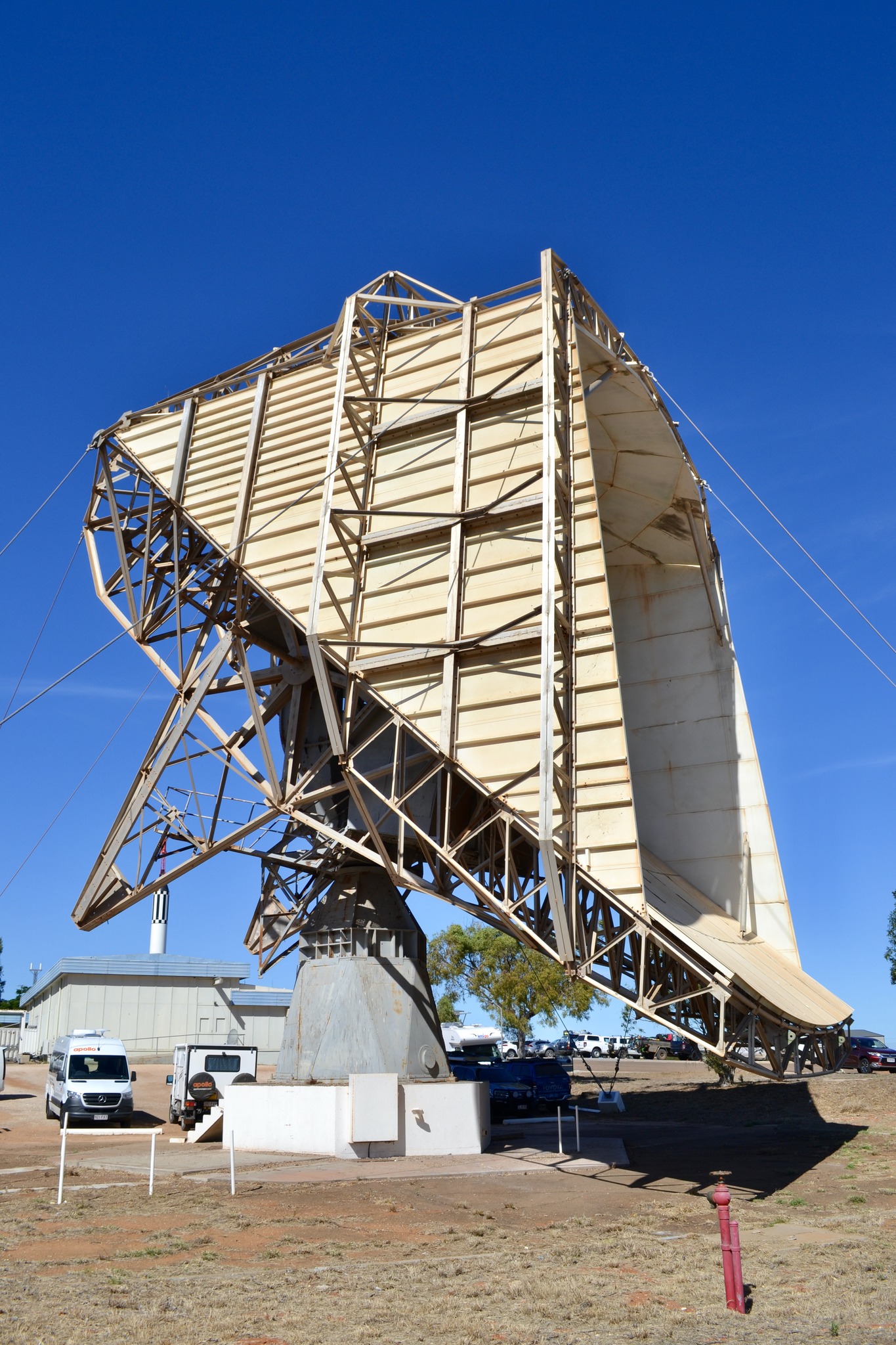
Another long 480km north and we arrived at our destination, Carnarvon, we found an inexpensive caravan park that was run by a young woman who was super happy and a very hard-working lady. We stayed here 3 nights as I had work to do and we needed time to just catch up with washing, shopping and to relax a little. Once again, we expected a larger more commercial town. There was a nice esplanade, some small gift shops and coffee places and more industrial-style businesses but otherwise, an ordinary town.  We must mention though that we did visit the Space and Technology Museum which proved very entertaining with hands-on activities and a wealth of information. This was a tracking station for early space missions such as Gemini, Skylab and Apollo. It was easy to spend a couple of hours going through all the exhibitions. A very worthwhile visit. It appears small but is jammed pack with interesting and interactive highlights.

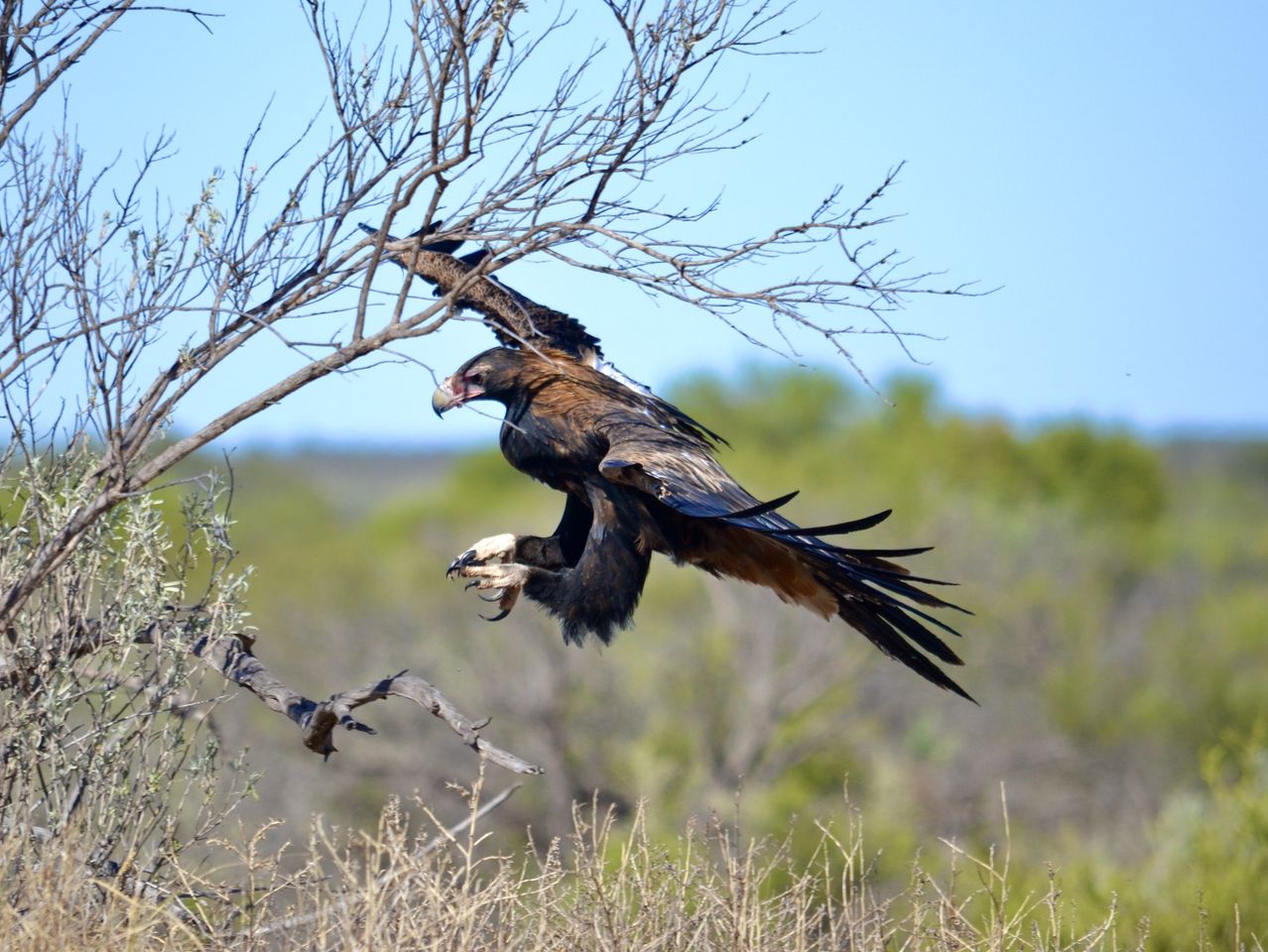
Having sorted ourselves out and prepared supplies for our 5 days at Exmouth we left on the 18th to head for our eclipse headquarters. It is 364 km to Exmouth and other than a coffee break we drove straight through. Getting close to the Exmouth turnoff Ken saw a hawk in the sky and just happened to comment that he had not seen an eagle for some time. As if by magic we passed 5 eagles hovering over roadkill on our right. As it happened Ken checked the km at that point and realised it had changed dramatically as we were going the wrong way. We had to turn back and as we drove toward the point where the eagles were feeding, we stopped and Ken walked quietly down to try for a photo. He was rewarded generously as one very large eagle held back until the last minute and he was able to photograph the eagle in flight. It was a brilliant photo and very unexpected. We of course were quite happy that we had missed that turn-off.
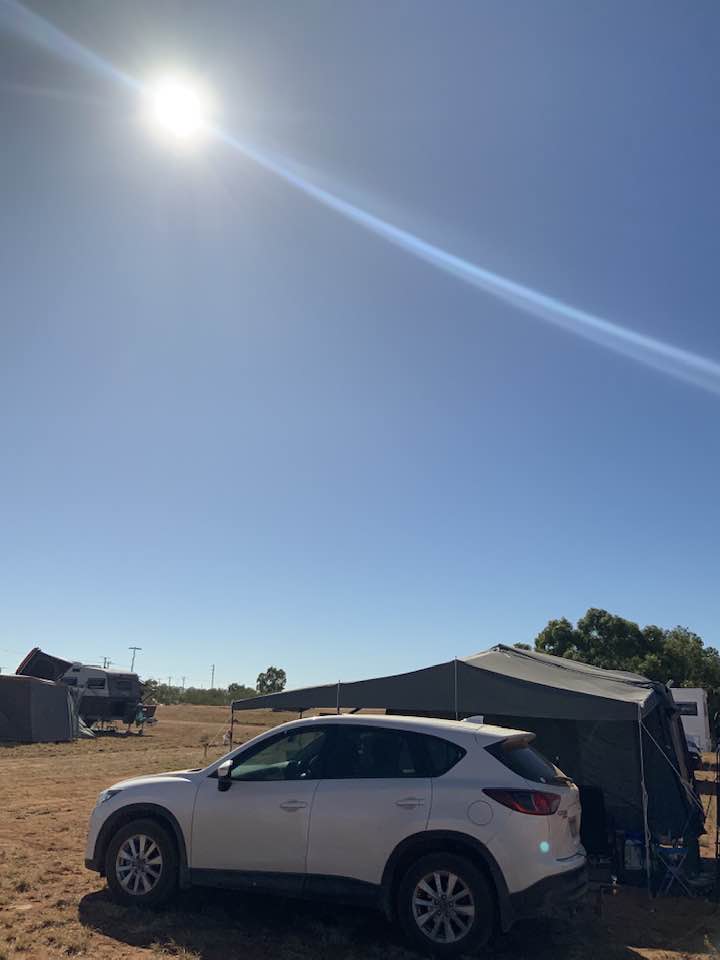
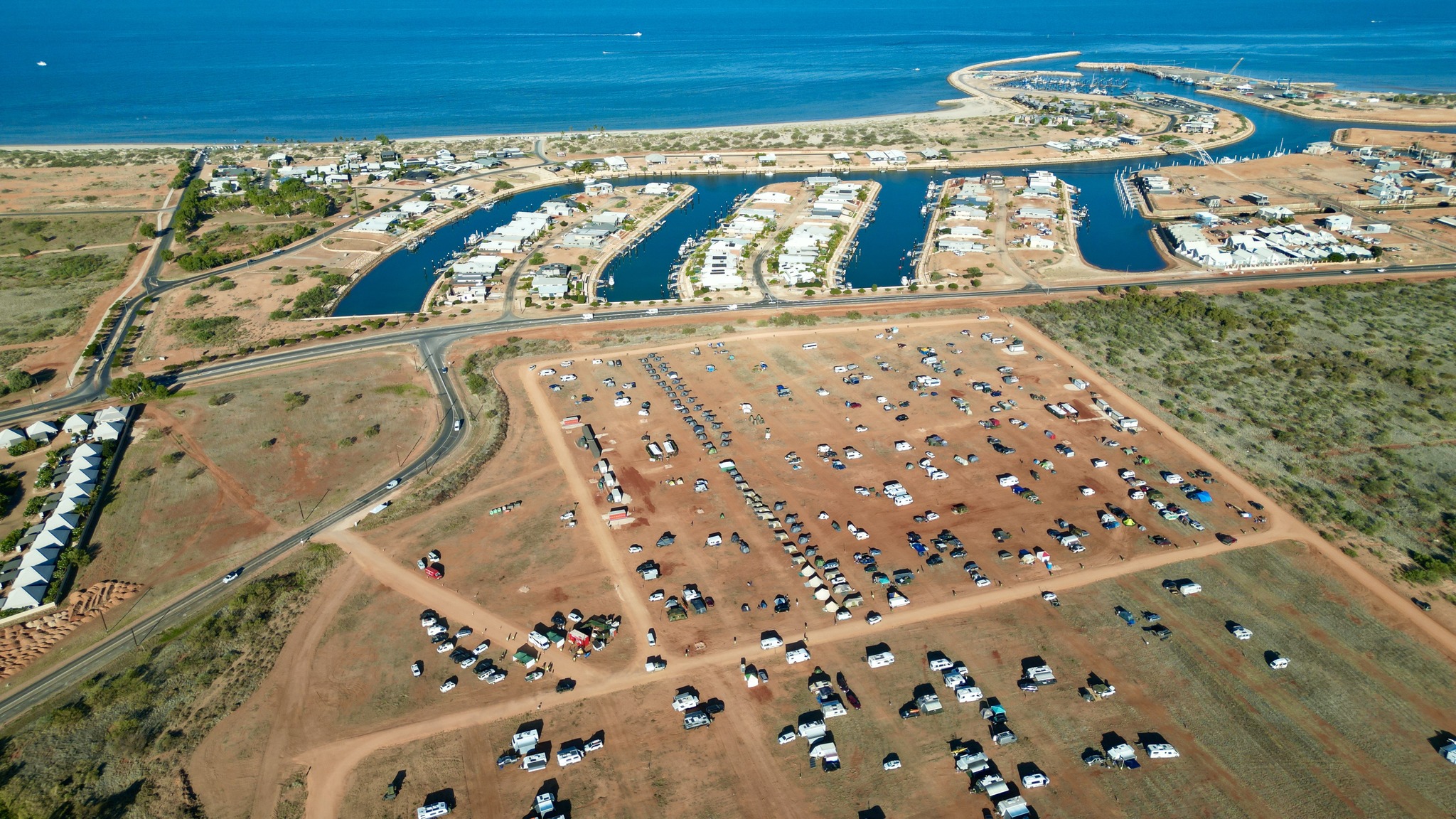
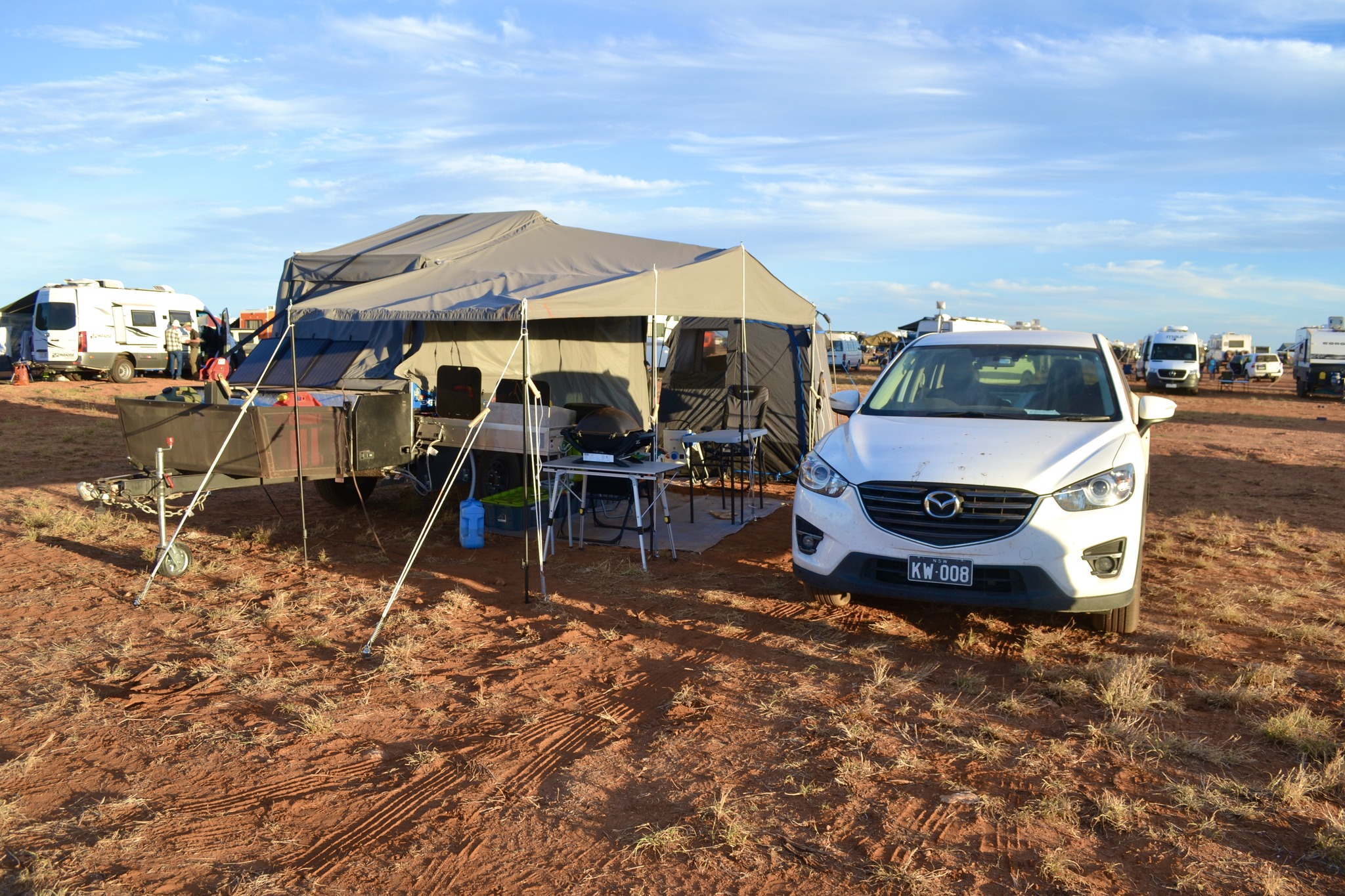
 It was amusing to see the many traffic warnings along the way. There were many warnings of traffic delays due to upcoming events, and frequent roads blocked off.   We personally experienced no delays of any kind and drove easily to the entrance of the overflow camp where we had booked along with hundreds or possibly thousands of others. We were cordially welcomed and were instructed to follow the man in the high-vis yellow jacket madly peddling his bicycle to our allocated spot. They were very organised, with many helpers and all just as excited as we were. We had a great spot with few vans around us. We did have to be self-sufficient so up went the annex for the first time along with the Joolca shower and toilet tent. The weather was brilliant. Hot but with a nice breeze. It was afternoon so after unpacking we went for a drive to the centre of town to find a pub and a cold beer. We had no trouble and arrived at the Froth Hotel which quite a few others tried out as well. A short drive around town we were able to get our bearings as to where the beach was, our expected viewing site for the Eclipse. It was conveniently within walking distance from our camp.  We settled down for the night in anticipation of a mass arrival of campers the next day. As it turned out there was a steady stream, but the area was huge and accommodated everyone very well. We did notice that our little corner was still not crowded out.  We were close to an exit which made it very easy to come and go. That morning we had a visit from an acquaintance, Mandy, and her husband Brian. Ken had spoken to Mandy before in relation to a visit we made to Lightening Ridge.
Mandy writes for The Outback magazine for RM Williams. She wanted to ask us about what to expect regarding the eclipse as it was her first experience. They are a happy friendly couple whose company we enjoyed. She will be doing an article, whether we are in it we will have to wait to find out. We hope she enjoyed her first eclipse as we were unable to meet up with her after the event. I am sure she would have been very busy interviewing many people about their experiences.

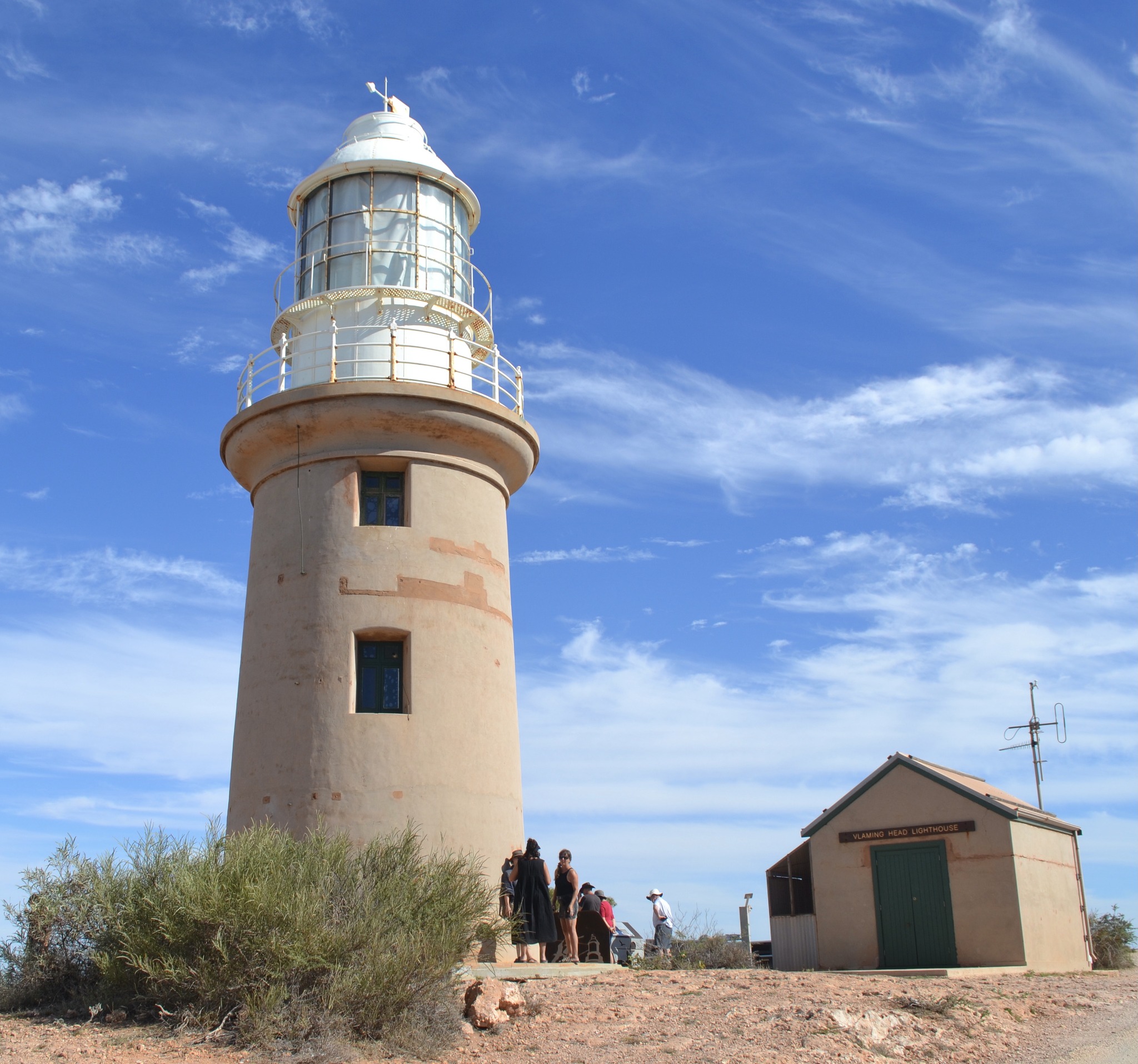
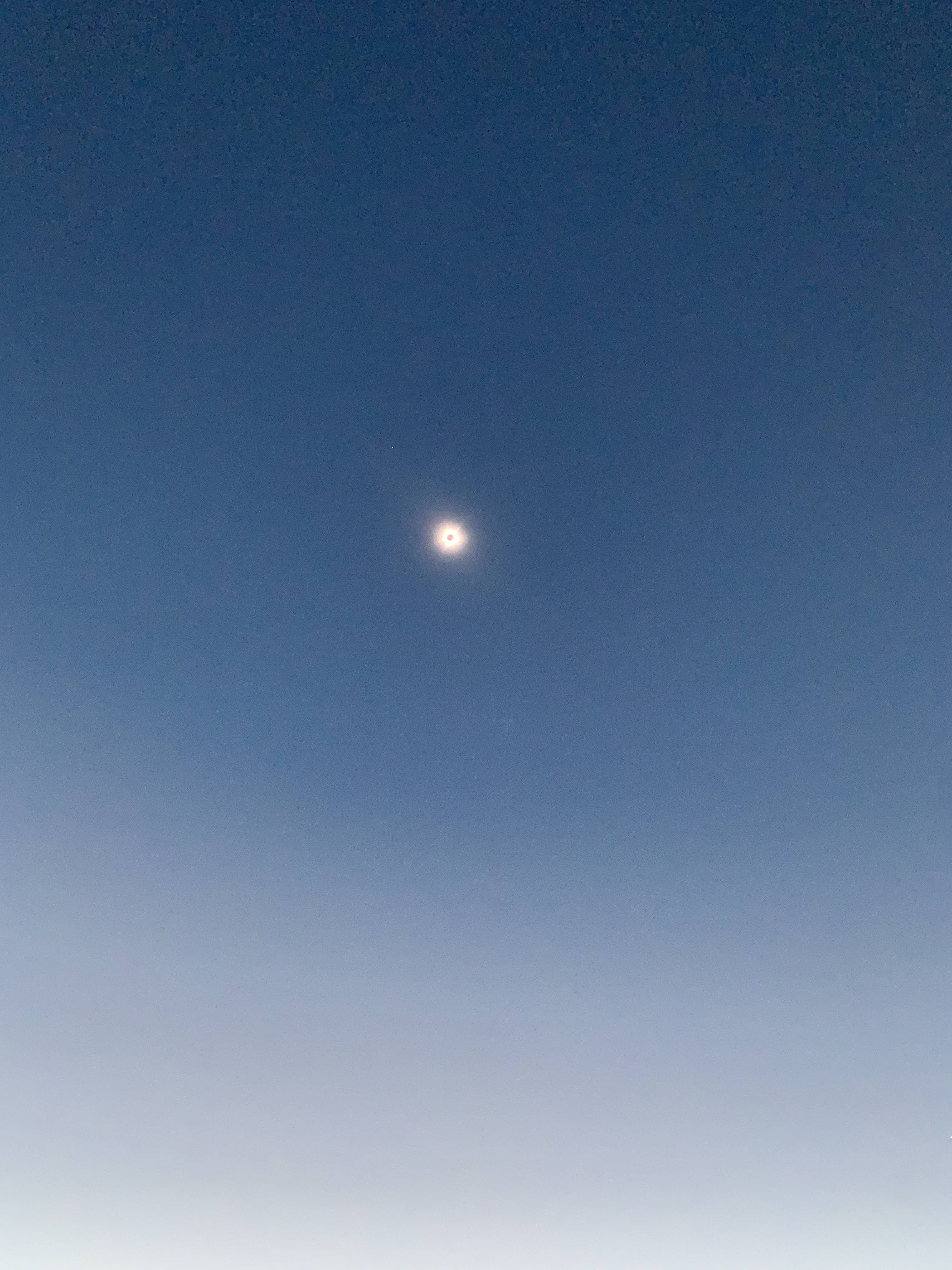
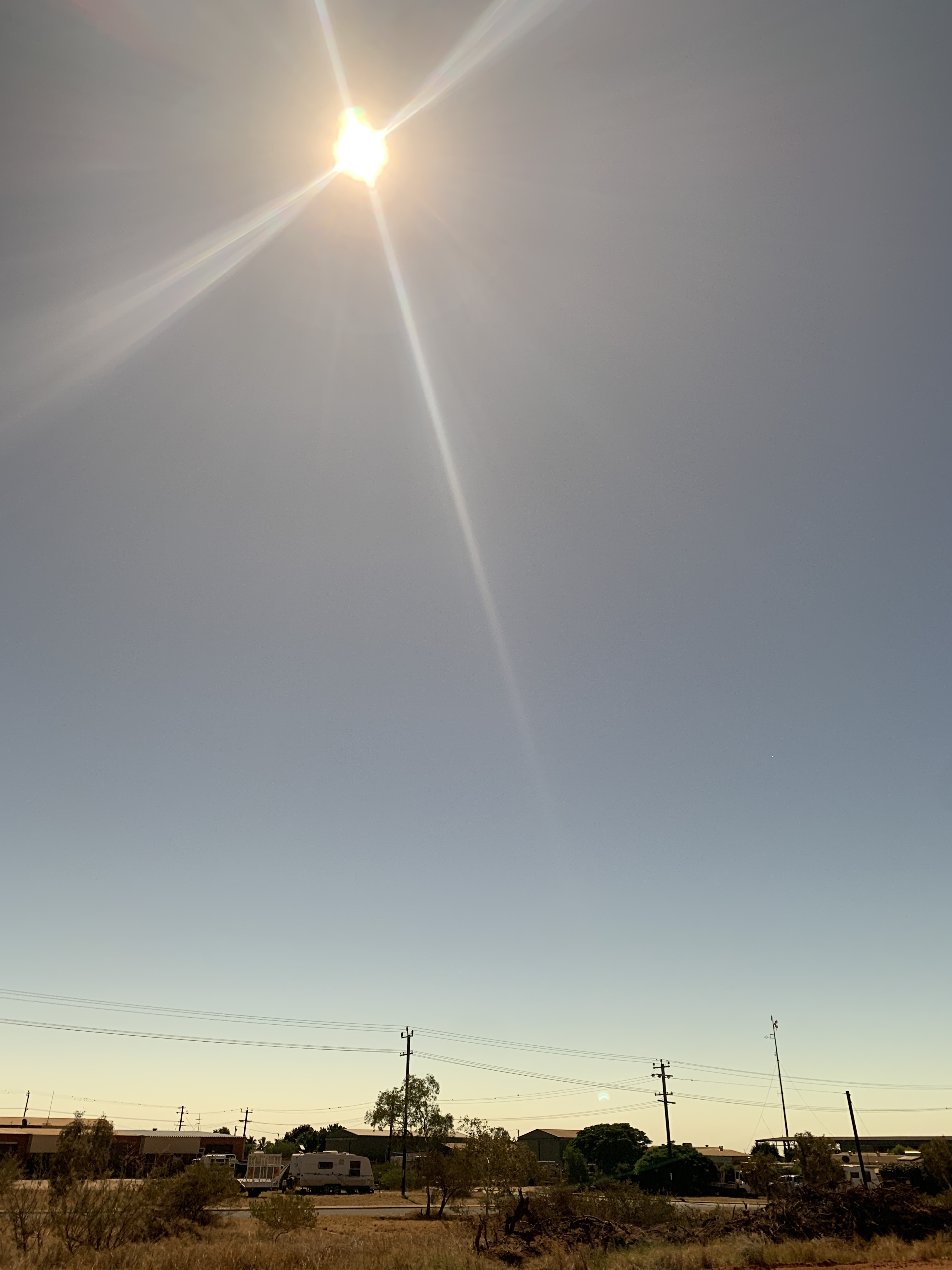
The morning passed quickly, and we met up with some other friends that evening for a meagre feed of sausage sandwiches accompanied by beer and wine. Earlier in the day we took a drive up to the Vlamingh Head Lighthouse, one of the few places where both sunset and sunrise can be observed over the ocean. We also visited a local beach and went for a brief dip at Town Beach. The water is warm and shallow, and you can walk knee-deep for quite a way out.  The next morning was eclipse morning, and it was decided we only needed to move a few metres from our camp. Ken had decided he would not bother trying to photograph as he wanted to be able to watch the eclipse without interference and in the end was very happy with his decision. It is a spectacular experience that everyone should endeavour to see at least once in their lifetime. It is also one of the hardest things to describe and one of the most difficult to put into words. This was my 4th eclipse and Ken’s 6th, of course not all are successful, but all are meaningful. All I can tell you is that if the sky is clear, it is an exceptional occurrence. The sky changes, the moon covers the sun and at the final moment when the sun is nearly completely covered, the image of a diamond ring appears as the last rays push through peaks and valleys  Once the sun is completely covered you will see eruptions or prominences sprout out from behind the shadow. As the sun was quite active at the time, we were lucky enough to see white baileys beads and red prominences which were a bonus. This eclipse was very short, only 57 seconds in our position. Within moments there were cheers from the field. The number of cameras clicking at the time would have been phenomenal and the number of photos showing up on Facebook pages later in the day proved the absolute joy of those who were privileged to view it. Certainly, an experience that is hard to forget. Absolutely worth the 5,500 km we had travelled so far. I look forward to 2028 when hopefully we can be a lot closer to home in the Blue Mountains of NSW when this event will occur once again with a 5-minute duration.

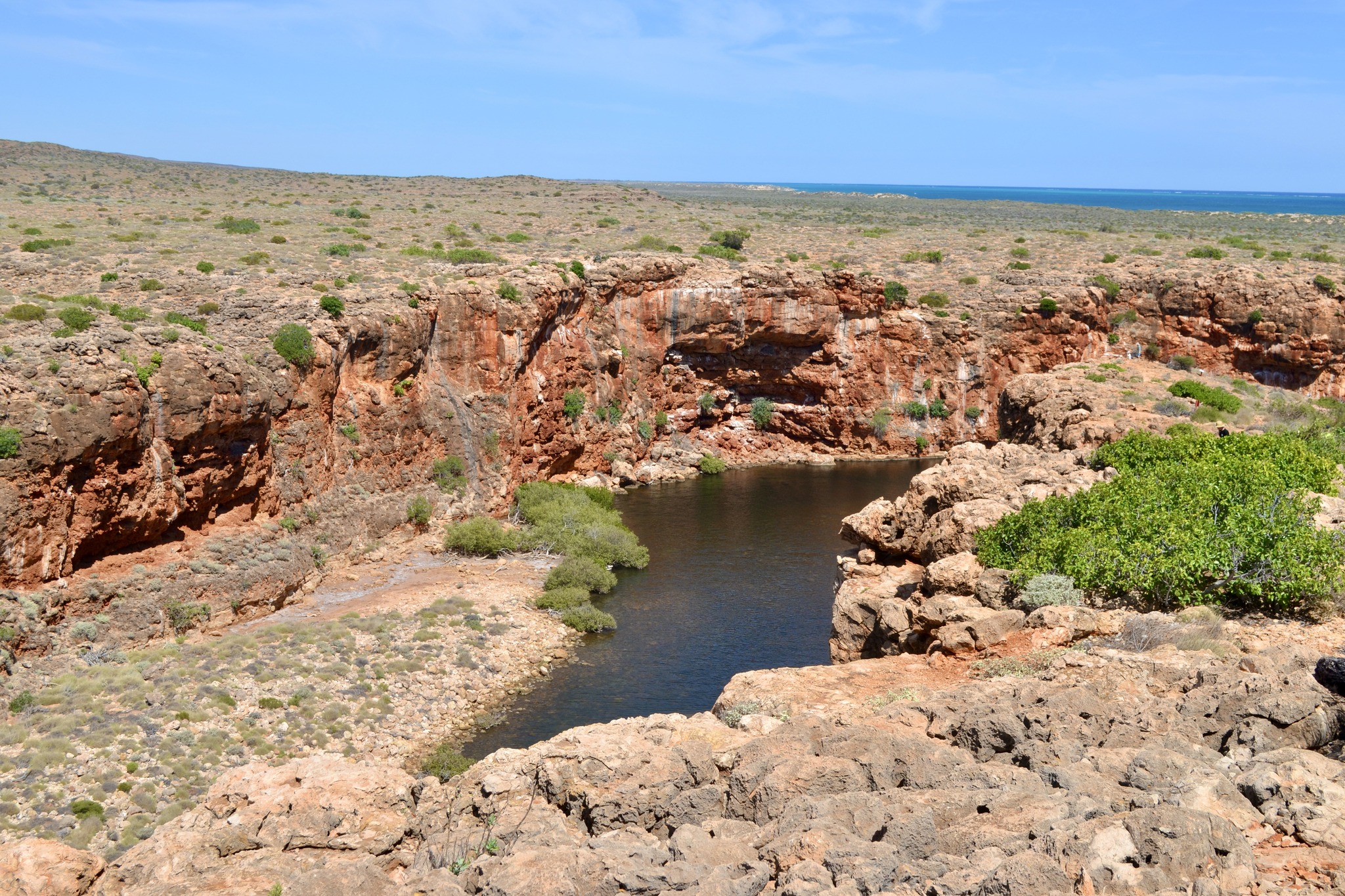
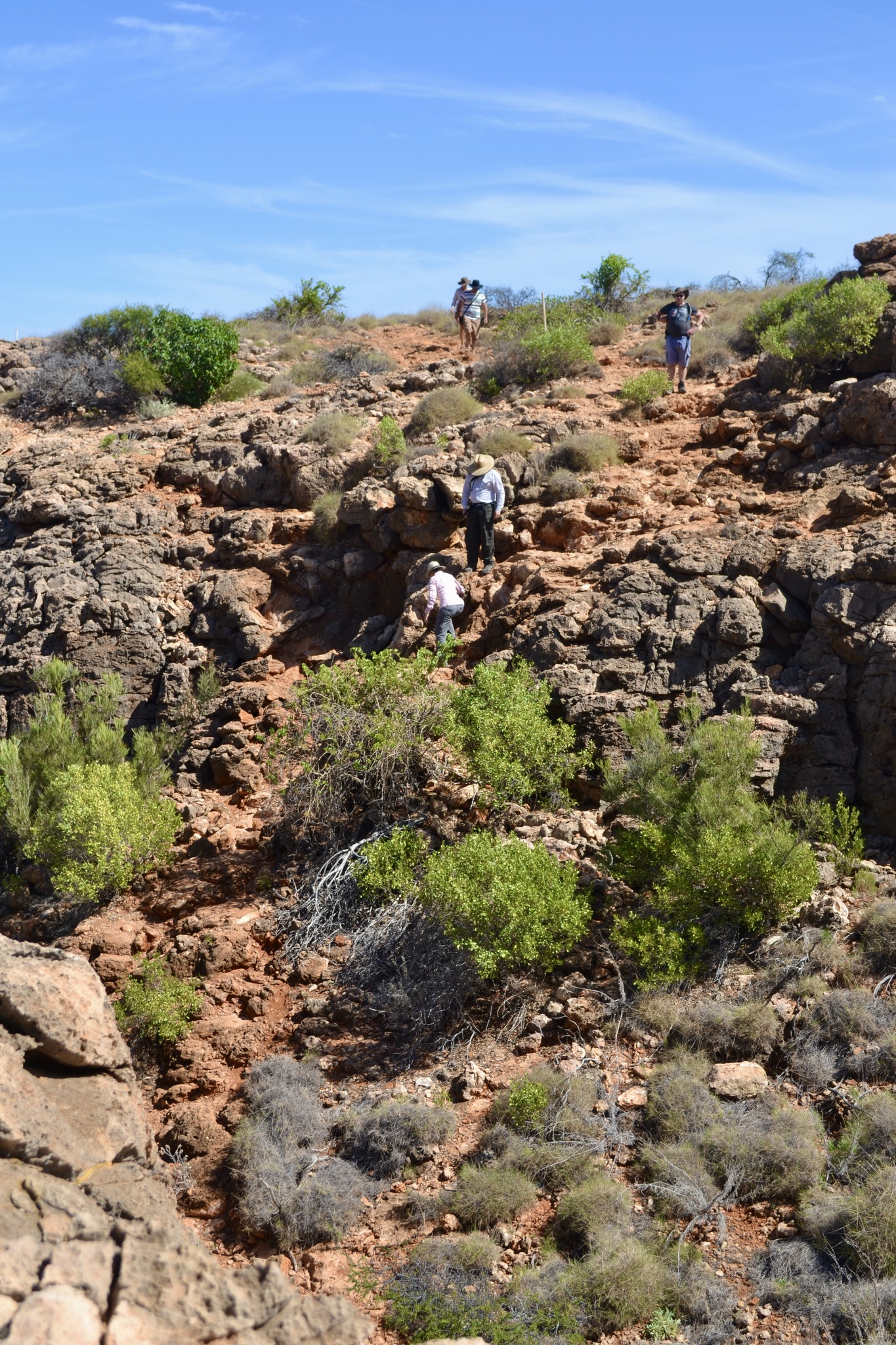
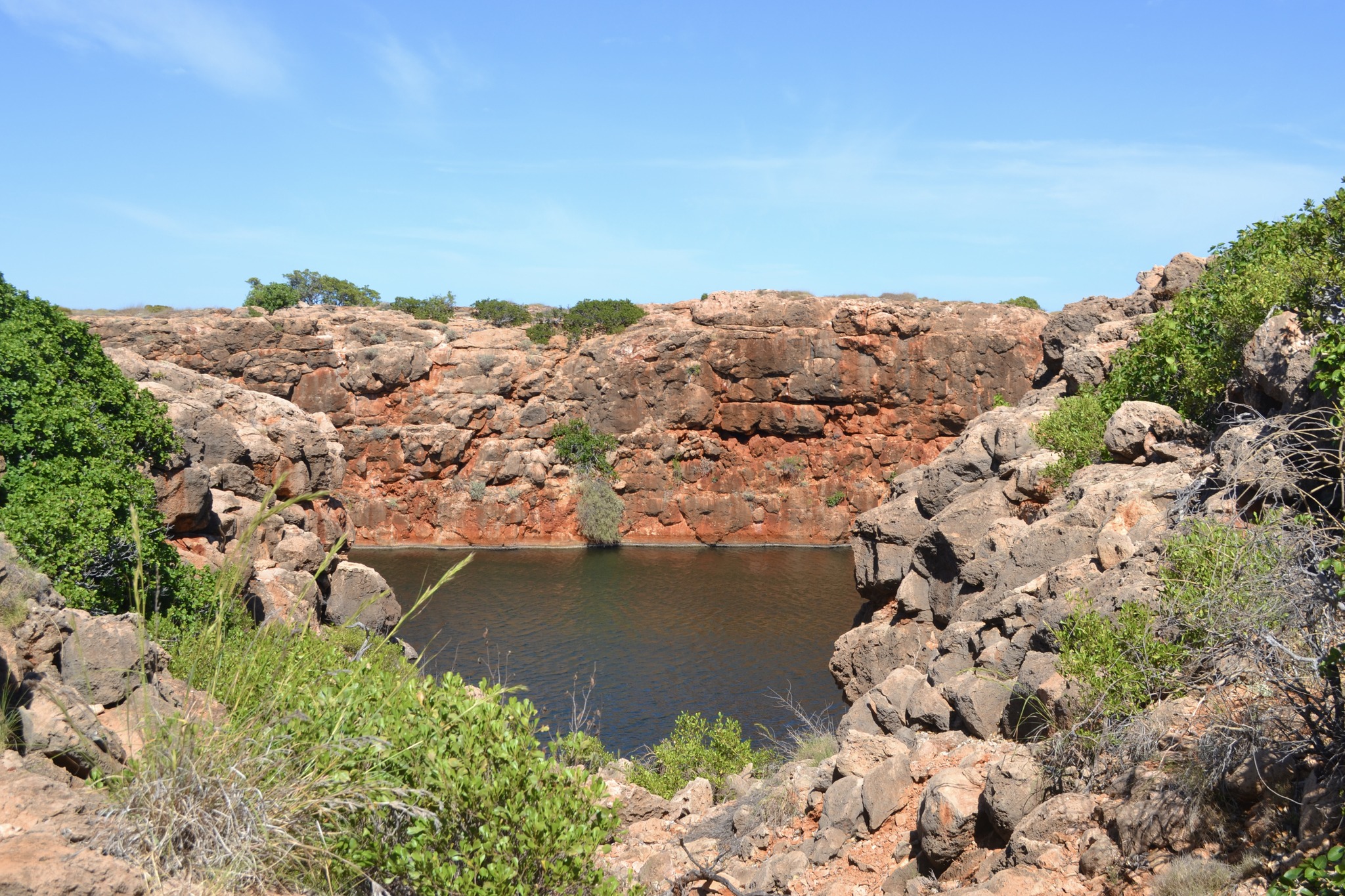
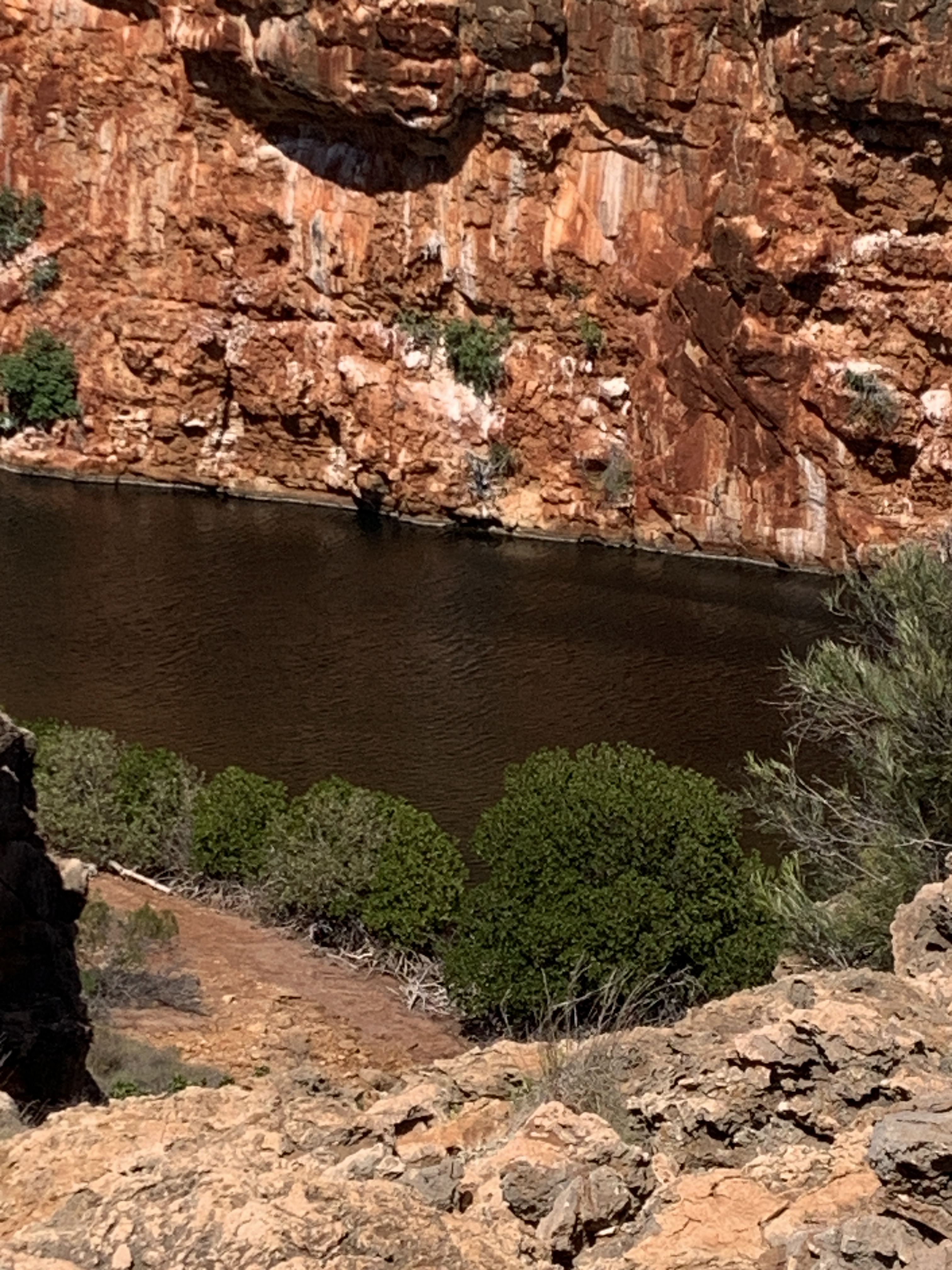
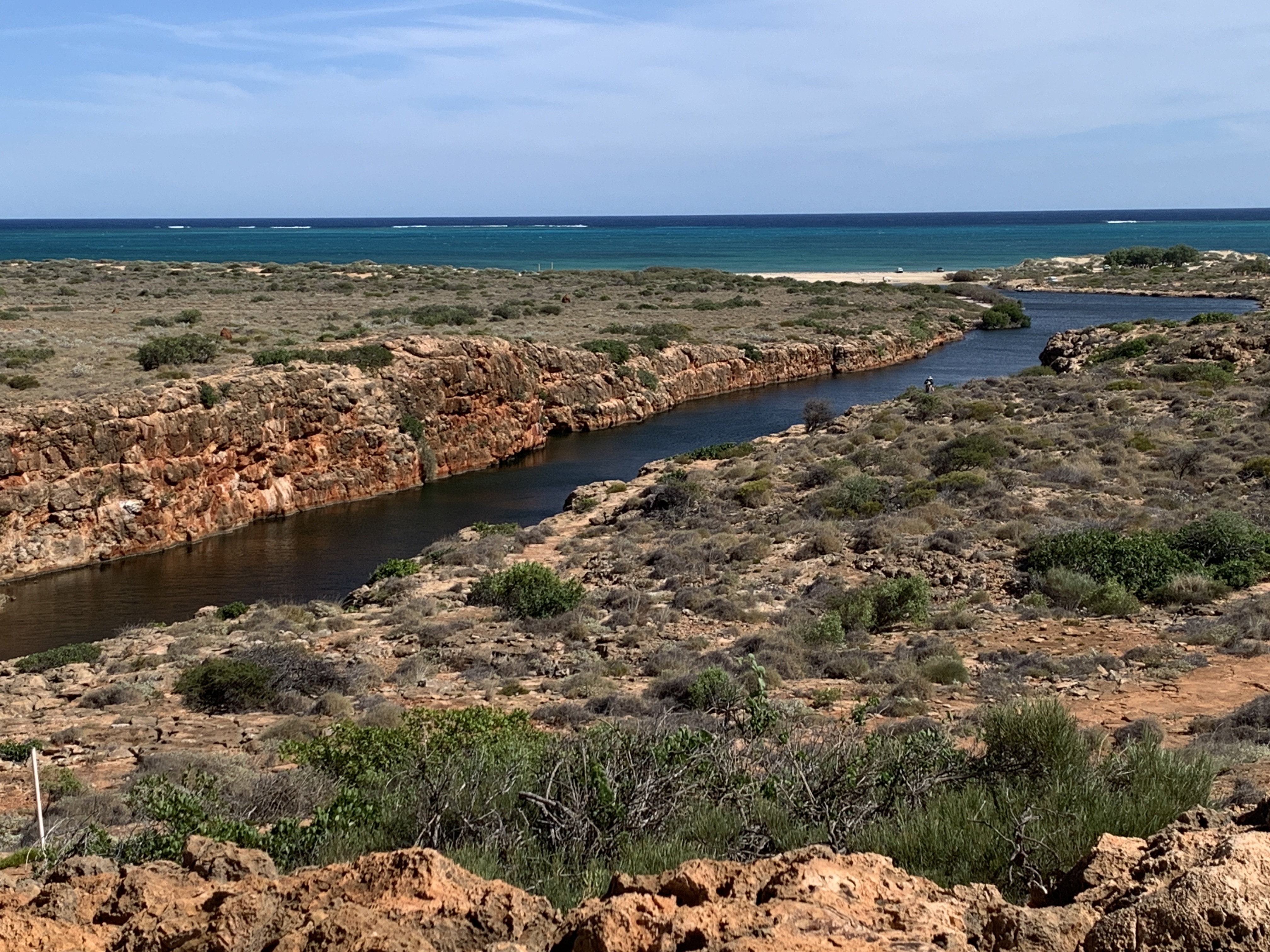
It was all over as quick as a wink and there was more to do and to see. We decided to try for a drive to the local national park. Some of the park had been closed off to travellers and much of the park is 4wd only. We drove out not sure of what we were going to be able to see. We passed the lighthouse from the previous day and drove on for many kilometres. Passing several side roads leading to beaches eventually, we pulled over to the Yardie Creek Gorge car park. The walk along the top of the gorge did not look too difficult and was about 3-4 km return. At the opening of the gorge and still, on a flat walking trail, there was a river barge taking people for a leisurely trip up to the centre and back. Together with some kayakers slowly meandering up the gorge, it was quite a serene picture. It was not too far up the track, and you could appreciate the beauty of the area. The high cliffs of red rock meeting the deep blue of the ocean water were worth the effort. The gorge turned around to the left and the track headed up to higher ground which looked quite manageable, until of course it wasn’t. We came across a deep ravine that would have to be navigated if one wanted to get to the top.  A little boulder hopping and then a whole lot of rock scrambling got us down and up the other side. I must admit it took a massive amount of self-talk and some encouragement from other walkers to keep me going. I am used to coming up against obstacles in our walks and usually, the challenge means there will be a reward at the end. Part of the problem with this walk was that it was hot, and I had worn a light dress with bike shorts underneath, not the best outfit for climbing. Regardless I soldiered on thinking it would flatten, not long after we came across another canyon to master! Ken turns to me and says just watch where I put my feet and follow on. Well, if my legs were as long as his and I was 20 kilos lighter I would have so much less of a problem. The challenge was met and beaten not without several cries of “I can’t do this“ once again. The sense of satisfaction is tremendous. We find ourselves above the gorge looking down onto the cliffs once again. The wind is blowing, and the sun is beating down as we stand alone looking far and wide across the many ridges. It gives one a feeling of beauty and solitude. It makes you realise just how much of Australia is untouched by humanity. Unfortunately, we had to traverse the same route on the return trip. Of course, we made it back in one piece tired and hungry. A very tasty late lunch at a waterside café and an evening of wine and cheese with our friends saw the day come to an end. Another day exploring the town and our time at Exmouth and this leg of our trip had ended. An early night and early start the next day where we headed back.